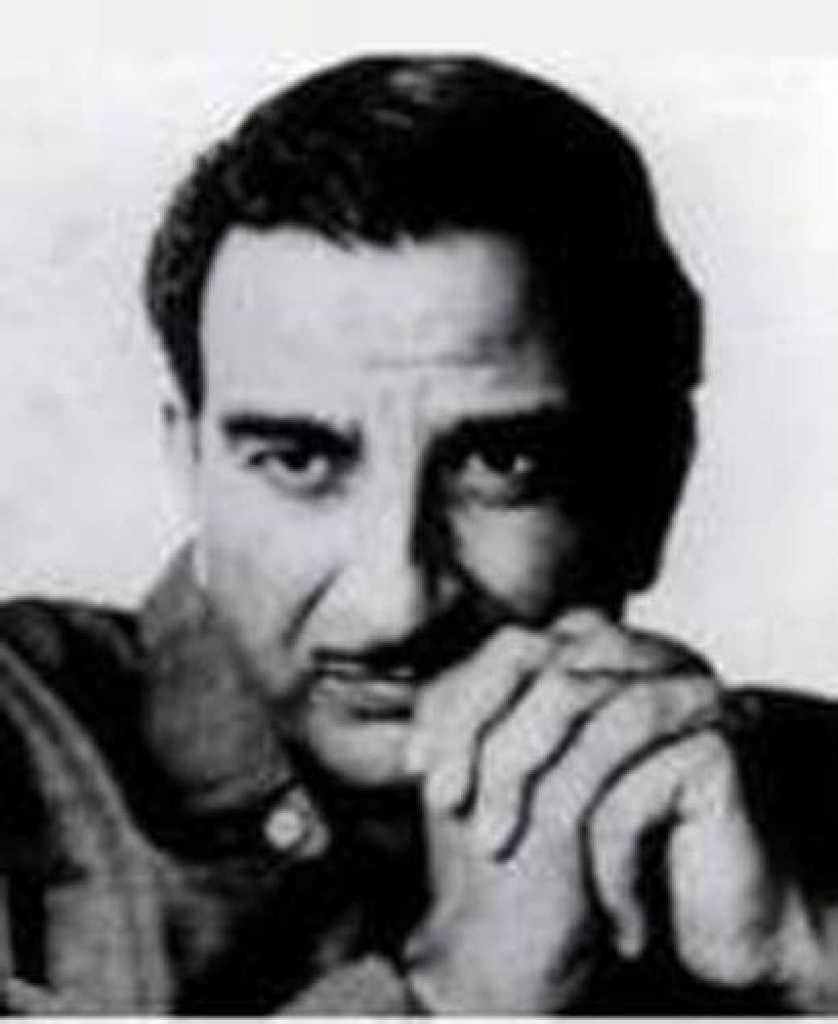
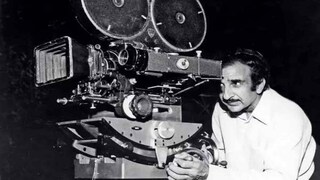
Raj Khosla was born on May 31, 1925, one of the director, producer and screenwriter in Hindi film industry from the 1950s to the 1980s. He was known for bringing in “neo-noir” and style in Indian Cinema, and also as a “women’s director” because he showcased actresses at their best. He has given many successful films with Dev Anand. Starting his career under Guru Dutt, he went on to make hit film C.I.D. (1956). His early background in classical music ensured that most of his films excelled in music.
He was trained to be a classical singer. He came to Bombay to look for work as a singer while working in All India Radio for while as a music staff.
On Dev Anand’s advice to take up direction, he became Guru Dutt’s assistant. His directorial debut Milap (starring Dev Anand and Geeta Bali) in 1954. His second film, C.I.D., released in 1956 set the ball rolling and the young director never looked back. C.I.D. is an entertaining and engaging thriller. A newspaper editor gets murdered when he was about to expose the underworld links of a rich person. So, a C.I.D inspector gets assigned to investigate the murder case. Pitting a suave Dev Anand against a shadowy criminal mastermind, the story is told with tempo and light and shade. C.I.D. was a slick crime thriller that highlighted Khosla’s stylish shot taking and innovative song picturization. On 14 September 1956, Filmfare wrote, “Designed as a crime thriller, C. I. D, directed by Raj Khosla, is a sleek entertainer which moves at a swift pace and is interspersed with good songs”. Guru Dutt had reportedly gifted Raj Khosla a swanky foreign car after the success of C. I. D.
Kala Pani (‘Black Water’) is a 1958 Hindi-language thriller film, was the story of a young man who, upon learning about his father’s wrongful implication in a fifteen-year-old murder, vows to bring the true criminals to justice and release his innocent father from prison, with the help of a fearless journalist & a prostitute, who is the eye-witness of the murder & have evidences against the criminals. Upon its release on 9 May 1958, the film became a huge critical and commercial success.
Solva Saal (Sixteenth Year) is a 1958 Hindi movie was a story of a single night wherein a girl elopes with her lover who dupes her and is helped back home by a journalist before her father wakes up and realizes what the girl has done.
Bombai Ka Babu (Gentleman from Bombay) is a 1960 Hindi film was a thriller, the hero, a killer, entering the family of the man he has killed as their long lost son and falling in love with his “sister”. Except for the “brother-sister” angle, the plot of Bombai Ka Babu is inspired by O. Henry’s short story, “A Double-Dyed Deceiver”. Bombai Ka Babu as Raj Khosla Ji’s best work. It didn’t bring home the bacon in terms of the box office receipts but view it from an art lover’s prism, it stands out as a fine piece of cinematic experience. Khosla places the audience in the midst of the stormy star-crossed relationship. To his credit, the film acknowledges the civilising strength of the feminine race.
Ek Musafir Ek Hasina (A Traveller and A Beauty) is a 1962 film written and directed by Khosla. An army officer loses his memory, falls for a married woman, then regains part of his memory but forgets her.
Woh Kaun Thi? (Who Was She?) is a 1964 Hindi-language black and white thriller film. One stormy night, a doctor offers a ride to a ghostly woman he meets on the side of the road. Later, he discovers his intended bride is identical in appearance to the ghost.
Mera Saaya (My Shadow) is a 1966 Hindi -language thriller film. A lawyer’s wife dies in his arms. Yet, another woman – identical in appearance and accused of aiding a gang of bandits – claims to be the lawyer’s wife. A courtroom drama ensues. Khosla offers the audience a much-needed reprieve from the tense courtroom scenes with a rich haul of imaginatively-picturised songs shot outdoors in picturesque Udaipur. The imaginatively shot (a Khosla speciality), songs segue not from the courtroom, but appear in flashbacks when Dutt is alone at home. Khosla, a master of suspense, sprinkles them generously.
Do Badan (Two Bodies) is a 1966 Hindi film explores the true meaning of love and separation. Khosla excelled in this love story as a director. “Do Badan” still has repeat value after its glorious silver jubilee in 1966. Khosla proved that he was excellent in handling emotional scenes and song picturisation.
Do Raaste (Two Paths) is a 1969 Hindi film was based on the trials and tribulations of a lower-middle-class family. It placed emphasis on respect for elders, the paramount status of the mother, the sanctity of the joint family and the supremacy of relations that are stronger than ties of blood. Khosla managed to infuse his rendition with dollops of pathos – although a tauter editing could have made the film more enjoyable.
Mera Gaon Mera Desh (My village, my country) is a 1971 action film, was a box office success. The film contains many hit songs including: “Apni Prem Kahaniyan”, “Aaya Aaya Atariya Pe Koi Chor”, “Sona Lai Ja Re”, “Kuch Kehta Hai Yeh Saawan” and “Maar Diya Jaye Ke Chhod Diya Jaye”. In this film visuals are excellent and Khosla finds great angles and creates some really dramatic shots. The balance between the elements is excellent, the songs are just right and at the right moments, and the action sequences are brilliant.
Kuchhe Dhaage is a 1973 Hindi -language action film story revolves around Brahman Pandit Tulsiram who betrays Thakur Bahadur Singh to the police, and as a result, Bahadur is sentenced to be hanged. Widowed, pregnant and devastated, Bahadur’s wife swears that she will raise her child to hunt down and kill Tulsiram at any cost. She gives birth to a son, names him Lakhan, and lets the bandits teach their way of life. As soon as Lakhan grows up, he kills Tulsiram. Hearing of his father’s death, army-man, Roopa, resigns and openly swears to kill Lakhan. Unknown to both of them, a beautiful young woman named Sona enters their lives, making them wish that they were living an honest life instead, and both fall head over heels in love with her. Both are on the verge of changing their lives when they find out that the other also has fallen in love with Sona, and they return to their bitter oaths – kill or be killed.
Prem Kahani (‘Love story’) 1975, Nehle Peh Dehlaa 1976, Main Tulsi Tere Aangan Ki 1978, Do Premee (The two Lovers) 1980, Dostana (Friendship) 1980, Sunny 1984, films directed by Khosla.
He was known for his excellent song picturizations, probably stemming from his musical background. Raj Khosla initially entered the Film Industry with hopes of making it as a playback singer. In most of his films he would have at least a song based on folk tune e.g. C.I.D., Bambai Ka Babu, Solva Saal, Mera Saaya, Do Raaste, Mera Gaon Mera Desh to name a few. From here onwards even as he continued to make films, Khosla ricocheted from style to style while adding his own touch to each genre. Never wanting to play safe Khosla made some films, which were startlingly different in those times.
In Main Tulsi Tere Aangan Ki, he evoked sympathy for the mistress even as he told the story from the wife’s point of view. Khosla was a director who understood women and was known as a women’s director much like George Cukoe in Hollywood.
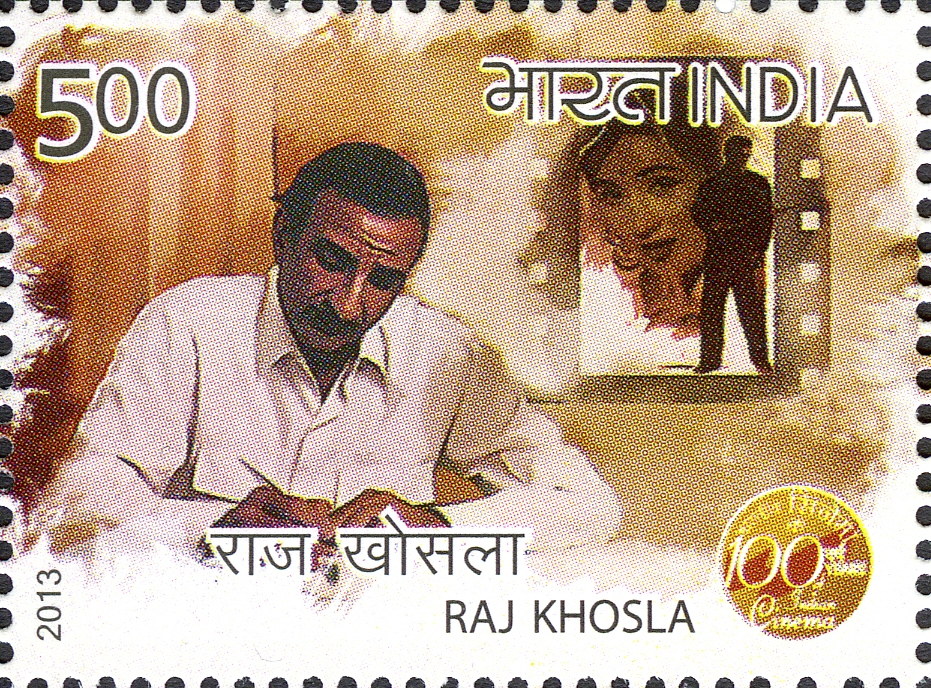
A postage stamp, bearing his face, was released by India Post to honour him on 3 May 2013.
After his death “The Raj Khosla Foundation” was established by his daughter Sunita Khosla Bhalla, with Shatrughan Sinha, as its chairman, and members like Manoj Kumar, Moushumi Chatterjee, Kabir Bedi, Mahesh Bhatt, Amit Khanna and Johny Bakshi.
The first authorised biography of Legendary director Raj Khosla release in 2022. Biography is written by author Amborish Roychoudhury in association with Raj Khosla’s daughters — Uma Kapur and Anita Khosla.
“Considering his stellar filmography, it is surprising that Khosla hasn’t been talked about as much as his contemporaries. The book aims to correct this… The book will not only contain priceless anecdotes but also insights about his style of filmmaking which has inspired a number of directors who came after him,” Roychoudhury told PTI. Khosla’s career spanned roughly three decades wherein he worked on 27 films. The filmmaker, who trained under legendary actor-director Guru Dutt, was also credited for shooting musical sequences with dexterity. Talking about the book, author Roychoudhury said that the biography is based on his research and interviews with actors who worked closely with Khosla in the past.
Photos courtesy Google. Experts taken from Google.
 Writer Sunita