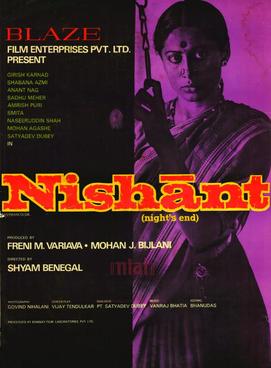
Nishant (Night’s End) is a 1975 Hindi drama film directed by Shyam Benegal, based on a pre-independence uprising in Telangana. Vijay Tendulkar’s screenplay and Satyadev Dubey’s dialogue capture a flagrant feudal system. The film focuses on the power of the rural elite and the sexual exploitation of women.
Vishwam (Naseeruddin Shah) is the youngest brother of the powerful and cruel landowner Zamindar (Amrish Puri). He is married to Rukmani (Smita Patil) and, unlike his brothers, does not indulge in alcohol or women. But one day the village gets a new school teacher (Girish Karnad), whose wife Sushila (Shabana Azmi) instantly catches Vishwam’s eye. Noticing this, his brothers come one night and kidnap Sushila for all to see, including her husband who tries to stop them but fails. He is shocked that no one of the so many present people dared to even raise a voice to stop this abduction. He turns to every possible authority, including the police, the court, the press, but is shocked to see a complete rejection resulting from the fear to face off the Zamindar.
The distraught school teacher, is helped by the old priest of the village temple. They succeed in mobilizing the villagers who slaughter their oppressors. In the end the frenzied villagers also kill the innocent Rukmani as well as Sushila whom her husband was trying to rescue.
Film is a morally conflicting and emotionally revolting film about gender, hierarchical and social injustices. This is the story of well-made film which portrays the state of those times’ rural India. The film depicts a reality which is a bit difficult to see. The proceedings are very serious and the film is dark and dim. Benegal’s direction is excellent, with a serene narrative style that easily conveys the raw atmosphere of the village as well as the film’s own mood. It is realistic and authentic, without any overt dramatisation. The film shows us the power of human nature. While Sushila terribly misses her son and goes through emotionally destructive experiences of gang-rape and humiliation, she later accepts the cruel reality, finds comfort in the house and ultimately starts getting attracted to the quiet Vishwam. Her absence tortures her husband and his helplessness makes his life miserable. One of the film’s best scenes is when they finally meet in a local temple. She preaches him for his cowardice, ironically, in the same way he himself did with the people who did not stop her kidnappers. This makes him realise that a change must happen within the simple people and not the landowners.
Benegal uses the mythological reference of Seeta –Haran (Abduction of Seeta) and Ravana – Vadh (killing of Ravana) from Ramayana but his violent climax is not just a feel-good victory of good over evil, it has many grey shades and leaves the viewer pondering about complexity of life.
The film is very well acted. Girish Karnad is excellent as the tormented teacher who loses his wife and is unable to get her back. Shabana Azmi is outstanding as Sushila in a restrained and deep act. Smita Patil makes her acting debut with this very film and though her part is small, she makes the best of every scene she appears in. Amrish Puri is successfully frightening as the merciless Zamindar. Naseeruddin Shah is as always wonderful and his character is very sympathetic despite the conflict it creates. The boy who plays Sushila’s son is extremely cute.
The most poignant moments in the film are when mistress and wife are in the same frame. Rukmini is initially gentle with Susheela, the wife who has been violated and the mother who is lost to her child. However, Rukmini’s tone changes when she discovers Susheela is Vishwam’s obsession. On the other hand, even as Susheela develops clout, she cannot forget Rukmini’s kindness. Prisoners of shared circumstances and slated for the same destiny, the women find themselves in a subconscious, indefinable amity. Superb performances from both Azmi and Patil illustrate Benegal’s understanding of women as survivors even when they are stripped of all dignity.
The daily newspaper The Hindu praised the movie greatly in its article dated 4 October 2012, in the following words: “Miles removed from the work of everyday filmmakers, for many of whom cinema is nothing more than a hero waiting in eager anticipation of the heroine and post-dinner desserts, Benegal’s “Nishant” is a dawn that did not come an hour too soon. The National Award for the best film, the nomination for the Oscars were just rewards for a film that lived up to its name. ” The film was invited to the London Film Festival of 1976, Melbourne International Film Festival of 1977, and the Chicago International Film Festival of 1977, where it was awarded the Golden Plaque.
Photos courtesy Google. Experts taken from Google.
 Writer Sunita