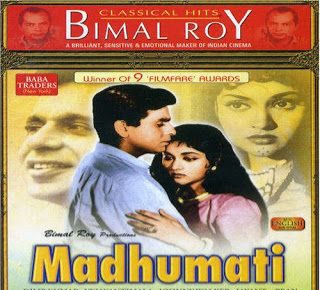
Madhumati is a 1958 Indian Hindi-language paranormal romance film directed and produced by Bimal Roy, screenplay and story written by Ritwik Ghatak. The plot focuses on Anand, a modern man who falls in love with a tribal woman named Madhumati. But they face challenges in their relationship finally leading to a paranormal consequence.
Escaping a storm and a landslide on the way to pick up his wife and child, Devinder (Dilip Kumar), an engineer, takes shelter in a mansion on a mountain by the riverside with his friend (Tarun Bose). At the dilapidated mansion, some ‘happenings’ in the dead of the night lead Devinder to a painting of the former owner of the place, Raja Ugra Narayan (Pran).
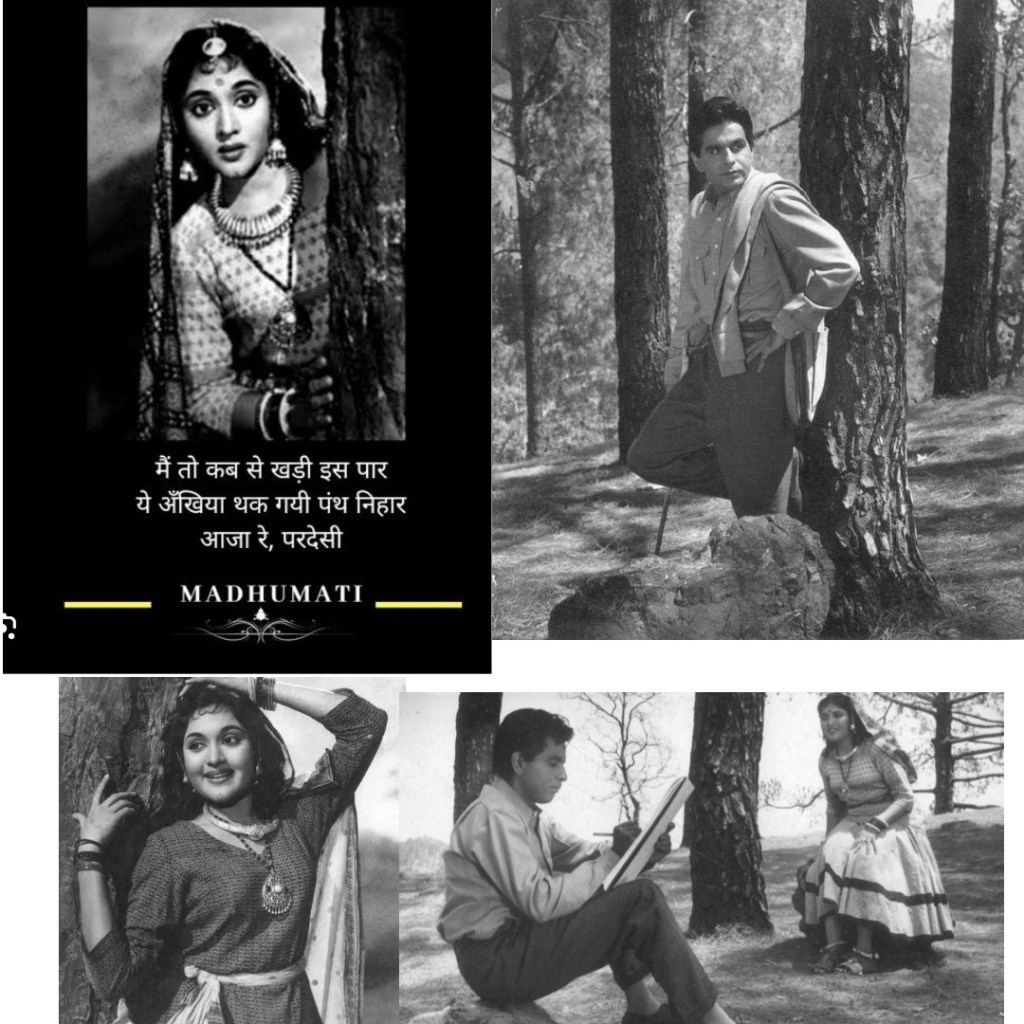
Suddenly Devinder starts seeing images and cut to a flashback. In his previous life, he was Anand, an accountant at Ugra Narayan’s Shyamgarh timber estate. An artist in his spare time, he travels to the hills and falls in love with Madhumati (Vyjayanthimala), a tribal village belle. When Anand first sees her, she’s standing atop a far-off mountain, shrouded in fog — an enduring directorial style.
With Anand and Madhumati falling in love over several songs, Ugra Narayan lays his eyes on the tribal girl and keeps looking for ways to trap her. On one occasion, he manages to send Anand away, tricks her to come to his mansion and attempts to rape her. On the rainy chandelier-lit night, shadows loom large and appear overpowering. Anand returns to the village to find Madhumati missing and begins the search for clues to the mystery behind her vanishing.
Anand lives but his mind wanders. One day, he meets a woman who looks exactly like Madhumati. She introduces herself as Madhavi but Anand refuses to believe her. He tries to reason with her and is beaten by her companions. Later, Madhavi finds a sketch of Madhumati and realizes Anand was telling the truth. She takes the sketch with her and tries to learn his story. Meanwhile, Anand is haunted by the spirit of Madhumati, who tells him Ugra Narain is responsible for her death. He appeals to Madhavi, who agrees to pose as Madhumati before Ugra Narain and make him confess to her murder.
Anand returns to Ugra Narain’s palace and seeks permission to paint a portrait of him the next evening. The day after, at the stroke of eight, Ugra Narain sees Madhavi posing as Madhumati in front of him. Ugra Narain is shaken; he confesses his part in her death and is arrested by police waiting outside the room. Anand realizes that the questions Madhavi posed to Ugra Narain, especially about Madhumati ‘s burial place, were things she could not have known; even Anand did not know. Madhavi smiles and moves towards the stairs. The real Madhavi, dressed as Madhumati, then rushes into the room. She is late because her car broke down on the way. Anand realizes he saw Madhumati’s ghost and not Madhavi. He runs to the terrace, where the ghost beckons to him. Madhumati had fallen from the same terrace, trying to escape Ugra Narain. Anand follows the ghost and falls to his death.
After telling the story of Anand and Madhumati, Devendra receives news that the train on which his wife was traveling has met with an accident. The road is cleared and they rush to the station. Devendra walks through the station fearing the worst but is relieved to see his wife Radha, emerging from the train unharmed. Radha is the reincarnation of Madhumati, and Devendra informs her, based on his recent recollections, that they have been partners through several births.
Cinematographer Dilip Gupta builds the ‘mood’ for the thriller, a must especially for black and white noirs, from the first rain-drenched frames. A particular rock is Anand’s seat whenever they meet in the forest. Clouds and mist wistfully appear and disappear, probably a metaphor for Madhumati, whose songs calling out her ‘Pardesi’ (foreigner) in the initial half of the movie suddenly appear and then vanish as mysteriously, driving Anand’s search for her. It also lends a background to the underlying supernatural theme of the film’s later half. Waterfalls, bouldery streams are an integral part of the duo’s romance.
The film’s music is as haunting as it is memorable. Composed by Salil Chowdhury and with lyrics by Shailendra, it has such gems as the melancholic “Aa Ja Re” and the melodious “Suhana Safar”,. The music was composed before the lyrics were written. Folk music sung in the tea gardens of Assam was used in the soundtrack and Polish folk music was used for the song “Dil Tadap Tadap Ke Keh Raha Hai”, which was adapted from the 18th century Silesian song “Szla Dzieweczka do Gajeczka”. Dinesh Raheja, writing for Rediff.com, said, “The music and the tonal correctness of the performances hold us in thrall”. The soundtrack of Madhumati became the best-selling Hindi film soundtrack of 1958.
Writing for Filmfare, Meghna Gulzar calls Madhumati “poetry in black-and-white” and praises Roy, writing “the songs and their picturization – Bimal Da’s mastery exudes in every frame”. She described the song Aaja Re Pardesi as “mysterious and melancholic”. According to Philip Lutgendor of University of Lowa, the film sustains its suspense even with the flashback-within-the-flashback frame story, has socio-realistic themes, and is similar to the Alfred Hitchcock films Rebecca (1940) and Vertigo (1958). Lutgendorf praised the performances of Kumar and Vyjayanthimala, and said, “Kumar gives an appropriately haunted performance as the two incarnations of Devendra / Anand, and Vyjayanthimala is alternately earthy and ethereal in the various permutations of the title character”.
Writing for Upperstall.com, Karan Bali commended Roy’s ability to “recreate just the right mood and ambiance”, especially praising few scenes as “luscious romantic interludes outdoors or the swinging chandeliers”, “dark shadows within the haveli” and “several documentary like establishing shots”. Bali’s view is shared by Manisha Lakhe of Daily News and Analysis, who wrote, “Bimal Roy’s masterstrokes are evident when you watch the long shadows of trees falling on that stone with fascination”.
Madhumati led the 6th Filmfare Awards with 12 nominations and won 9 awards, including Best Film, Best Director for Roy, Best Music Director for Chaudhary, a record it held for 37 years. It also won the National Film Award for Best Feature Film in Hindi. Since its release, it had multiple screenings at the Tenth Bite – The Mango Film Festival (2004), the 4th Pune International Film Festival (2006) and the Toronto International Film Festival (2011). Madhumati was selected as India’s official submission for Best Foreign Language at the 32st Academy Awards, but it was not nominated.
Photos courtesy Google. Experts taken from Google.
 Writer Sunita