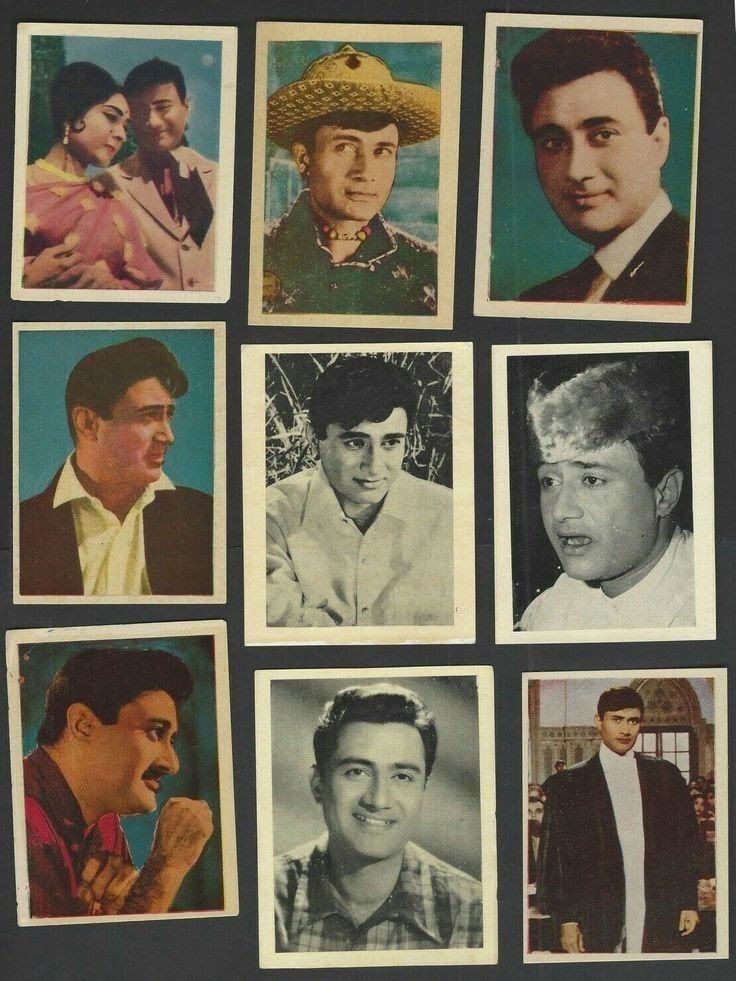
Dev Anand (Dharamdev Pishorimal Anand; 26 September 1923 was an Indian actor, writer, director and producer known for his work in Hindi Cinema. Anand is considered as one of the greatest and most successful actors in the history of Indian cinema. Through a career that spanned over six decades, he worked in more than 100 films.
After completing his BA degree in English literature. Anand left his hometown for Bombay in the early 1940s. He began his career in the military censor’s office at Churchgate. Later, he worked as a clerk in an accounting firm. He joined his older brother, Chetan, as a member of the Indian People’s Theatre Association (IPTA). Anand aspirned to become a performer after seeing Ashok Kumar’s performance in films such as Achhut Kanya and Kismet. Anand quoted in an interview that “I remember when I gate-crashed into the office of the man who gave me the first break, he kept looking at me – Babu Rao Pai of Prabhat Film Studios. At that time he made up his mind that this boy deserves a break and later mentioned to his people that ‘this boy struck me because of his smile and beautiful eyes and his tremendous confidence.” Then he was soon offered the lead role in Prabhat Films’ Hum Ek Hain (1946), a film about Hindu-Muslim unity, where Dev Anand played a Hindu boy. While shooting the film in Pune, Anand befriended the actor Guru Dutt. Between them, they agreed that if one of them were to become successful in the film industry, he would help the other also to be successful. They formed a mutual understanding that when Anand produced a film, Dutt would direct it and when Dutt directed a film, Anand would act in it.
Anand was offered his first big break by Ashok Kumar. He spotted Anand hanging around in the studios and picked him as the hero for the Bombay Talkies production Ziddi (1948), which became an instant success.
In the late 1940s, Anand was offered a few roles starring as the male lead opposite singer-actress Suraiya in woman-oriented films. The two of them were paired in many films: Vidya (1948), Jeet (1949), Shair(1949), Afsar(1950), Nili (1950), Sanam and Do Sitare (1951). The films he starred in with Suraiya had been successful, the producers and directors of those films attributed their success to the acting prowess and screen presence of Suraiya. Anand began looking for an opportunity to play the main male lead in a film where his acting skills could be demonstrated.
In 1949, he launched his own company Navketan Films. Dev chose Guru Dutt as director for the crime thriller, Baazi (1951). The film Baazi The collaboration was a success at the box office and the duo of Dev Anand and Kalpana Kartik were offered many films to star in together. They signed all the film offers and subsequently the movies Aandhiyan (1952), Taxi Driver (1954), House No. 44 (1955) and Nau Do Gyarah (1957) went on to become big hits too. As head of his film production company, Anand introduced a multitude of talent to the Indian Film Industry by way of actors, directors, music composers and cinematographers. He introduced new talent to cinema and experimented with new ideas for movies. He also headed one of the finest Film Sound Post-Production facilities in India – Anand Recording Studios – which has to its credit more than 3,000 Indian feature films that have been mixed/ surround mixed for worldwide release.
A rapid-fire style of dialogue delivery and a penchant for nodding while speaking became Dev’s style in films such as Baazi (1951), Jaal (1952), House No. 44 (1955), Pocket Maar (1956), Munimji (1955), Funtoosh (1956), C.I.D. (1956) and Paying Guest (1957). His style was lapped up by the audience and was widely imitated. He starred in a string of box office successes for the remainder of the 1950s opposite newcomer Waheeda Rehman in C.I.D. (1956), Solva Saal (1958), Kala Bazar (1960) and Baat Ek Raat Ki (1962). Waheeda first became a star when C.I.D became a hit. The pair acted in Roop Ki Rani Choron Ka Raja (1961 film) and Prem Pujari later. In 1955, he also co-starred with Dilip Kumar in the blockbuster film Insaniyat. With his acting in the box office success Kala Pani (1958) opposite Madhubala and Nalini Jaywant, as the son who is willing to go to any lengths to clear his framed father’s name, he won his first Filmfare award for Best Actor for the film. Dev also played a few characters with a negative shade, as in Jaal (1952) where he played a smuggler, then as an absconding gang member in Dushman (1957), and as a black marketer in Kala Bazar.
In the sixties, Dev Anand acquired a romantic image with films such as Manzil and Tere Ghar Ke Samne with Nutan, Kinare Kinare with Meena Kumari, Maya with Mala Sinha, Asli-Naqli with Sadhana, Jab Pyar Kisi Se Hota Hai with Asha Parekh and, Teen Deviyines Kalpana, Simi Garewal and Nanda. In this film Dev Anand played a playboy. One of his notable films of the early sixties was Hum Dono (1961) which he produced and acted in, as Anand, a young lover who joins the army in frustration over being shunned by the father of his love Meeta (played by Sadhana). Anand played a double role in the film, also acting as Major Varma, his look-alike who he runs into in the army and forms a deep friendship. Notable for its music by Jaidev, the film was a box office hit.
His first colour film, Guide with Waheeda Rehman was based on the novel of the same name by R. K. Narayan. Dev Anand himself was the impetus for making the film version of the book. He met and persuaded Narayan to give his assent to the project. Dev Anand tapped his friends in Hollywood to launch an Indo-US co-production that was shot in Hindi and English simultaneously and was released in 1965. Guide, directed by younger brother Vijay Anand, was an acclaimed movie. Dev played Raju, a voluble guide, who supports Rosy (Waheeda) in her bid for freedom. He is not above thoughtlessly exploiting her for personal gains. Combining style with substance, he gave an affecting performance as a man grappling with his emotions in his passage through love, shame, and salvation.
He reunited with Vijay Anand for the movie Jewel Thief (1967), based on the thriller genre which was very successful. Their next collaboration, Johny Mera Naam (1970), again a thriller, was a huge blockbuster.
His directorial debut, the espionage drama Prem Pujari. 1971 directorial effort, Hare Rama Hare Krishna, shot primarily in Nepal around Swyambhunath, and Bhaktapur, in which talks about the prevalent hippie culture. His find Zeenat Aman, who played the mini-skirt sporting, pot-smoking Janice, became an overnight sensation. Dev also became known as a filmmaker of trenchantly topical themes. The same year, he starred in Tere Mere Sapne, an adaptation of A. J. Cronin’s novel, The Citadel. The film was directed by Dev’s brother, Vijay, and was also successful. In 1971 he paired with Zaheeda in Gambler which went on to become a success.
He also starred in English films such as The Evil Within (1970), where he was paired opposite Vietnamese actress Kieu Chinh and Zeenat Aman and Guide (English Version). The English language film The Evil Within was a 20th-Century Fox production that couldn’t get the nod from the concerned authorities due to its parallel track dealing with opium selling and thus the Indian viewers were deprived of this American venture.
Shatrughan Sinha disclosed in an interview that it was Dev Anand who gave him a break in films by giving him a role in Prem Pujari and since Dev had given Sinha a very small role in that film, he compensated for it by giving Sinha another role in his next film Gambler. Sinha quoted: “Later on we worked together in Sharif Badmash and it was really a privilege to work with him”. It was under Dev Anand’s Navketan Banner where Guru Dutt, Raj Khosla, Waheeda Rehman, S.D. Burman, Jaidev, Sahir Ludhianvi, Majrooh Sultanpuri, Yash Johar, Shekhar Kapur and Kabir Bedi were given breaks into Hindi films and Dev launched actors Zaheera, Zaheeda Hussain, Zarina Wahab, Natasha Sinha, Ekta Sohini and Sabrina.
Anand is regarded as one of the greatest actors of Indian cinema. Anand is noted for his charm, diverse roles and handsome face. One of the highest paid actors from 1950s to early 1970s. In 2022, he was placed in Outlook India’s “75 Best Bollywood Actors” list. Anand was placed seventh among the “Greatest Bollywood Stars” in a UK poll celebrating 100 years of Indian cinema in 2013.
Anand was widely known as the “first fashion icon” of Bollywood. He made fashion statement with his scarves, mufflers and jackets and his singnature puff. Many film actors and fashion designers have taken inspiration from Anand. Filmfare place him third in its “Bollywood’s most stylish men”. After the film Kaala Paani, there was a period when Anand did not wear black in public. In September 2007, Dev Anand’s autobiography Romancing with Life was released at a birthday party with the Indian Prime Minister Dr. Manmohan Singh. In February 2011, his 1961 black-and-white film Hum Dono was digitised, colourised and re-released.
Devesh Sharma of Filmfare termed him a “debonair hero” and noted, “His true matinee idol good looks, suave demeanour and charismatic screen presence made his fans swoon every time he came on screen.” Subhash K. Jha of Firstpost called him the “most easygoing superstar cinema has ever known” and said, “Dev Anand symbolized the most dazzling bastion of Hindi cinema. He was flamboyant, debonair, mischievous and romantic.” Shekhar Gupta of The Print said, “Nobody could match Dev Anand for style.” He added, “Many of his films were ahead of his time. But you always walked out of the sultry small-town hall copying Dev Anand’s leaning-tower gait, his mannerism, and always hummed his songs.” Journalist Rauf Ahmed added Anand on his “Biggest stars in Hindi filmdom” list and noted, “For almost five decades Anand has continued to fascinate his fans with his never-say-die spirit and flamboyance. He is one actor for whom time has had the courtesy to stand still.” Saibal Chatterjee of The Tribune noted, “There is nobody quite like Dev Anand. A timeless Bollywood icon, an eternal dreamer and a man of action, his creative life has never known anything akin to a full stop.”
Anand was often compared to the famous hollywood actor Gregory Peck the world over, Dev Anand said that he didn’t feel ecstatic hearing the tag line bestowed on him in his heyday. “When you are at an impressionable age you make idols, but when you grow out of the phase, you develop your own persona. I don’t want to be known as India’s Gregory Peck, I am Dev Anand”. Acquainted with the Bollywood actor, Peck’s personal interactions with him spanned four to five long meetings in Europe and Mumbai.
One of the most beloved, charismatic and accomplished actors as well as one of the most imaginative and pathbreaking directors in the history of Indian cinema, Dev Anand was a leading man for more than five decades in over 110 motion pictures and continues to bestride Indian film fraternity even after his passing. He gave a new dimension to that magical state known as Stardom. From the time he embarked on his career as a Film Actor in the mid-forties till his demise, his movies had been a journey filled with enriching experiences for the ‘Evergreen Living Legend’ of Indian Cinema. And he had always remained eternally youthful by his remarkable ability to live always in the present and the future; never in the past.
Anand won two Filmfare Awards – in 1958 for his performance in the film “Kala Paani” (Black Water) and in 1966 for his performance in Navketan International Films’ “Guide”. “Guide” went on to win Filmfare Awards in five other categories including ‘Best Film’ and ‘Best Director’ and was sent as India’s entry for the Oscars in the foreign film category that year. He co-produced the English Version of “Guide” with the Nobel Laureate Pearl S. Buck (“The Good Earth”). Eventually, his creative sensibilities got the better of him and he started writing and directing his own movies. The Government of India honored him with Padma Bhushan, Indian third highest civilian honour in 2001 and with Dadasaheb Phalke Award in 2002.
In 1969, he was a member of the jury at the 6th Moscow International Film Festival.
In July 2000, in New York City, he was honored by an Award at the hands of the then First Lady of the United States of America – Mrs. Hillary Rodham Clinton – for his ‘Outstanding Contribution to Indian Cinema’. And again Anand was awarded the Indo-American Association ‘Star of the Millennium’ Award in the Silicon Valley, California. The President of India honored Anand with the prestigious Padma Bhushan Award on India’s Republic Day – January 26th, 2001. And yet again, Donna Ferrar, Member New York State Assembly, honored him with a New York State Assembly Citation for his ‘Outstanding Contribution to the Cinematic Arts Worthy of the Esteem and Gratitude of the Great State of New York’ on May 1st, 2001. Most recently, in April 2003, Anand was given a ‘Lifetime Achievement Award’ by the F.I.F.A. Committee in Johannesburg, South Africa. For an Indian Movie Icon who has hobnobbed with royalty, heads of State and celebrities, he did it all.
On the occasion of 100 years of Indian cinema, a postage stamp bearing his image and likeness was released by India Post to honor him on 3 May 2013. In Anand’s honor, a brass statue was unveiled at Walk of the Stars at Bandra Bandstand, along with his autograph, in February 2013.
Various film festivals have given tribute to Dev Anand. In 2011, Bengaluru International Film Festival and in 2023, Kolkata International Film Festival organised event and screened Anand’s films. A three-day weekend retrospective of five of Anand’s biggest 1960s hits, was organised by the Directorate of Film Festivals in 2005. A garden named “Sadabhaar Dev Anand Udyan”, after the actor was inaugurated by his son in Mahavir Jain Vidyalaya, Mumbai.
Photos courtesy Google. Excerpts taken from Google.
 Writer Sunita