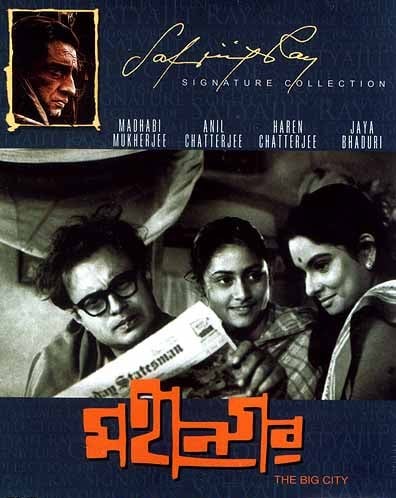

Mahanagar (‘The Big City‘) is a 1963 Indian Bengali-language film written and directed by Satyajit Ray. Starring Madhabi Mukherjee in the leading role and based on the short story Abataranika by Narendranath Mitra, it tells the story of a housewife who disconcerts her traditionalist family by getting the job of a saleswoman.
Shot in the first half of 1963 in Calcutta, this was also the first film directed by Ray set entirely in his native Calcutta, reflecting contemporary realities of the urban middle-class, where women going to work is no longer merely driven by ideas of emancipation but has become an economic reality. The film examines the effects of the confident working woman on patriarchial attitudes and social dynamics.
Middle-class clerk Subrata Majumdar (Anil Chatterjee) pursuades his wife Arati (Madhabi Mukherjee) to take a job as a saleswoman as he with his meagre salary is unable to care for his large joint family consisting of his parents, unmarried sister Bani (Jaya Bhaduri) and son Pintu (Prasenjit Sarkar). The family is horrified at the thought of a working woman in their midst. For Arati, going door-to-door selling sewing machines opens up a whole new world which includes an Anglo-Indian friend, Edith (Vicky Redwood) and her employer Mukherjee (Haradhan Bannerjee). She proves to be quite successful in her work and gains self-confidence as she earns her own money. Earning money also changes Arati’s status within the family, causing further problems, more so when Subrata loses his job. He suffers as he watches his wife go out while he sits in bed and scans newspapers for job opportunities. They begin to grow apart. When Edith is unjustly sacked for racial reasons, Arati resigns in protest…
Mahanagar defines a marked departure in Satyajit Ray’s oeuvre. With Mahanagar, Ray took his first step inside a low middle-class Bengali family home. As he once said, “somehow I feel that a common person, an ordinary person who you meet everyday on the street, is a more challenging subject for cinematic exploration than persons in heroic moulds, either good or bad. It is the half-shades, the hardly inaudible notes that I want to capture and explore.”
Mahanagar is based on a short story penned by Narendranath Mitra named Abataranika. The original story placed the husband at the centre but Ray shifted the emphasis to the wife, Arati. This change of focus re-wrote the history of women in Indian cinema. It traced the beginnings of the working wife in a lower middle-class family of Calcutta, her gradual autonomy in the face of economic pressures, and her changing status within the family by virtue of the change in her status quo in terms of employment. By going beyond the realms of the original, Ray changed the entire perspective of the story. Mahanagar is Ray’s personal statement on the changing values of the traditional, middle-class Bengali family of Calcutta. It is a microcosm of changes in urban, social values. Mahanagar is a strong, positive and realistic statement on the socio-economic changes in urban Bengali life, more through the metamorphosis of Arati than through other characters in the film. Arati stands as both the sign and the signified of this slow but steady socio-economic evolution.
The interiors of the Majumdar household reflect Ray’s genius for detail, detail that reaches beyond the borders of physical reality to underscore the emotional underpinnings in the relationships between and among the different members of the family. The clutter within the small flat, the sister-in-law drawing the tape that hangs the mosquito net, a slightly disturbed Subrata smoking inside the mosquito net, the close-up of Arati and her sister-in-law joking over the classifieds in the newspaper, the sister-in-law proudly scribbling Dada-Boudi in chalk on the kitchen floor as they lunch before stepping out, the sister-in-law shyly showing off the new saree Arati has bought for her with her salary, are a few examples.
The strong female bonding between a low-middle-class Bengali housewife and a low middle class Anglo-Indian spinster is perhaps, unique in Indian cinema. Ray establishes through the friendship between Arati and Edith, between Arati and her other female colleagues, the notion of ‘collectivity’ between and among women. This acquires and sustains greater power and strength only when established beyond the restrictive confines of ‘family.’
Despite surface differences, Arati and Edith are reduced to one entity, a working woman struggling to keep her family alive. The question of morals, whether linked to Arati’s clandestine use of lipstick, or to Edith’s so-called loose morals, has nothing to do with their efficiency at their jobs. The boss is a man in power, holding the financial futures of the women in his control. He abuses this power with Edith. He is over-generous with Arati. Ray’s handling of Edith’s humiliation and Arati’s angry response to the injustice meted out to Edith just because she is Anglo-Indian, is a telling comment on racism in reverse, the English-educated Bengali boss hitting it out at the dregs of British rule in India, the Anglo-Indian.
In 1967 release in the United States, Mahanagar drew praise from Roger Ebert, Pauline Kae and others. According to Ebert, “the power of this extraordinary film seems to come in equal parts from the serene narrative style of director Satyajit Ray and the sensitive performances of the cast members.” He described the film as “one of the most rewarding screen experiences of our time”. Bosley Crowther of the New York Times wrote a rave review of the film “There is nothing obscure or over-stylized about this characteristic work by Mr. Ray. It is another of his beautifully fashioned and emotionally balanced contemplations of change in the thinking, the customs and the manners of the Indian middle-class.”
Satyajit Ray won the Silver Bear for Best Director at the 14th Berlin International Film Festival in 1964. The film was selected as the Indian entry for the Best Foreign Language Film at the 36th Academy Awards, but was not accepted as a nominee.
The film won the All India Certificate of Merit for the Third Best Feature Film in 1963 at the 11th National Film Awards.e
The film won first best Filmfare Bengali Movie Award 1963 – R.D. Bhansal
Photos courtesy Google. Experts taken from Google.
 Writer Sunita