
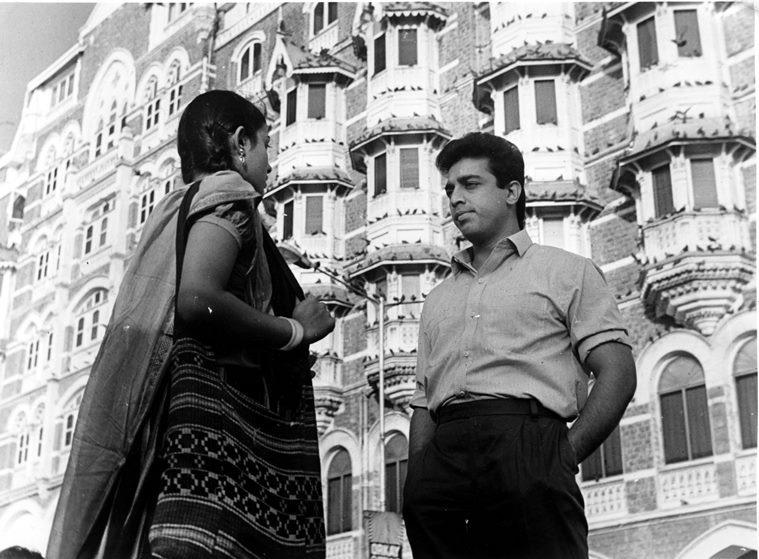
Nayakan (Hero) is a 1987 Indian Tamil-language epic crime film written and directed by Mani Ratnam. The film stars Kamal Haasan and Saranya. It revolves around the gradual transformation of Velu Naicker (Haasan) from an ordinary slum dweller to a feared don.
Nayakan is loosely based on the life of the Bombay underworld don Varadrajan Mudaliar. Cinematography was handled by P. C. Sreeram, and editing by B. Lenin and V. T. Vijayan. Filming began in late 1986, taking place primarily in Madras and to a lesser extent, Bombay.
An anti-government union leader’s son Sakthivel “Velu” is arrested by the police to find his whereabouts. They trick Velu into believing them as his well-wishers and release him. When Velu meets his father, he sees his father killed in cold blood by a policeman. Feeling betrayed, Sakthivel kills the policeman and runs away to Bombay, where he is raised by Hussain, a kind-hearted smuggler living in the Dharavi slums. One day, when Hussain is ill, a young Velu decides to carry out the smuggling activity on behalf of Hussain. His demand for a bigger commission from the smugglers enrages them, and they involve Inspector Kelkar to arrest Hussain and kill him in jail. When they close the case as suicide, Velu is enraged knowing the truth and murders Kelkar. He later takes care of Kelkar’s family which consists of his wife and a mentally challenged son Ajit. Kelkar’s wife knew that her husband’s immorality resulted in his death.
Velu meets Neela, a schoolgirl forced into prostitution, who has interests to pursue her education. Her innocence and courage impress Velu, and he eventually marries her. They have two children: Surya and Charumathi. Velu’s power and command gradually increases in Dharavi as he voices out in support of local people which gains him huge popularity among the masses. His rival smugglers try to murder Velu in an attack, but Neela is killed instead. After avenging Neela’s death, Velu sends his children to Madras to safeguard them.
Years pass by, Velu’s power further increases in Bombay and is fondly called Velu Naicker by everyone. Surya and Charumathi return to Bombay as adults after education. Surya follows Velu’s footsteps, a fact that he is initially hesitant of, and later learns to accept. But when Surya is killed trying to flee the police in a botched mission, Charumathi blames Velu for the deaths of Neela and Surya. She decides to leave Bombay citing that she wants to get away from her father and his violent ways. Charumathi disowns her father and leaves his home. A new ACP, Patil is deputed in Bombay to eliminate gangsters; his first target is Velu. He collects all the evidence needed for the arrest of Velu. When Velu comes to meet Patil, he learns that Charumathi is married to him and they have a son. Patil too learns that his wife is Velu’s daughter and suspects that she might help her father to flee from the police.
Velu absconds and his allies are arrested. He decides to surrender to the police to save them from undergoing torture in the police station. Through Charumathi, Velu sets up his surrender. Patil is shocked due to the lack of proper evidence against Velu as none comes forward from the public as a witness against the crimes committed by him. Patil meets Kelkar’s widow and the now grown-up Ajit and requests to disclose the truth behind her husband’s death in the court. She refuses and defends Velu’s acts. But Ajit is shocked after learning the truth. Velu is produced in the court and is exonerated due to lack of valid and strong evidence. He is overcome with emotion when he meets his young grandson (Charumathi’s son) Shaktivel. Velu steps out of the court amid a big cheer from his supporters, until Ajit shoots him to avenge his father’s death, Velu dies on the spot.
Ratnam manages to present a series of social comments, with the corruption of the authorities, the life in the slums of Dharavi, and the hardships Tamil people faced through the years (the scene with the baby in the hospital is indicative) being excellently portrayed. Granted, some excessiveness does exist in the script, but in general, and considering the time of the movie, this issue is essentially lost in the overall artistry.
Nayakan has a soul, a very Indian one at that, and with a myriad range of emotions and multilayered characters and complex relationships, it has the required depth to touch the viewers on an emotional level unlike any run of the mill gangster movie. There are several moments from the film that stay with the audience much longer after the credits have rolled up.
Ratnam wanted Haasan to have as realistic a look as possible. He preferred Haasan in traditional Hindu attire. A common man’s struggles against a corrupt police force put him on the wrong side of the law. He becomes a don, who is loved and respected by many, but his growing power and influence exact a heavy toll. Nayakan is Kamal’s movie and he knew how important it was for him. He shines like the Pole Star through the length of this film, right from the entry of a young Velu to the last scene where Velu Naicker is felled by the bullets from Ajit’s revolver. He becomes the life and soul of the film, becoming one with the character he is playing and goes on to prove again what a giant of an actor he is.
The soundtrack was composed by IIaiyaraaja, this being his 400th film soundtrack. Pulamaipithan wrote the lyrics for all the songs except “Nila Adhu Vanathumele”, which Ilaiyaraaja himself wrote. The song “Andhi Mazhai Megam” is set in the Carnatic raga Natabhiravi, “Nee Oru Kaadhal Sangeetham” is in the Hindustani raga Desh, and “Nila Adhu Vanathumele” is in the Carnatic Keeravani. The theme song “Thenpandi Cheemayile” plays for most of the film; during the introduction titles, it has the colloquial line “yaar adichaaro” (sung by Ilaiyaraaja), but when it plays later in the film, the line is altered to the more polished “yaar adithaaro” (sung by Haasan).
Film critic Baradwaj Rangan asked Ratnam whether this change was an indication to the eventual refinement of Velu. Ratnam said that Ilaiyaraaja’s portions were recorded first, and that when they went for recording, they had this rustic version which lacked background music, and was of folk quality. Because the song was going to be repeated throughout the film, they also wanted a more orchestral version, and in this version sung by Haasan, the language became more sophisticated. “Nee Oru Kaadhal Sangeetham” is featured on both sides of the original LP record as the second track. Though Ratnam liked the original tune Ilaiyaraaja created for “Thenpandi Cheemayile”, he felt it did not suit the song’s narrative; the original tune was then used for “Nila Adhu Vanathumele”.
On the technical perspective, the cinematography by PC Sriram can be considered world-class, capturing lights and emotions perfectly. The overall setting benefits the most by the combination of P. C. Sreeram’s cinematography and Thota Tharani’s art direction, with their efforts resulting in a series of visually impressive scenes, that also highlight the different settings and the passing of the years, with artistry and realism. The editing by VT Vijayan is crisp. The many and occasionally quite violent scenes of the movie benefit the most by their effort, but also by the excellent editing, that also results in a relatively fast pace that suits the aesthetics of the movie fully, while the different elements of the narrative (calm and tense moments, music video sequences etc) are excellently placed. The National Awards they both received in 1987 were more than justified.
The third national award for the movie went to Kamal Haasan who gives an astonishing performance as Velu, being equally convincing as a poor man, a Don, a criminal, a father, a powerful and a sad man. Mani Ratnma anchored the film on him, and he responded in the most excellent fashion, in a truly memorable effort in a rather difficult role.
Nayakan was India’s official submission for the Best Foreign Language Film at the 60th Academy Awards, but it was not nominated.
Photos courtesy Google. Excerpts taken from Google.
 Writer Sunita