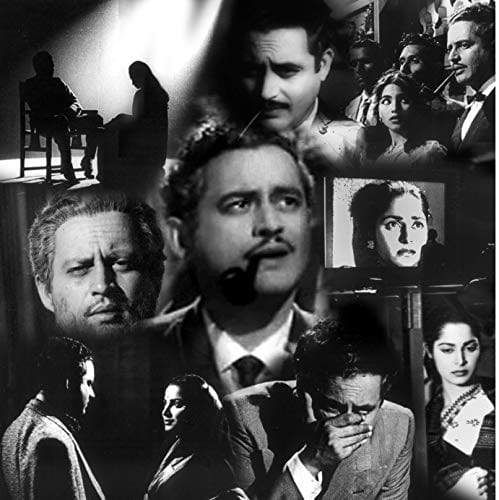
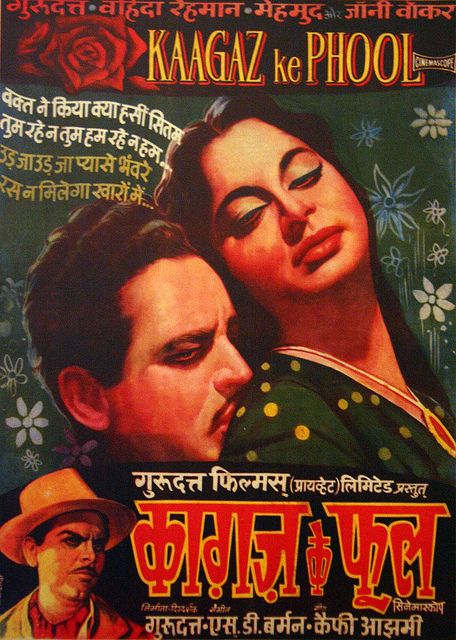
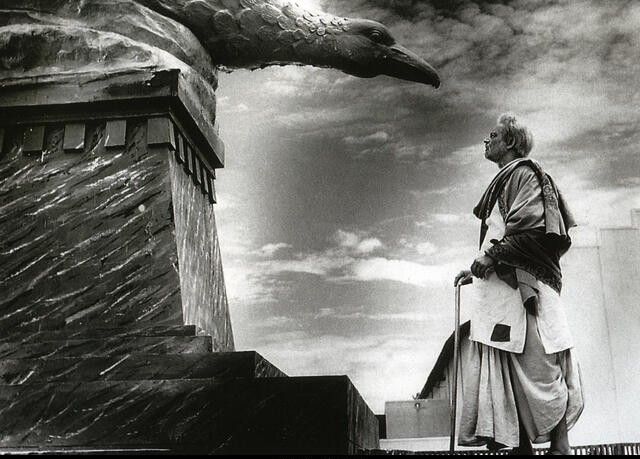
Kaagaz Ke Phool (Paper Flowers) is a 1959 Indian Hindi – language romantic drama film produced and directed by Guru Datt, who also played the lead role in the film along with Waheeda Rehman. It is the first Indian film in Cinema Scope and the last film officially directed by Dutt. Film is Dutt’s masterclass in filmmaking and heartbreak. It marked a technical revolution in Indian cinematography and is widely considered to be ahead of its time.
The film tells, in flashback, the story of Suresh Sinha (Guru Dutt), a once-successful film director whose personal life is a mess. His marriage to Veena is on the rocks, due to her wealthy family seeing filmmaking, as a job, lacking in social status. He is also denied access to his daughter, Pammi, who is sent to a private boarding school, in Dehradun.
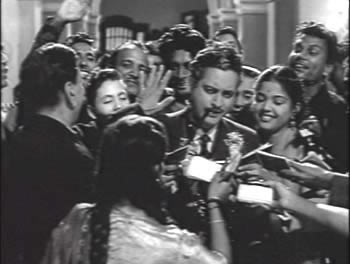
On a rainy night, Sinha meets a woman, Shanti (Waheeda Rehman), and gives her his coat. She comes to the film studio to return the coat, unintentionally disrupting the shooting, by walking in front of the camera. While reviewing the rushes, Sinha recognises her potential as a star and casts her as Paro, in Devdas. Shanti goes on to become a rage and an acclaimed star. Shanti and Suresh, two lonely people, come together. The start of a new, happy life for both Suresh and Shanti, stark contrast to the the earlier song, ‘San San San Woh Chali Hawa‘ is a bright, happy song about new hopes and dreams, and the first flush of romance. The alleged romance is written about in the tabloids, and Pammi, cruelly teased by her classmates, visits Shanti and makes her promise to leave.
Suresh, whose career has meanwhile nosedived, is heartbroken over Shanti’s departure as well as his unsuccessful custody battle for Pammi. Losing custody of Pammi, along with Shanti’s departure from films, drives Suresh to alcohol. This marks the beginning of his downfall, both personally and professionally, in his career and consequent decline in his fortunes. He turns to alcohol, and his producers tell him they can’t work with him anymore unless he follows their safe scripts and doesn’t change a word. Unable to take this assault on his creative freedom, Suresh spirals further and further into loneliness, alcoholism and depression, right up until the tragic end.
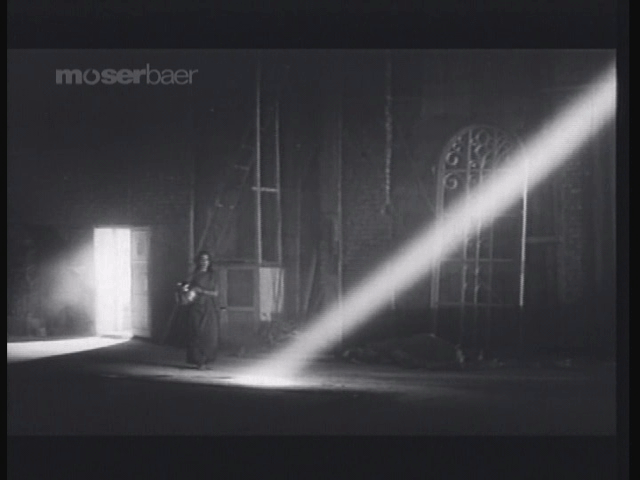
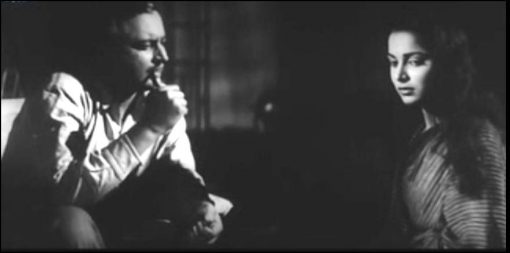
The play of shadow and light is as much a part of the mood as the music is. Even though the movie bombed at the time, it won two Filmfare awards — for art direction (M.R. Achrekar) and cinematography (V.K. Murthy). The camera is put to exceptionally lovely and imaginative use in the film’s iconic song, ‘Waqt Ne Kiya Kya Haseen Sitam‘. His “beam shot” in this song sequence is considered a classic in celluloid history. Inspired by a light boy who was reflecting light with a mirror, he got that parallel beam using a pair of ordinary mirrors. The light-beam effect was produced using two large mirrors to fall on the floor and natural sunlight. Apart from the song’s composition and lyrics, it is also considered one of the best photographed songs of all time.
The music of the movie was composed by S. D. Burman. The song Waqt Ne Kiya Kya Haseen Sitam became an evergreen hit. The opening credits, “Dekhi zamaane ki yaari, bichhde sabhi baari baari (I have seen the friendships of this era, they all drifted away one by one)”, Kaifi Azmi’s heartbreaking words sung by Mohammed Rafi, melt away any such mundane thoughts. The words “Jaayenge kahaan soojhta nahin, chal pade magar raasta nahin, kya talaash hai kuch pata nahin, bun raha hai dil khwaab dum-ba-dum” (We don’t know where we are going, we have started walking but we don’t know the way, we don’t know what we’re looking for but the heart weaves dreams anyway) are made even more layered and heartbreaking by the fact that they were sung by none other than Geeta Dutt.
An early shot in the film reveals Suresh leaning from the balcony of a cinema hall. The film is an introspective and retrospective journey of Suresh, a once-celebrated film director who is currently going through a bad patch both professionally and personally. Three women of different ages and from different backgrounds mark his life. One of them is his wife Bina, another is his growing daughter Pammi and the third is Shanti, the woman he introduced to films and who later became a famous star.
He is estranged from his wife and daughter, while Shanti, the leading lady who he had groomed to fame and glory, and had subsequently fallen in love with, has drifted away. He discovers that the studio floors are his last recourse, and seeks refuge there, tracing back his journey. He finally comes to terms with the reality that fame and success are as ephemeral as life itself. By then, however, it is too late to travel back in time and remedy things.
Kaagaz Ke Phool focusses primarily on Suresh Sinha, a director of films. Three women of different ages and from different backgrounds mark his life. One of them is his wife Veena, another is his growing daughter Pammi and the third is Shanti, the woman he introduced to films and who later became a famous star. The wife and the daughter affect him negatively even with their physical absence from his life. It is Shanti who functions as the sacrificing woman who falls desperately in love with him. They fall in love but never get to express their love for each other.
The most telling metaphor in film is Shanti knitting sweaters. It is introduced as an innocent time-filler when she begins knitting on the sets during breaks in the shooting. Shanti presents Suresh with a sweater, the only one she could manage to give him. Years later, during the shooting of a film, as the female lead, in a scene she is supposed to do with a bit player, Shanti recognises Suresh who steps in as the bit player from the sweater he is wearing when he removes his costume. It is full of holes now, but he still wears it, almost like a second skin. Nasreen Munn Kabir writes in Guru Dutt – A Life in Cinema: “A dying woman knits them for a man who refuses to die in her memory.”
The movie made cinematic history as the first in India to be shot in CinemaScope, a lens created by the president of 20th Century Fox. The process of securing the lens, which involved a trip to Paris, and then learning to shoot in a different aspect ratio, was a major production. And because CinemaScope screens existed only in a few theatres in Bombay and perhaps Delhi, the film had to be shot twice, one version for regular screens and one in the new lens. But director and producer Guru Dutt was adamant.
Guru Dutt’s classic, tragic black and white masterpiece film with shades of real, grey life brought to life by subtle performances and dialogue, gorgeous camerawork and Kaifi Azmi’s haunting lyrics.
NDTV’s listed it in “India’s 20 greatest films”, citing, “Kaagaz Ke Phool, Guru Dutt’s most melancholic film ever, takes his deepening disillusionment with the world and its guardians to a new level of despair. The iconic actor-director plays a filmmaker on the skids. He is unable to get his point of view across to the people who matter and life is a constant struggle, both personally and professionally. The masses failed to connect with the film, but Kaagaz Ke Phool has lived longer than many money-spinners of the golden era of Hindi cinema.”
Kaagaz Ke Phool‘s screenplay was published in 2014 as a book as Kaagaz Ke Phool: The Original Screenplay. In 2019, British Film Institute named Kaagaz Ke Phool as the Best Musical of 1959, citing, “if proof were needed that Guru Dutt was no one-hit-wonder, it’s right here.” It was ranked first in The Cinemaholic’s list of “Best Hindi Cult Films that were Flops”, citing, “The last film officially directed by the legendary Guru Dutt. Often regarded as one of the greatest film ever made, the failure of Kaagaz Ke Phool severely impacted Guru Dutt.”
Today Kaagaz ke Phool is a part of syllabi in many film schools. It is considered to be the finest self-reflexive film to have ever been made in India.
Photos courtesy Google. Excerpts taken from Google.
 Writer Sunita