
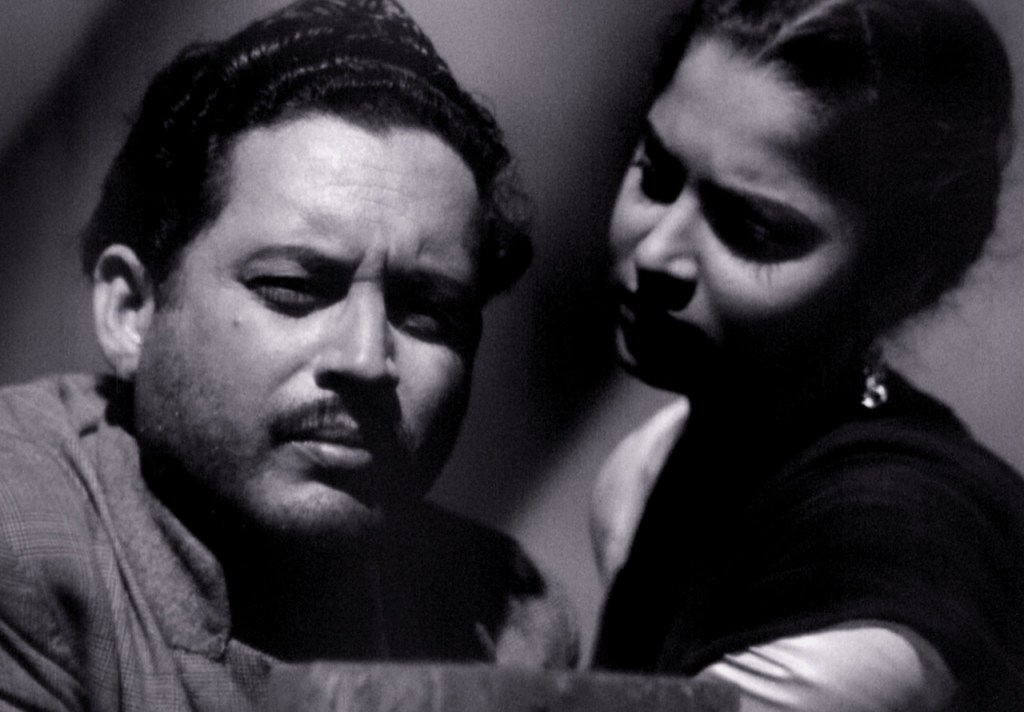

Pyaasa (Thirsty) is a Indian Hindi film story, screenplay, directed and produced by Guru Dutt, who stars alongside Mala Sinha, Waheeda Rehman, Rehman, and Johnny Walker. Set in Calcutta, it focuses on the disillusioned Urdu poet Vijay (Dutt), whose works are underestimated by publishers and panned for writing on social issues rather than romantic topics. The film follows his encounters with the golden-hearted prostitute Gulabo (Waheeda Rehman) and his former girlfriend Meena (Sinha), how the former helps him to get his poetry published, the success of his works, and his romantic relationship with Gulabo. Pyaasa is a visionary artwork that remains a unique masterpiece for all-time superhit.
Vijay is an unsuccessful, idealistic Urdu poet in Calcutta whose works are not taken seriously by publishers. They condemn Vijay for writing on social problems such as unemployment and poverty, rather than those on conventional romantic topics. His brothers also dislike his occupation, trying to sell his poems as waste paper. Unable to bear their taunting, he stays away from home and, beside that, find the poems his brother has sold.
Around this time, Vijay encounters a prostitute named Gulabo, who buys and is enamoured with his works and, consequently, falls for him, and his former girlfriend Meena; he finds out that the latter has married the publisher Ghosh due to financial security. Ghosh hires him as a servant to find out more about him and Meena. A dead beggar to whom Vijay gave his coat and whom he tries to save unsuccessfully from the path of a running train is mistaken for Vijay. Gulabo goes to Ghosh and gets his poems published. Ghosh does so feeling he can exploit the poems and make a killing. The poems are very successful. However, Vijay is alive and in the hospital after the train mishap.
Ghosh and Shyam, Vijay’s close friend, refuse to recognise him and he is committed to a mental asylum since he insists that he is Vijay and is thought to be mad. Vijay’s brothers too are bought off by Ghosh not to recognise him and a memorial is held for the dead poet. Vijay, with the help of his friend Abdul Sattar escapes from the mental asylum and reaches the memorial service, where he denounces this corrupt and materialistic world. Seeing that Vijay is alive, his friend and brothers side with a rival publisher for more money and declare that this is Vijay. At a function to honour him, Vijay becomes sick of all the hypocrisy in the world around him and declares he is not Vijay. He then leaves with Gulabo to start a new life.
Pyaasa was based on a story idea called Kashmakash, written by Guru Dutt, when he was 22. The film’s theme and philosophy was inspired by his life experiences in early struggling days of his life.
Waheeda Rehman’s character in Pyaasa was inspired from a real life character. Abrar Alvi and his friends were visiting Bombay and they decided to visit the red light area. Alvi got talking to a girl who called herself Gulabo. According to Alvi “As I left, she thanked me in a broken voice, saying that it was the first time that she had been treated with respect, in a place where she heard only abuses. I used her exact words in the film.”
The film is outstandingly directed by Guru Dutt, the film has artistic scenes, unique shots. Dutt’s direction is excellent. He pays attention to the smallest of details, keeps the film consistently realistic ultimately managing to build a wonderfully captivating and engaging picture. The well-crafted screenplay was written by Abrar Alvi. The film has an excellent presentation. The last twenty minutes of movie are the strength of this classic flick. the film is appropriately and incredibly poetic in tone, with amazing dialogues bringing so much depth and finesse to it. Its musical style the narrative is full of songs and never do they take away from the efficiency of the script. The cinematography is very effective and just like the songs it often manages to capture the characters’ state of mind.
Film is a heartbreaking story of a very talented yet struggling poet, Vijay, played by Guru Dutt himself. He is excellent in an author-backed role which only he could play given he had the idea of how it should have been done. He is an idealist and a true romantic who is abandoned and constantly put down by everyone. His own family hates him, and even the woman he loves marries someone else, all because he chooses to live life on his terms. His art isn’t valued, and he is pushed into poverty. Vijay finds recognition and love eventually, but not in a way he imagined.
Mala Sinha displays the negative shades of her role as well as her inner compassion very well. Waheeda Rehman’s portrayal of Gulabo is intelligent, she is kind, and she has self-respect like any other woman. Waheeda, a streetwalker who has a policeman on her heels, takes refuge in Guru Dutt’s arms. When the policeman wants to know her identity, Guru Dutt calls her his wife. Her role that allows her to grow through the film and draw the audience’s sympathy with her heartfelt and authentic portrayal. Johnny Walker’s Abdul Sattar provides levity during some of the more tense moments of the film. The song he performs, ‘Sar Jo Tera Chakraye‘, is instantly recognisable across Indian households, and Walker’s skill as an actor does not go unnoticed. His character, even with limited screen time, shines, an impressive feat for essentially a tragic film.
The true beauty of ‘Pyaasa’ lies in the way it transcendently manages to merge human pathos of love and relationships into larger realms of humanity. A rebel poet not only lays bare the herd mentality of a whole society but also opens up the selfishness and materialistic instincts fostering within the individuals that make up the same society. He forgives none, not his brothers, neither his past lover. He finds solace in a women outcast by society. Guru Dutt clearly implying here the existing hypocrisy in society, where no one close to him cared about him as much as someone who the society didn’t care about.
Dutt’s regular cinematographer, V. K. Murthy, provides some of Indian cinema’s most breathtaking images in starkly contrasted black and white. The film’s mastery of cinematic devices is especially demonstrated through Guru Dutt’s genius for “picturization,” which seamlessly coordinates music the legendary S. D. Burman, lyrics Urdu poet Sahir Ludhianvi, rhythmic editing, stark lighting, and fluid camera movement. When Vijay, working as a servant at Mr. Ghosh’s snooty literary soiree, sings one of his poems (Jaane woh kaise), a pattern of forward and reverse tracking shots, pushing and pulling, back and forth, underlines the persistent desire and unbridgeable distance that now defines the poet’s relationship to Meena, his former but shallow lover.
An important scene in the movie, when Vijay is at the lowest point in his life and has given himself up to drinking, a friend of his takes him to a brothel. There, a woman is dancing for the men, and when her child, who is in a pram, starts crying, she becomes restless and tries to go to her child but is dragged back — first by her employer, then by a man who wants her to entertain them first before attending to her child. At this scene, the powerful moment, Guru Dutt makes use of subjective perspective as he cuts back and forth between the point of view shot of Vijay and the extreme close-up of his teary eyes. He does that because he wants the audience to understand what he is feeling — the eyes tell the emotion that the face cannot. Facial expressions can mislead, but the eyes always tell the truth. His idealistic worldview only makes things harder for him. He finds himself helpless in a world full of immoral, mean, and corrupt people. He has realised the ideal world he thought he lived in does not exist in reality. But he is still not ready to give in to their ways. Somewhere in his heart, he is still hopeful of creating this ideal world as he sings the haunting ‘Jinhe naaz hai hind par vo kahan hain’ (Where are they who claim to be proud of India?).
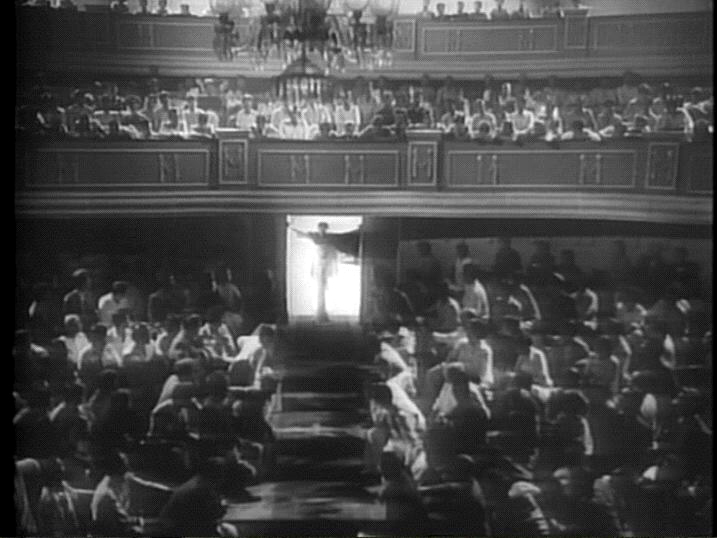
The poems have become widly popular after Vijaya’s supposed death. Upon learning of this , Vijay attends his own death anniversay gathering. He enters the auditorium where people seem to be posthumously celebrating his art. His arrival underlined by the crucifixion like pose that Vijay strikes during the film’s last song, “Yeh duniya jahaan aadmi kuch nahi hai, wafa kuch nahi, dosti kuch nahi hai. Yahaan pyaar ki qadr hi kuch nahi hai, yeh duniya agar mil bhi jaye to kya hai” (This world where man counts for nothing, Loyalty and friendship count for nothing, Where love has no importance, Would I care if such a world were mine?). Song elevates the film to an astonishing musical and dramatic crescendo, as slight head movements by all the major characters in the film match rising musical figures as Dutt cuts rhythmically among their close-ups. As the song builds from a whisper to a scream, Mohammed Rafi’s steady voice breaks as Vijay’s supposed admirers mutate into a rioting mob: the sequence provides a textbook example of how a filmmaker can wed the visual and sound elements of cinema to a storyline in the construction of powerful emotional meaning.
The film received international acclaim in 1980s when it was first released in Europe, subsequently becoming a big commercial success there, long after Guru Dutt died and is now considered a “seminal landmark” in the history of Indian cinema. It was a huge commercial success during its 1984 French Premiere. Since then, the movie has been screened to huge mass appeal the world over, like the recent screening at 72nd Venice International Film Festival held in Italy, in September 2015.
In 2004, as part of Sight & Sounds’s feature “celebrating the relationship between cinema and music”, Pyaasa was listed as one of The Best Music in Film and was named by Olivier Assayas as one of his favourites, who called its music as “possibly one of the most remarkable transpositions of poetry on screen.”
In 2011, the British author Nasreen Munni Kabir published The Dialogue of Pyaasa, which contains original dialogues for the film in Hindi and Urdu as well as its translation in English.
Photos courtesy Google. Excerpts taken from Google.
 Writer Sunita