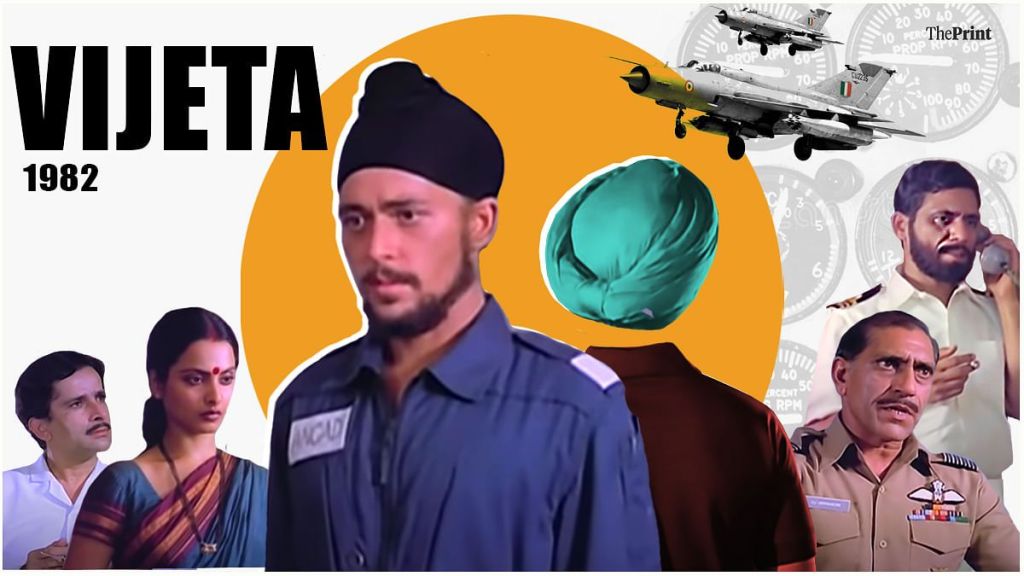
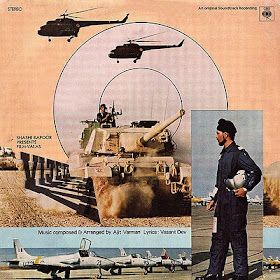
Vijeta (The Victor) is a 1982 Indian coming-of-age Hindi film produced by Shashi Kapoor and directed by Govind Nihalani. It stars Shashi Kapoor, his son Kunal Kapoor, Rekha, Amrish Puri and Supriya Pathak with K.K. Raina, Raja Bundela and Shafi Inamdar, who went on to become notable supporting actors in Bollywood movies.
Angad (Kunal Kapoor) is a confused teenager trying to find himself and is caught in between the marital problems of his Maharashtrian mother Neelima (Rekha) and Punjabi father Nihal (Shashi Kapoor), it is time for him to decide what he wants to do with his life. Angad chooses to become a fighter pilot with the Indian Air Force. What follows is his struggle to become a victor both with his self and the outer world. Angad is attracted to Anna Varghese (Supriya Pathak), who is the daughter of his flying instructor Group Captain Varghese (Amrish Puri) a Malayali Syrian Christian. Angad must learn to adapt to flying, leaving his mom and dad for long periods of time, as well as try and woo Anna who helps him overcome his fears and realize his potential as a fighter pilot. Nihal is a clean-shaven Sikh, Neelima is a Hindu, Angad is a Sikh and Anna a Christian, while Angad’s fellow officers represent all religions.
The film is notable for some rarely seen aerial photography of combat aircraft active with the IAF in the 1980s. The central character of Angad is a MIG-21 pilot and is shown flying the aircraft in the ground attack role in the Indo-Pakistani War of 1971. Much of the movie, including the climax involving a MIG-21bis, was shot at Pune. The IAF No.4 Squadron (the ‘Oorials’) provided the pilots and planes for the film’s aerial sequences. The movie included good color footage of the Oorials aircraft in flight and in operation.
There’s a scene in the film in which Angad Singh, a young Indian Air Force pilot readying for his first war, is sitting with his friend and fellow officer. The two share what is going through their minds before they take to the skies to defend their nation. His friend laughs and says if he survives, he’ll take the plunge and get married, but Angad is thinking about the fact that he will soon be flying over the land that his ancestors are from, warring against people who once shared a country with his family. He is scared of inadvertently killing innocent people.
This is a movie about IAF pilots in which the actual war they fight is given barely a few minutes of screen time, towards the end. Then, there is Angad’s awareness that this is not a fight with the people of another country. There is no jingoistic demonising of the other — in fact, although there are clues to indicate this is the 1971 war, nowhere, in this scene or in the entire movie, is the name of the ‘enemy’ country ever clearly stated.
One of Angad’s closest friends in the IAF is a man from Andhra Pradesh named Venkat Raju; the others are Aslam Khan from Allahabad and Wilson from Bhopal. This seems like an inconsequential detail, but it’s just one example of the quietly determined pluralism that runs through Vijeta like a leitmotif.
Angad, an aimless young boy who repeatedly fails his matriculation exams, to the frustration of his parents. His relationship with his father is particularly rocky, partly because he can’t get past Nihal’s gruff exterior and partly because he holds Nihal responsible for his parents’ strained marriage, Neelima, who was just doing her job, is quietly feminist, and lovely. It is her Naval officer brother Arvind (Om Puri), who takes Angad under his wing for a few days, and explains to him that marriage is complicated and that life and human relationships are layered and not easy for anyone on the outside to understand. Arvind also shows him around the Naval base, and during this time, Angad decides he wants to join the defence forces, but as an Air Force pilot.
The scene then shifts to the National Defence Academy, where Angad undergoes gruelling training for three years as a cadet. His father is convinced he will give up and come back home soon, but he’s wrong. In between studying flight theory and overcoming his fear of heights during beautifully shot spin flights (Nihalani also did the cinematography, with help from senior IAF pilots, and won a Filmfare award for his work), Angad finally finds his groove.
He gets pummelled in boxing bouts, travels around the area with his trusty camera and even has a serious horse-riding accident that would ordinarily make a career as an IAF pilot impossible, but with grit, the help of his fellow cadets and the support of his family, including a slowly thawing father, he gets right back in the saddle, literally. He also, meanwhile, falls in love with Anna Verghese (Supriya Pathak), the only and much-loved child of his daunting chief instructor and mentor with a penchant for playing the piano (Amrish Puri).
This is yet another example of Vijeta’s progressive tone — the fact that Angad is a Sikh and Anna a Malayali Christian is not even raised once. Anna is more concerned with Angad’s boyish inability to admit his feelings for her rather than with his religion, and the scene when he finally does is hilarious and adorable. Film is equally about Angad’s parents, about marriage, love, loyalty and family, which makes it stand out in a sea of Hindi movies about war and the armed forces.
Nihal and Neelima are constantly prickly with each other — that is, when they bother to talk to each other. She drowns herself in her classical music (the film has only one song, a lovely classical-style one), which is almost like her lifeline in a marriage that has long since stopped feeling like one. Rekha’s performance is dignified and quiet.
Nihal battles his own demons — namely, his and his mother’s narrow escape from Punjab during the bloody, traumatic Partition that decimated his family and everything he had known until then. He has an obvious inferiority complex, calling himself a “hal jotne wala Jat” (a Jat farmer), code for not as well-educated, cosmopolitan or cultured as his wife who’s from Pune. He is hard on his wayward son, to love him like he loves his mother. He also yearns for Neelima, who, despite being in the same house, keeps her distance.
One of the film’s most powerful scenes, in fact, is when Angad has written to Nihal for the first time since he joined the NDA. Nihal is perplexed, touched and unable to stop reading the letter, even prompting Neelima to tease him about it. That step towards forgiveness between father and son also paves the way for the couple to repair their relationship.
It’s one of the movie’s many triumphs, along with the sweet equation that Anna goes on to share with Nihal. Tragedy has struck both families, and though it is never clear whether Angad has married Anna or they’re still dating, she goes to stay with Nihal once the war starts. She calls him dad and the two crack jokes about his drinking and her cooking.
In 1982, the year of the Indian Air Force’s golden jubilee. Film is not only about IAF pilots and their magnificent flying machines. The movie is also about individuals caught in the construct of a nation-state at war with another nation-state. Vijeta continues to be remembered as a cult classic. Beautifully shot by the director, the movie has air combat scenes and authentic depictions of National Defence Academy training that have rarely been seen before or since. Some of the authenticity can be credited to the two screenwriters – poet and novelist Dilip Chitre and theatre personality Satyadev Dubey.
Film World magazine rated the film “Good” and wrote, “Vijeta is perhaps the first film of its kind, a film which shows the Indian Air Force, its gallant men and their life in true colours.” According to Asiaweek, “Vijeta is a tribute to the IAF in celebration of its golden jubilee last year”.
Film won Filmfare Awards for Best Cinematography (Govind Nihalani), Best Sound Design (Hitendra Ghosh) and Best Editing (Keshav Naidu).
Photos courtesy Google. Excerpts taken from Google.
 Writer Sunita