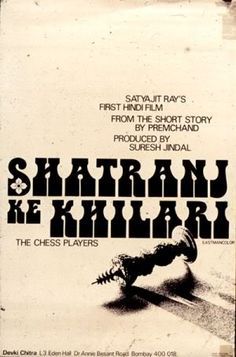
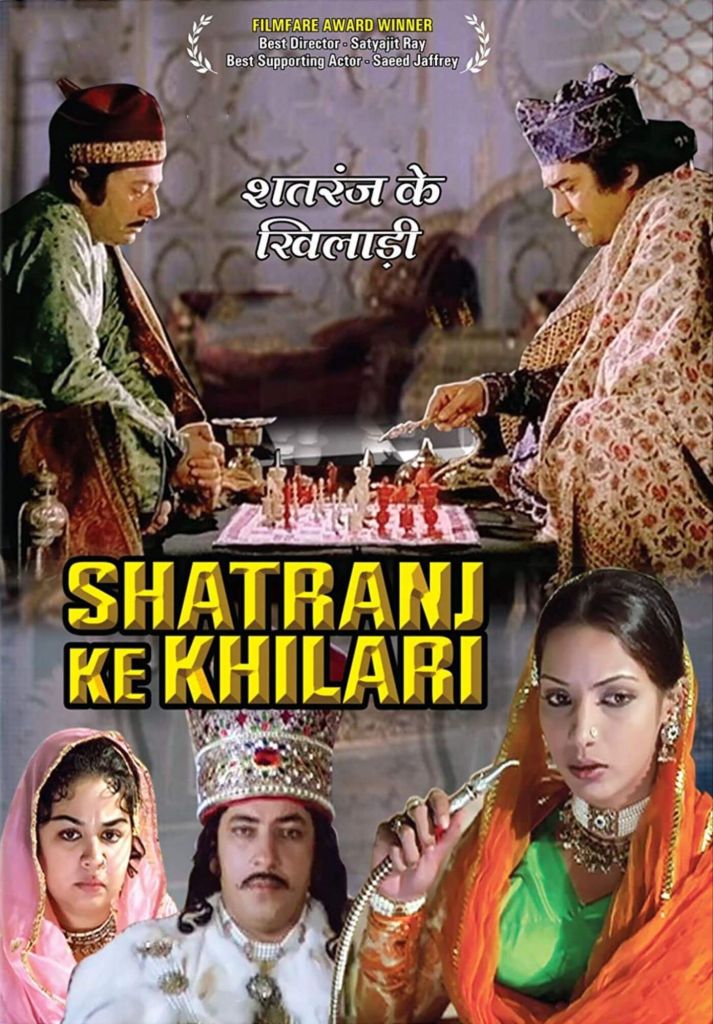
Shatranj Ke Khilari, also subtitled and later internationally released with the translated title The Chess Players, is a Indian Film written and directed by Satyajit Ray, based on Munshi Premchand’s short story of the same name. Amjad Khan plays the role of Nawab of Awadh Wajid Ali Shah, and Richard Attenborough enacts the role of General James Outram. The main cast includes actors Sanjeev Kumar and Saeed Jaffrey as the chess players. It also has Shabana Azmi, Farooque Shaikh, Farida Jalal, David, and Tom Alter. It has Amitabh Bachchan as the narrator.
Nawab Wajid Ali Shah, the ruling Awadh, is a languid artist and poet, no longer in command of events and unable to effectively oppose the British demand for his throne. Parallel to this wider drama is the personal tale of two rich, indolent noblemen of this kingdom, Mirza Sajjad Ali and Mir Roshan Ali. Inseparable friends, the two nobles are passionately obsessed with the game of shatranj (chess). Both effectively neglect their wives and fail to fight the takeover of their kingdom by the British East India Company. Instead, they escape their harangued wives and responsibilities, fleeing from Lucknow to play chess in a tiny village untouched by greater events. Ray’s basic theme in the film is the message that the self-centredness, detachment and cowardice of India’s ruling classes catalysed the annexation of Awadh by a handful of British officials, among whom Captain Weston, a British soldier in love with Urdu poetry, is also worth noting.
Movie begins with a conversation about Wajid Ali Shah, between General James Outram and a young Captain Weston of British East India Company played by Tom Alter. This initial dialogue between these two employees of Company Sarkar is in English language apart from that most of the dialogues in the movie are in Hindustani, a mixture of Hindi and Urdu, quiet popular at that time.
Satyajit Ray successfully depicts condition of Awadh state and its capital city Lucknow during Wajid Ali Shah’s rule just before sepoy mutiny and India’s first independence struggle. The Nawab of Awadh is portrayed as a very sensitive but sympathetic figure who is an artist and poet.
Politics is not discussed in much detail by Premchand considering short nature of the story but Ray had a full feature film of two hours to experiment with and he elaborated political discussions a lot more in the movie. He also tried to convey the message that the detachment and poor political will of India’s ruling classes allowed British East India Company with few officials and a small army to take over the kingdom of Awadh without any opposition.
Fearing blood shedding of his people in a hopelessly unequal battle, the king opts to hand over the kingdom to the British with out a fight, singing to himself a Thumari that he has composed – “Jab chhod chale lakhnau nagari, kaho hal aadam par kya gujari” (As we leave our beloved city of Lucknow, see what pain we have to go through…)
Apart from this political drama a more personal and humorous tale of the chess battles between our heroes, two rich noblemen of the Kingdom of Oudh, unfolds parallely. Both of them, Mirza Sajjad Ali and Mir Roshan Ali, are noblemen from city of Awadh and are protected by the royalty. Being rich they don’t have to work for their livelihood and they pass their entire days and months playing chess. It is real fun to watch them fighting over a move like small children do. Their wives, servants and even neighbours are all tired of their obsession for chess. Sometimes they skip their lunch and play chess later into the evenings.
Tired of his obsession for the game when Mirza Sajjid Ali’s Begum (wife) hides the chess board both our heroes are very irritated and left his house to buy a new set but soon realized that it is Sunday or something and they can’t buy new one on the same day. They suddenly reminded of Vakil Saheb (lawyer) in the neighbourhood who displays a chess set in his living room. Both decides to borrow it for a day until they buy new one on the next day but finds Vakil Saheb on his death-bed at his house and was attended by his son.
They are in dilemma as how to ask for a chess-board as Vakil Saheb is on death bed but they pretend as if they are there to ask his whereabouts. But they can’t resist their temptation looking at the board in Vakil Saheb’s living room and starts playing when attendant left them to their own.
In the last scene, after which Mir shoots at Mirza and complains out loud “(If you die) I won’t have a partner to play chess with”, Mirza responds to him “but you have one in front of you!” (thus making him understand that he forgives him). He finally concludes that “after nightfall, we will go back home. We both need darkness to hide our faces.”
It was the most expensive film Ray ever made. The expense mainly went into reconstructing the period – Lucknow in the 19th century – requiring expensive sets, costumes and jewellery. The expense of the film also made it imperative to take stars because only then would the film become ‘saleable’ and cover its cost. The stars took minimal fees as did Ray, who himself told me what he would take.
The film was well received upon its release. Despite the film’s limited budget, The Washigton Post critic Gary Arnold gave it a positive review; “Ray possesses what many overindulged Hollywood filmmakers often lack: a view of history”. According to Martin Scorsese, “This film deals with a moment of incredible change in Indian history and is told from a comical view that is a hallmark of Ray’s work. Watching it again, I realize this is what it must really feel like to live through a moment of historic change. It feels this big and tragic at the same time.”
It was India’s entry for the Best Foreign Film at the 51st Academy Awards, but did not receive a nomination.
Photos courtesy Google. Excerpts taken from Google.
 Writer Sunita