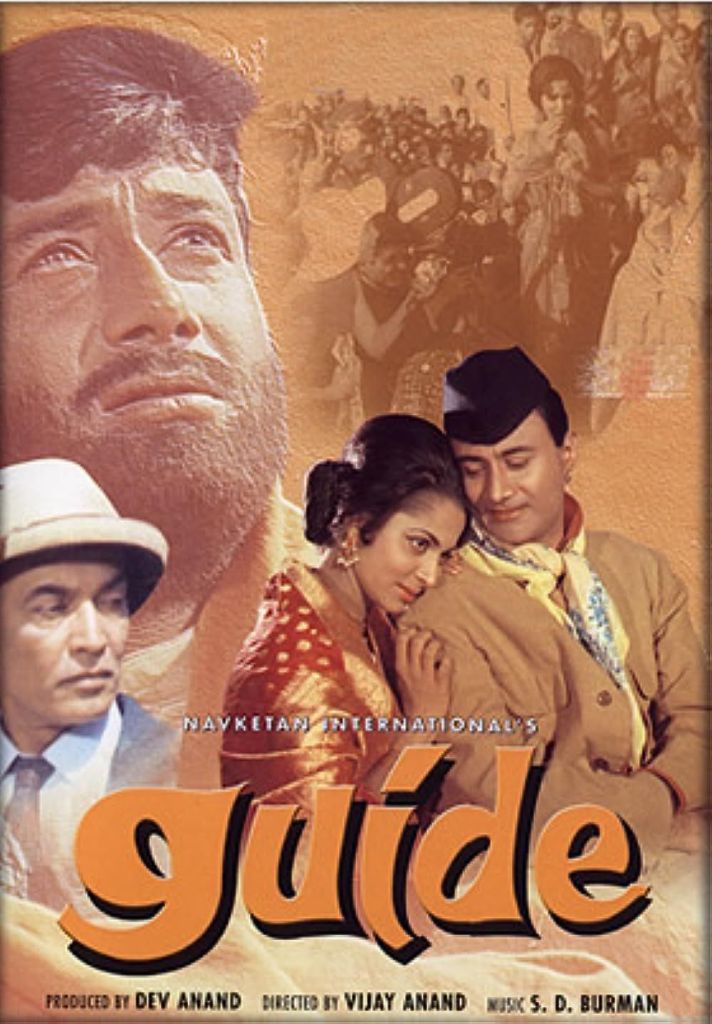
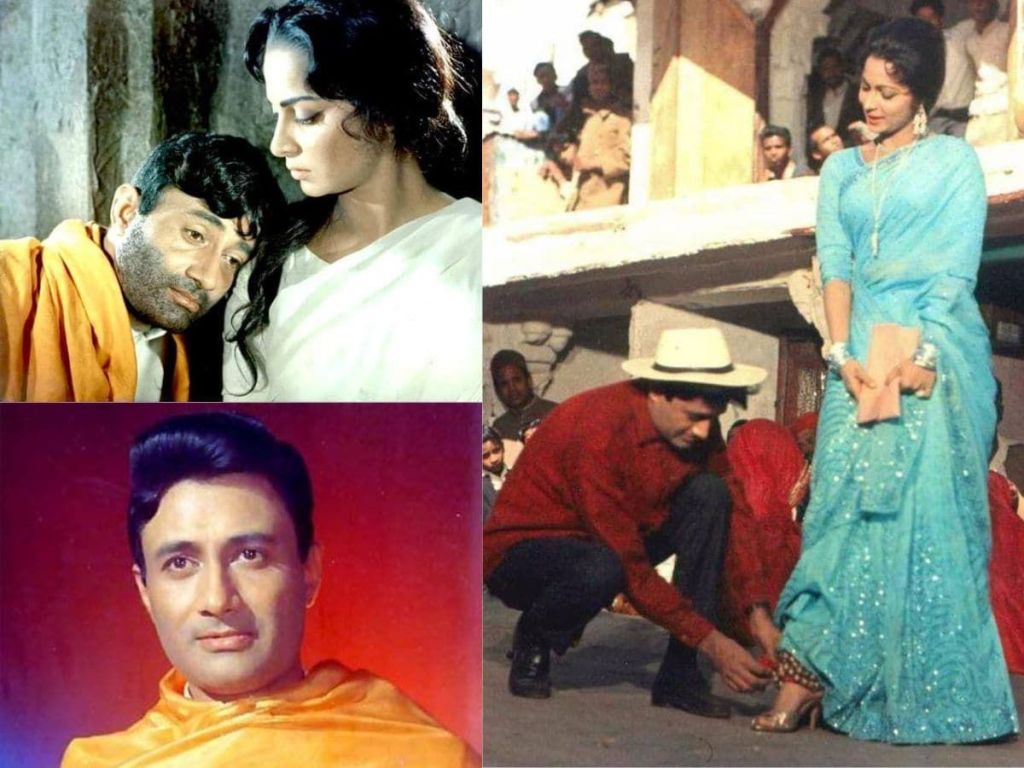
Guide is a Indian bilingal romantic film directed by Vijay Anand and produced by Dev Anand, who co-starred in the film with Waheeda Rehman. Based on R. K. Narayan’s 1958 novel The Guide, the film narrates the story of Raju (Anand), a freelance tour guide and Rosie (Rehman), the repressed wife of a wealthy archaeologist.
A tour guide, Raju, takes a serious-minded archaeologist, Marco (Kishore Sahu), and his beautiful but troubled wife, Rosie, on an excursion to look at ancient caves. Despite reservations, Raju is attracted to Rosie, even when he learns of her past as a prostitute. Rosie leaves Marco for Raju, but only tragedy awaits the new lovers. Raju spends time in prison, and upon release undergoes a spiritual transformation after villagers believe him to be a holy man.
The movie starts with Raju being released from jail, and then the story unfolds in a series of flashbacks. A wealthy and aging archaeologist named Marco arrives in the city with his young wife Rosie, who is the daughter of a courtesan. Marco wants to do some research on the caves outside the city and hires Raju as his guide. He discovers a new cave and ignores Rosie.
Film is nation-building, modernization, and social reform, world-renunciation and spiritual self-realization. Dev Anand stars as the effervescent Raju, a fast-talking, self-promoting tourist guide in the Rajasthani city of Udaipur. A frame story about Hindu concepts of the power of faith and renunciation, involving an ex-con who is mistaken for a saint and gradually grows into the role. The emboxed narrative of the unhappy dancer Rosie, Raju away from a loveless marriage to the archaeologist Marco, and into the role of the acclaimed “classical artiste” Nalini.
The film is strongest on the inception of their relationship, when Raju slowly becomes aware of the depth of Rosie’s sorrow and of the abuse she receives from the rich Mr. Marco, to whom her mother married her in a desperate bid for respectability — a sour antiquarian who lusts after stone images of copulating couples while despising his own voluptuous young wife. Raju gradually begins “guiding” Rosie to belief in herself and in her talents, eventually giving her shelter in his home despite the voyeuristic scandalization of his neighbors and the outraged opposition of his relatives. Raju’s courage and compassion, and the hypocrisy of “respectable” society’s attitude toward “public women” are powerfully portrayed, as is the chemistry between him and Rosie. Their later falling out, at the height of Rosie’s success, is rendered more sketchily — the film implies, that worldly success inevitably corrupts and that career women must indeed construct (in Rosie’s words) “a sort of fortress around the heart.” Raju’s hurt over this rejection helps to drive him to melancholia, booze, and gambling; a lingering jealousy of the rich Mr. Marco prompts his fateful act of forgery.
There is much superb dialog that uses Raju’s code-switching skills to sharply-ironic effect: as when the bogus holy man trumps unscrupulous village Brahmans by responding to their Sanskritshlokas with an incomprehensible speech in the new father tongue of Command — English; and when the slick dance promoter uses Sanskritized shuddh Hindi to convince school officials that a Bharat Natyam performance will help their charges resist degenerate Western jazz and pop. There is also wonderful music — R. D. Burman’s notable score comprises nine songs, most of which became hits — and gorgeous cinematography of Fali Mistry that takes full advantage of the primary colors and rugged monuments of the Rajasthani landscape. The film’s return to its frame narrative may strike some viewers as jarring, for the filmmakers clearly decided on a less-ambivalent portrayal of the conman-turned-saint than is found in Narayan’s novel. This decision is already hinted at in the film’s opening, when the paroled Raju makes the choice not to return to his home city and instead takes up a wandering life. During the credit sequence, we see him roaming through India, homeless and penniless, his Western clothes gradually falling to tatters and yielding to village khadi, while a voiced-over wayfarer’s song offers lyrics reminiscent of the antinomian nirgunadevotion of medieval poet-saints like Kabir.
In the final sequence, the film acquires overtones of the much-maligned mythological/devotional genre, and its validation of the simple faith of the villagers may appear, in a materialist reading.
Vijay Anand’s graceful and subtle direction and script were so brilliant that viewers did not realise that he had succeeded in dissolving their normal resistances. Vijay Anand’s careful screenplay, it is with his words and direction that the film managed to be bold and ventured into untested waters. The beauty of the script and the direction was such that audiences empathised with Raju. The subtle dialogue, the deft handling of the plot and the brilliant performances from the entire cast. Orthodoxy wasn’t too pleased with the film, but those who weren’t very rigid accepted the story-line.
Vijay Anand weighed in on the affair by showing Marco as boorish and uncaring. While the husband was the life-taker, it was the ‘other man’ who became the life-giver. Vijay Anand ensured that while watching the film, the audience had little choice but to reject the husband and not the lover. Thus, it was the protective ‘other man’ who boosted her morale and egged her to fight back; it was he who persuaded Rosie with a magnificent speech after she attempted suicide; that speech crafted by Vijay Anand laid the foundation for the imminent breakup of the couple.
S.D. Burman’s brilliant music, Fali Mistry’s excellent photography and Waheeda’s mind-blowing performance, especially the dances, made Guide the film to stand the test of time. However, Guide was slow to catch the audience’s interest. Film ran to full houses in Bombay. Just then Gujarat was hit by a drought, posters came up everywhere saying: Guide prays for rain. The film, expectedly had a silver jubilee run in Gujarat.
The ceremony also proved to be controversial, as S. D. Burman, who was nominated for Best Music Director and Lata Mangeshkar was nominated for Best Playback Singer for “Aaj Phir Jeene Ki Tamanna Hai”. The sequence featuring the song was shot in the Chittor Fort in Rajasthan.
At the 14th Fillmfare Awards, Guide received a leading 9 nominations, and won 7 awards, becoming the most-awarded film at the ceremony. Guide was also the first film to win all 4 major awards: Best Film, Best Director, Best Actor and Best Actress.
Photos courtesy Google. Excerpts taken from Google.
 Writer Sunita