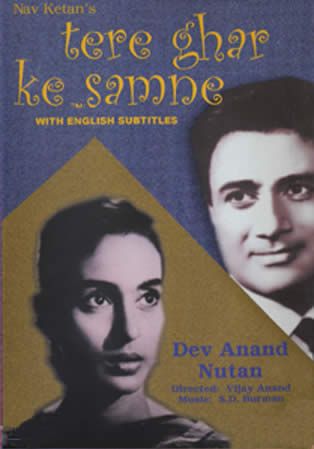
Tere Ghar Ke Samne (In Front of Your House) is a Hindi black and white film produced by Dev Anand and written and directed by Vijay Anand.
The film is a comedy which also sends across the social message that: “Not all that is new is bad, nor is all that is old good”. The story is about a young architect who returns to India after having had a western education and falls in love with a modern Indian girl, who respects Indian culture and her parents’ wishes. Their fathers are rivals in everything, and never cease to quarrel. The two of them must convince their fathers to put aside their differences and live together in harmony.
Jagannath and Karamchand play the two crusty old rivals. It is an auction for a plot of land or a contest for the post of president of a club, the two old men turn everything into a battleground of wits or muscle power. They stop at nabbing each other by the collar. When Jagannath’s architect son Rakesh and Karmchand’s daughter Sulekha not only fall in love but Rakesh is unknowingly selected by both businessmen to design and build their dream house on plots situated bang opposite one another. Helped by Sulekha’s brother Ronny, Rakesh constructs two bungalows that looks exactly the same.
Vijay Anand who understand the art of film making, it is one of the finest light-hearted romantic musicals to hit the film screen. He gifted screenplay who could cononjure up riveting images from ordinary incidents of everyday life. He could turn the simplest of events, conversation, and like a poet made the ordinary look sublime. Film is a simple story depicted in a such a delightful manner that tense human interactions. He serves up high class movie in an ingenious manner, wherein tradition and modernity are justaposed without prejudice.
Film becomes completely unforgettable thanks to the outstanding work by director from his team of actors, cinematographer Ratra, Biren Nag contributing with art direction, editor Babu Shaikh, lyrist Hasrat Jaipuri, music director S. D. Burman and singers. Mohammed Rafi sang as many as five songs for Dev Anand including three solos.
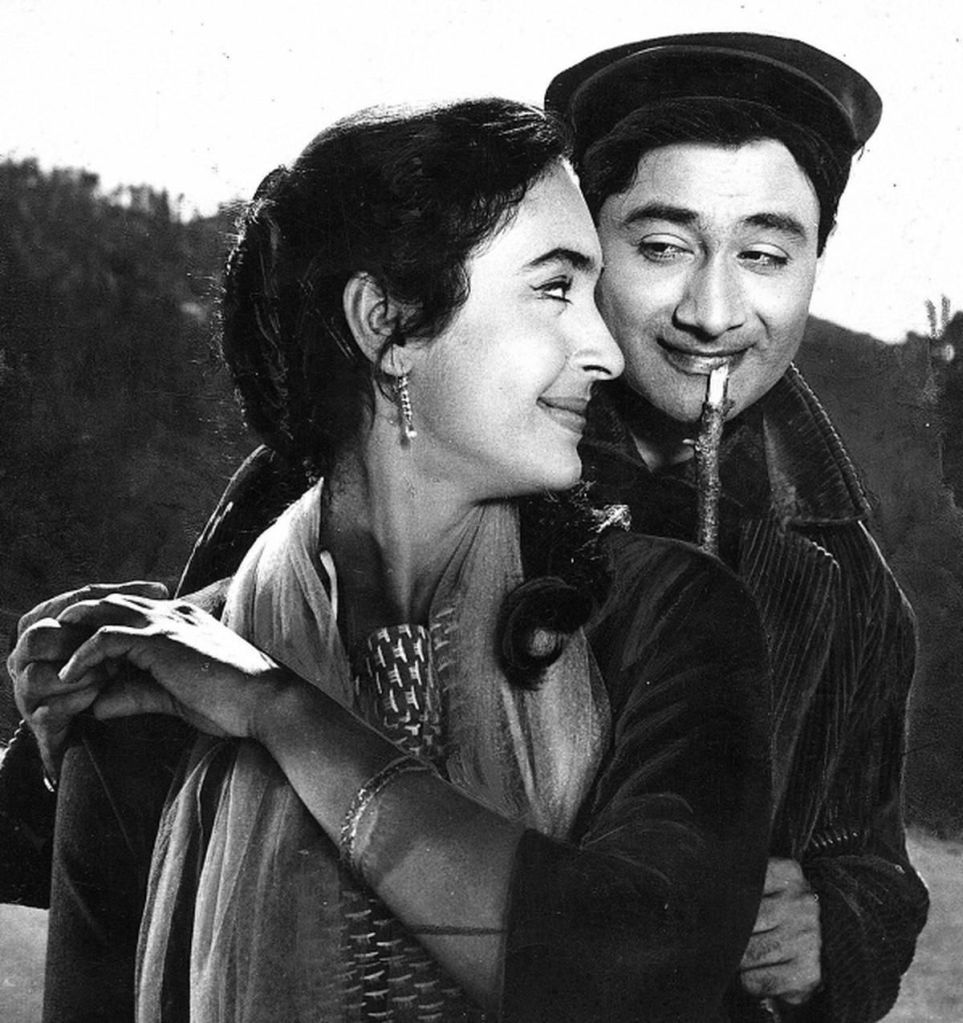
Dev Anand and Nutan together mean surefire chemistry. Dev Anand exudes boyish charm and looks totally besotted. He makes a confident suitor while Nutan could play a charming gamine too and, more important, was a comedienne par excellence. Dev has singing “Tu kahan yeh bata“, (“Where are you? Tell me”) wanders the moonlit streets of Shimla in search of Nutan, Rafi intonates loneliness and romance.
Memorable songs include “Dil ka bhanwar kare pukar” (“the bee of the heart calls out”), sung as Sulekha and Rakesh descend the winding stairs of Delhi’s 13th century Qutb Minar, and the surrealistic pictureization of the title duet Tere ghar ke samne ….ek ghar banaunga (“I’ll make my home…in front of your house”), in which Rakesh muses on his growing love for Sulekha, talent for song picturisation is best showcased in the number where Dev Anand visualises Nutan in his glass of whiskey, when he splashes a cube of ice into the glass. Nutan, who is presumably standing inside, literally shrinks away from it.
The charming old Delhi yesteryears with its winter sunlight, sprawling lawns, bazaars, majestic roads. Throughout the film, images of architecture and especially of home-construction serve to evoke the dual projects of modernization and nation-building.
Romantic film without a villain. This is one comical film without regular comedian. Innovative filming of the song on the stairs of qutub minar is a landmark.
Photos courtesy Google. Excerpts taken from Google.
 Writer Sunita