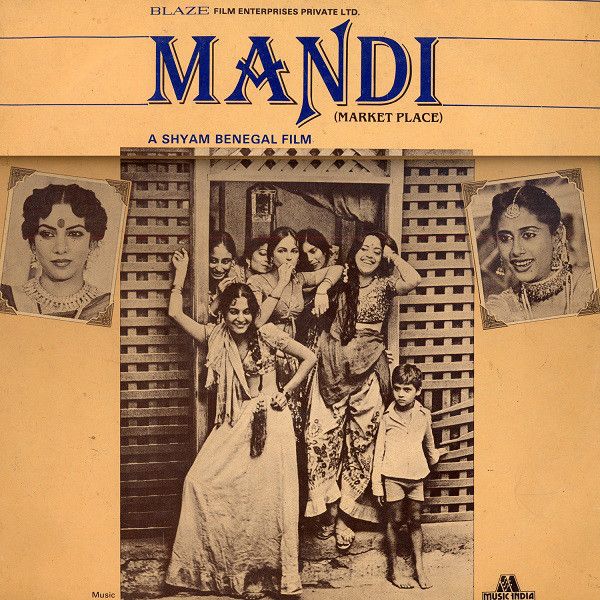
Mandi (Market Place) is a 1983 Hindi-language film directed by Shyam Benegal. This classic film is based on a classic Urdu short story ‘Aanandi’ by Pakistani writer Ghulam Abbas. The film narrates the story of a brothel, situated in the heart of a city, an area that some politicians want for its prime locality. The film is a satirical comedy on politics and prostitution.
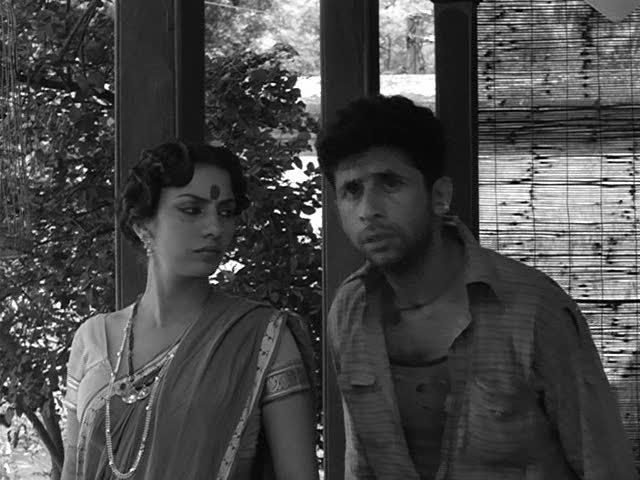
Rukmini bai (Shabana Azmi) is a madam who runs her brothel with a stern and demanding hand. She protects and looks after the brothel women as a mother figure. She empathizes with them when they are sad, looks after them turelessly when they are ill. The women in the brothel live in harmony. Aided by her melancholy houseboy, faithful helper Tungrus (Naseeruddin Shah), Rukmini is protective of her girls, especially Zeenat (played beautifully by Smita Patil), who is permitted to spend her days practicing her music and kathak.
Deaf and mute Phoolmani being sold off by her husband Shrikant less than a week after marriage is painful. Rukmini Bai who holds in her arms, craddles her, manages calms her down.
When a sanctimonious moralist, Shanti Devi (Gita Siddharth), flexes her political muscle in an attempt to drive the brothel out of town, Rukmini turns to her landlord Mr. Gupta (Kulbushan Kharbanda) for assistance, but finds in him only a conditionally. Caught in the crossfire is the town’s mayor, Agrawal (Saeed Jaffrey), who is under the powerful Shanti Devi’s thumb but also beholden to Rukmini. A dirty-minded photographer (Om Puri) who prowls around trying to snap naked pictures of the tawaifs; a police-wala who does his “night duty” at the brothel; Agrawal’s son, engaged to Gupta’s daughter but madly in love with Zeenat; Shanti Devi’s beleaguered assistant (Pankaj Kapur); a crazed and pious hermit (Amrish Puri) who shows Rukmini how to extract wishes from a variety of holy objects; and all the girls of the brothel (including Soni Razdan and Ila Arun), with their varying levels of satisfaction and loyalty to Rukmini.
Shabana Azmi as Rukmini Bai is stunning as the character, filled with warmth and intelligence Fiercely protective of Zeenat, whom she sees almost like her own daughter. Rukmani flits between angry snarls and obsequious smiles at a moment’s notice, one minute dripping with maternal concern and the next barking orders like a foreman. She cannot resist a mirror, interrupting herself often, whether mid-tirade, mid-sob, or even mid-prayer, to smooth a stray strand of hair. She flows through the different emotions of this word-wise woman with ease. With teary eyes she shouts at the audience that no matter that the men come into the brothel, the women are the ones who get blamed for indecency. Rukmini Bai says “Hashim Saheb to jante hain, ki hum hunar aur mehnat se Kalakar hain, par kismat ne hame kichchhad main patak dita”. Rukmini Bai’s pet Parrot is metaphorical representation of Zeenat. Both being compared to a cage golden bird. Smita Patil as Zeenat comes a charming performance. Shifting between innocence, she imbues the character with charm you can see why someone would fall instantly in love with her.
Aditya Bhattacharya as Sushil is filled with such innocence you know he is just a boy having his first love, and that love being a very innocent one. Their romance is cute. The two of them act like rebellious teenagers, which they are, no matter the circumstances. Naseeruddin Shah as Tungrus, the servant, has little lines, but the moments he sings a lot in his drunken state are filled with melancholy. One of the best things about this film is seeing all the cameos by actors who are still around, or were, and those that have gained proper notice decades later. There is Ratna Pathak Shah and Amrish Puri are in small roles, but they are instantly recognisable.
The film is really a showcase of splendid acting talent, as well as an interesting premise, one which has twists at the end. It can be a little boring, but it is not horrible by any means. It might not be for all, but I don’t regret watching it.
Mandi is full of powerful performanes by its members. It’s bitter take on realism, brutal honesty. It is also heavily laced with grim truths about human nature and it explores the play of politics and power.
Mandi‘s final scene is a little bit puzzling, but the ultimate message may be that degradation is in the eye of the beholder, and that perhaps the concealed hypocrisy of those who call themselves modern and upright is just as oppressive as the ancient traditions of the kotha. Whatever the true moral of this amorality tale may be, though, it is a terrific film.
The great director and screenwriter Shyam Bengal was a dazzling innovator and one of the harbingers of the film movement. Film makers of this movement were ‘keeping it real’ while wrapping it around highly talented actors and great stories.
The film won the National Film Award for Best Art Direction for Nitish Roy. It was selected at Indian Panorama at Filmostav, Bombay 1984, and was invited to the Los Angeles Exposition (FILMEX), the Hong Kong International Film Festival, and London Film Festivali 1983.
Mandi is the Hindi Film with the highest number of Filmfare Award winners (12) in the cast (Smita Patil, Shabana Azmi, Neena Gupta, Naseeruddin Shah, Om Puri, Saeed Jaffrey, Annu Kapoor, Satish Kaushik, Pankaj Kapur, Amrish Puri, Ila Arun and K. K. Raina). Additionally the film includes (4) Filmfare nominees in the cast (Kulbhushan Kharbanda, Anita Kanwar, Ratna Pathak Shah and Soni Razdan).
Photos courtesy Google. Excerpts taken from Google.
 Writer Sunita