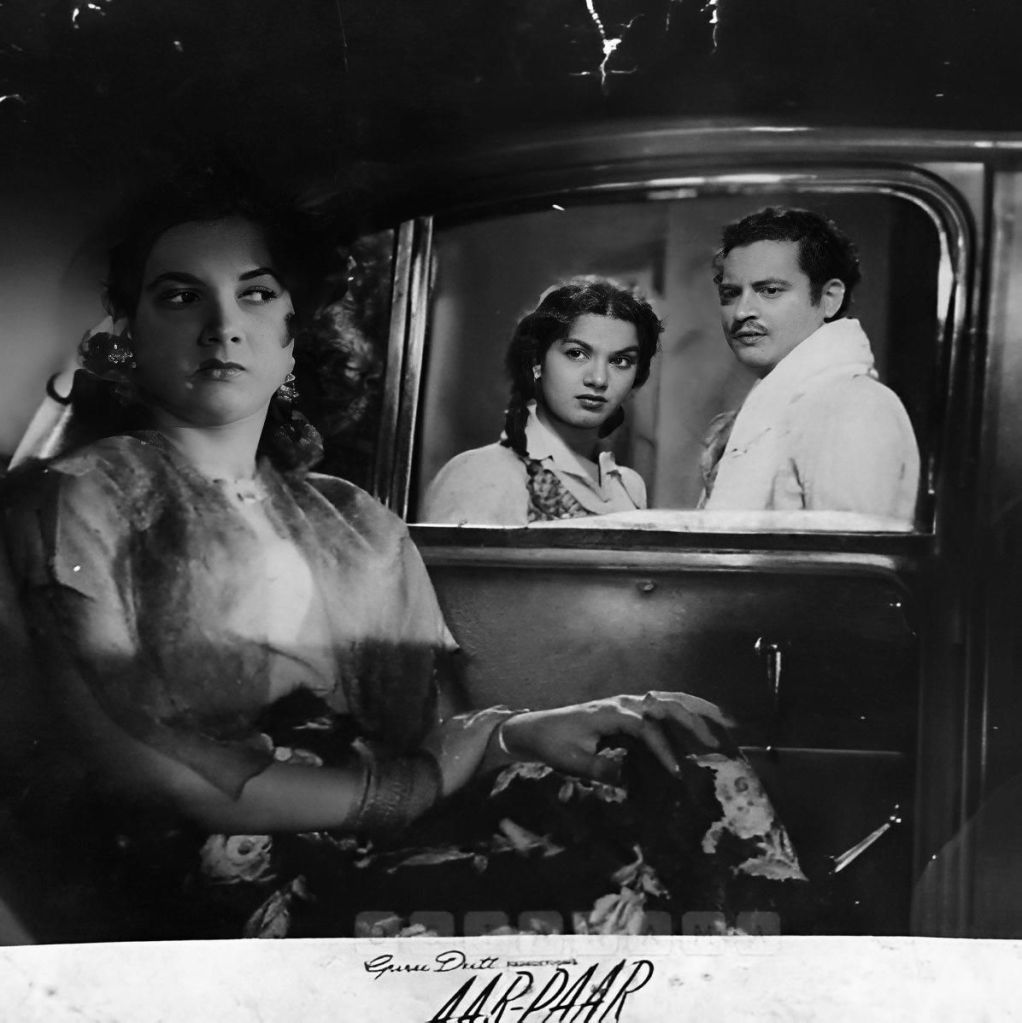
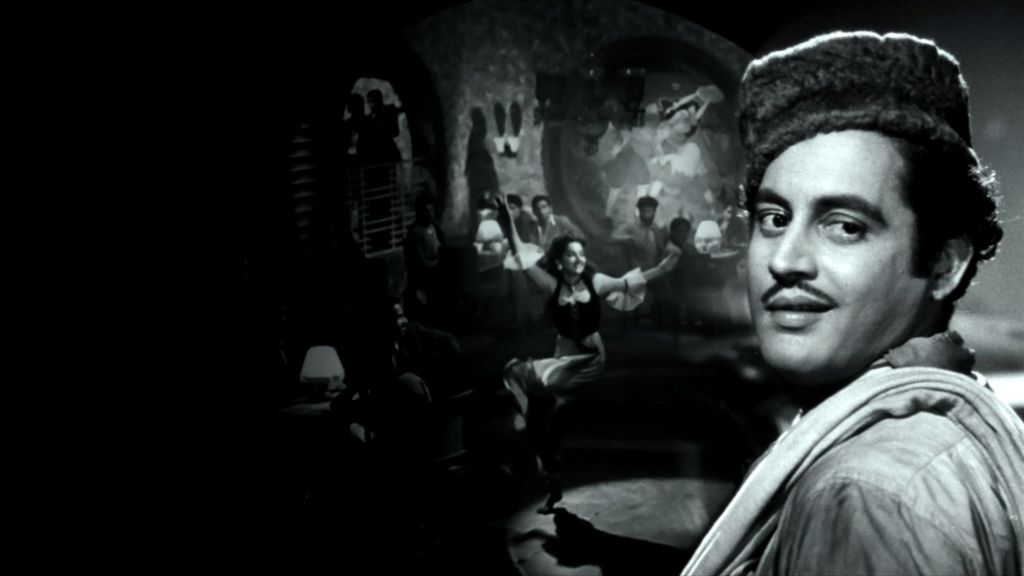
Aar Paar (This or That) is a 1954 Indian Hindi-language noir comedy film, directed by Guru Dutt. Guru Dutt’s brother Atma Ram assisted Guru Dutt in film direction. Film story is an ex-convict gets a job as a taxi driver to change his girlfriend’s prejudiced father’s view of him, and becomes embroiled with a criminal gang in the process.
Aar Paar, a thriller that explores both light and dark shades, opens with taxi-driver Kalu (Guru Dutt), a taxi driver in Mumbai who’s in jail for rash driving, being pardoned two months early for his good conduct. When he’s saying his farewells in prison, one of the other inmates asks him to go to a hotel and deliver a coded message to someone called Captain.
Kalu tries to get his old job back, but finds his former employer unwilling to give him a second chance. Even his own brother-in-law doesn’t want anything to do with him. He manages to get a job at a garage owned by Lalaji (Jagdish Sethi) where he also romances Lalaji’s daughter, Nikki (Shyama).
Guru Dutt makes a bold show of non-compliance with formula in Shakila’s character. She sheds a tear for the hero, but refuses to lay down her life for him or repent for her deeds at the end. Dutt also maintains a fast and furious pace like his protagonist’s speedster habits. But he shoots his scenes with care. Shyama looks happy as a lark in the breezy moments and wistful as a pained doe in the lovelorn scenes.
Nabendu Ghosh’s screenplay is brought to life by Alvi’s sparkling dialogues. Abrar Alvi became known as a writer who had his ear to the ground, almost literally. The beauty of Aar Paar’s dialogue is that every character speaks in a language that reflects where they’re from, their upbringing and education.
Aar Paar is a noir film that is infused with humour. Dutt’s friend and collaborator, V K Murthy, was behind the camera as usual, and the Dutt-Murthy combination’s play with light and shade was nothing short of magical. It is more evident than in Hoon abhi main jawan ae dil where Shakila, as the vamp, tries to convince the bar regulars, and perhaps herself as well, that she is still young, still desirable.
This was OP Nayyar’s first big hit, and he made the most of it with eight scintillating tracks. Their picturisation also stands testimony to Guru Dutt’s ability to use songs to aid his narrative. Kabhi aar kabhi paar is staged against a construction scene. The song also heralded Kumkum’s first screen appearance and was her first song. Arre na na na na na na tauba tauba introduced Johnny Walker, was picturised in Victoria Gardens, and Johnny Walker’s romantic interest in the film. Mohabbat karlo jee bhar lo plays out in the cab as it traverses the length and breadth of the city. Sun sun sun sun zalima is brilliantly choreographed in the closed confines of a real garage, while both Babuji dheere chalne and Hoon abhi main jawan highlight the smokey atmosphere in the bar.
Guru Dutt, manages to infuse his Kalu with an innocence behind his arrogant façade. Kalu is a mass of contradictions – he claims not to want much, but it is obvious that he is willing to overcome his scruples for a chance at luxury. He loves Nikki, but he needs her to be subservient to him.
Shyama is beautiful, and a wonderful actress, shown as a smart, spunky, ‘modern’ girl, who works in her father’s garage, and is perfectly capable of repairing cars. She suddenly turns into the archetypal Hindi film heroine, clad in salwar-kameezes, and engaged in making tea, and stitching, taking care of her father when he is ill.
Shakila, ostensibly the vamp, who is definitely more multi-dimensional than the heroine – she drinks, she dances in a club, she is relatively open about her role in seducing men to lose their wealth at the tables of chance. She is not the quintessential ‘whore with a golden heart’ who, for love of the hero, will sacrifice her life to save his.
It is written in an article by The Print, which states “the beauty of Aar Paar’s dialogue is that every character speaks in a language that reflects where they’re from, their upbringing and education. Instead of one-size-fits-all Hindi, there’s a bit of Punjabi, a bit of Parsi, inflections of Urdu, a smattering of street Bambaiyya, some heartland Hindi mixed with clumsy English. That attention to detail not only made the dialogue more authentic to the character, but also to the city of Bombay, long known for its cosmopolitan population.”
The film had very popular music. The album of the film was ranked #34 in the list of “Best Bollywood Albums of all time” by Film Companion. It was also named the “Best Album of Golden Era” for the year 1954 in the 7th Mirchi Music Awards, 2014.
Photos courtesy Google. Excerpts taken from Google.
 Writer Sunita