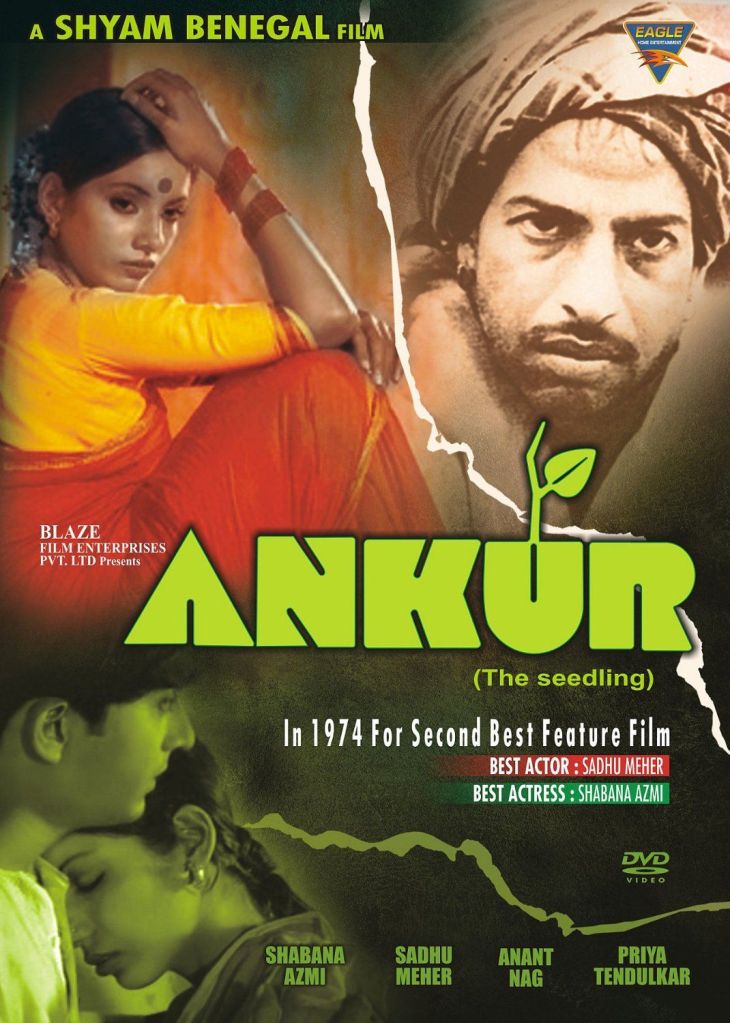
Ankur (The Seedling) is an Indian colour film of 1974. It was Benegal’s first feature film and also officially introduced, Shabana Azmi, Anant Nag and Priya Tendulkar to the Hindi silver screen. It belongs to the genre of Indian art films. The plot is based on a true story that occurred in Hyderabad, apparently in the 1950s. The film was shot almost entirely on location.
Ankur is a complex film that analyzes human behaviour in general and heavily stresses characterisation. The story revolves around two characters, Lakshmi and Surya.
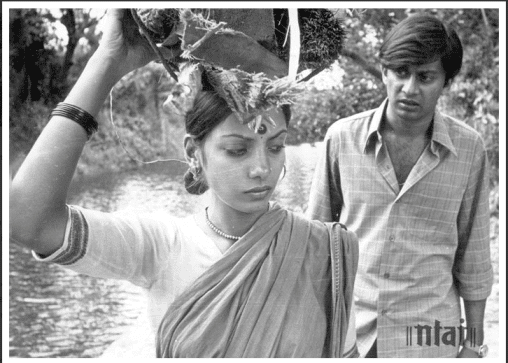
Surya (Anant Nag), the college-going son of a well-to-do farmer is forced into giving up his studies in order to look after the family property. He is married against his will to a young girl, Saryu (Priya Tendulkar). Bored and lonely in his farmhouse. Surya finds himself attracted to his maidservant Lakshmi (Shabana Azmi), wife of a poor deaf-mute potter Kishtaya (Sadhu Meher). Kishtaya is caught stealing Toddy and is punished. Humiliated, he runs away from the village. Lakshmi, now destitute gives in to Surya who promises to look after her. Their brief idyllic association ends with the arrival of Saryu who senses their past relationship and dismisses Lakshmi. Lakshmi, who is now pregnant, wakes up one morning to find Kishtaya beside her, giving her the money he has earned in his absence. He appears pleased at her approaching motherhood thinking the child to be his. Kishtaya goes to Surya asking for work and to tell him the good news. In a frenzy of conflicting emotions and fearing exposure, Surya beats him mercilessly. Lakshmi rushes to her husband’s rescue and tells Surya off.
Ankur marked a brilliant directorial debut for Shyam Benegal and a film which immediately gave him National prominence. The film is rightly regarded as one of the defining films of the Indian New Wave. The film is memorable for its engrossing details of rural life and its exposure of a feudal system that is both brutal and indifferent. It is primarily a study of human relationships with its strengths and weaknesses.
Benegal’s direction shows a fine understanding of the cinematic craft and a good control over storytelling. The women particularly are directed with much empathy and sensitivity and his handling of crowds suggest a seasoned virtuosity. The sounds of nature are omnipresent – the rustle of leaves in the wind, the chirruping of birds – and the colorful photography carries a warm golden glow. Benegal shows a keen eye for composition and his use of a tracking camera adds dramatic impetus to the script. The final act of rebellion when a small boy throws a stone at the landlord’s window foreshadows much of Benegal’s later work. The film also sees the use of Hindi with a ‘Hyderabadi’ accent being deployed by the characters keeping in tune with the area where the story is set.
The cinematography of the film was top notch. While keeping it realistic, Govind Nihalani experimented with his knowledge of photography and gave the audience a wonderful experience which they could relish.
Ankur takes a hard look at the entrenched caste system in our society. Ankur is a layered film and deals with issues of caste, privilege, hypocrisy, the ironies and vagaries of human nature. Lakshmi is a Dalit is starkly present in every scene. When Surya asks her to make tea and cook for him, she refuses, saying he can’t touch anything she has made.
Surya’s privilege as an upper-caste, educated, rich man is equally apparent, as he brushes away the issue of discrimination easily and orders people around to do work. The story centres on Lakshmi and Surya’s interactions, Lakshmi’s character arc is brilliant — she accepts the fact that she is downtrodden but even in the injustice of her everyday life, she holds her own. She grows close to Surya, she begins to feel guilty about being unfaithful to her husband. She does not desire the big things in life. She wants a child and her husband, and to earn an honest living.
Film is greatly aided by a sensational performance by Shabana Azmi in the central role of Lakshmi. It is hard to believe it is her first feature film. It is a sensitive, mature pyschologically penetrating performance and deservedly went on to win Shabana the National Award for Best Actress. Shabana, altering the script a little to suit her age and making Lakshmi a younger woman.
Shabana is prefectly supported by rest of the cast including Sadhu Meher – who also received a National Award for his performance, Priya Tendulkar and Anant Nag. Ankur kickstart Anant Nag’s acting career, but it also led to a fine working relationship between him and Benegal.
Being an Indian art film, Ankur is a “straight” feature without musical sequences. However, Surya plays parts of two records over the course of the film. The first recording consists of the third stanza of the song “Yahi To Hai Woh” by Mohd. Rafi from Solvan Saal (1958). The fourth stanza is then played in the background while Surya talks to Lakshmi.
Ankur won three National Film Awards and 43 other prizes, both in India and abroad. It was nominated for the Golden Bear at the 24th Berlin International Film Festival.
Photos courtesy Google. Excerpts taken from Google.
 Writer Sunita