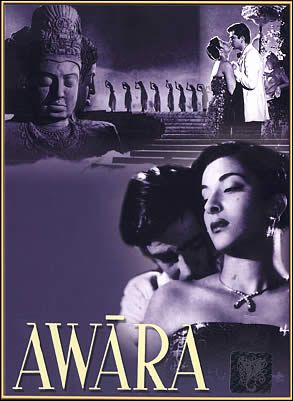
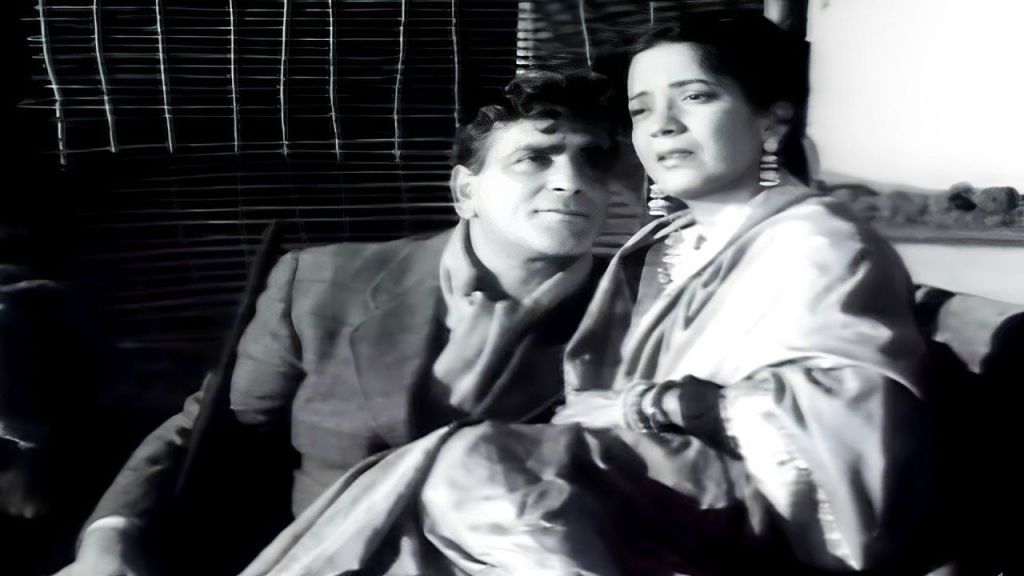
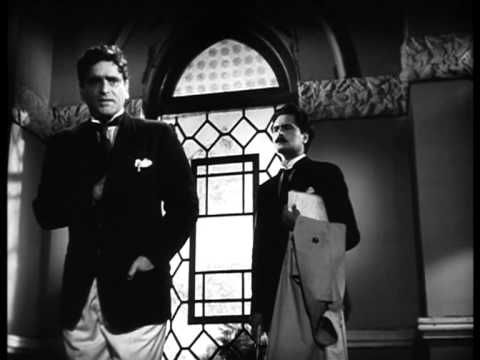
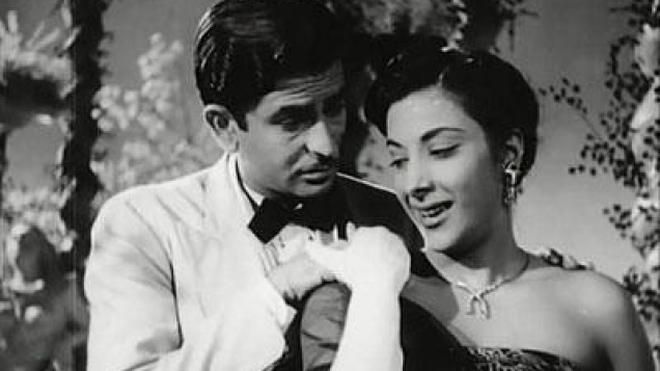
Awaara, known overseas as The Vagabond, is a 1951 Indian Hindi crime drama film, produced and directed by Raj Kapoor, and written by Khwaja Ahmad Abbas. It stars Raj Kapoor along with his real-life father Prithviraj Kapoor, as well as Nargis, Leela Chitnis and K. N. Singh. Film based, poor young man named Raj joins a criminal gang to feed his mother. But when he falls in love with Rita, he decides to reform himself for her.
Judge Raghunath (Prithviraj Kapoor) staunchly believes that a thief’s son will always be a thief and a good man’s son will always turn out good. In a series of flashbacks, the film showcases the stormy repercussions of this belief.
An advocate practising in Lucknow, Raghunath is devastated when his wife Leela (Leela Chitnis) is kidnapped by the dreaded dacoit Jagga (K N Singh). When Jagga learns of Leela’s pregnancy, he releases her after four days and changes his plan. Leela returns to her home. Raghunath is overwhelmed by the wagging tongues of his community. He concludes, in shades of the Ramayana, the seeds of doubt about the parentage of her baby are planted in his mind and he evicts her from his house. A hapless Leela gives birth to her son on the streets.
Unprotesting of her fate, Leela brings her son to Mumbai. A cute Shashi Kapoor in his only child’s role plays the young Raj. His mother wants him to be an advocate like his father, but Raj shows defiance. He secretly ruffles his hair after his mother has neatly oiled and combed it.
The ever present spectre of hunger sees Raj forsake his best intentions to stick to the straight and narrow and become victim of Jagga’s evil plans to prove his father’s doctrine wrong. Under Jagga’s tutelage, the judge’s son grows up to be the titular awaara (Raj Kapoor).
The sartorially well turned out Raj encounters rich lawyer Rita (Nargis) first as a possible prey for his thievery. When he discovers that she is his childhood friend, the two fall in love. He euphemistically tells her, “Rupaye ki len den hi hamara dhanda hai.”
Rita awakens Raj’s buried feelings of shame at his profession when she teasingly calls him junglee, while gambolling on the beach. In the famous sequence, Raj slaps her ruthlessly. While one wishes Rita could have been more assertive in the face of this violence, one presumes that for Raj, hitting her is like hitting himself. Raj’s real anger is at the unattractive side to himself that Rita’s love has made him acutely aware of.
There is now a tug-of-war for Raj’s soul, brilliantly expressed cinematically in one of the best dream sequences ever in the twin songs Tere bina aag yeh chaandni and Ghar aaya mera pardesi. In a surreal recreation of heaven and hell, Raj tries to escape the hell created by Jagga and climb the steps that lead him to Rita and salvation.
Raj’s reformation is not easy. He gets no work and Raghunath now an embittered judge and Rita’s guardian, continues to condemn him because he has no father. Rita, even after she learns that he is a thief, continues to stand by his side and exhorts him to change. Raj murders Jagga while attempting to save his mother from his clutches, Rita defends him in court. It takes a further tragedy before both father and son can expiate for their respective sins in a moving denouement.
The film expresses socialist themes, and blends social and reformist with the crime, romantic and musical melodrama.
Awaara’s success was an affirmation of Raj Kapoor’s gift for direction. It helped that he surrounded himself with exceptionally talented people like writers K A Abbas and V P Sathe, cameraman Radhu Karmakar and art director Achrekar.
Awaara‘s expensive looking sets and locations deserve mention even the prison cell is dungeon-like; and the interiors of Prithviraj Kapoor’s baroque mansion have to be seen to be believed. The dream sequence sets are elaborate. The entire song took three months to shoot.
The portrayal of romance is memorable. One of the scene is where a scruffy-haired Raj chases a beribboned Nargis on a boat till she warns that if he takes one more step towards her the boat will capsize. Nargis capitulates with Doob jaane do. It captures the spirit of abandon that characterises the rich Rita’s love for her awaara. Raj and Nargis together are magical. Nargis exudes vitality. She is exceptionally good in the party scene where she goes from delight to a dawning realisation that her lover is a thief without uttering a word.
In film, there are three genaration of the Kapoor family in the film. There is Deewan Basheshwarnath Kapoor in the film, who was the grandfather of Raj Kapoor (father of Prithviraj ) who plays the role of judge, who comes in the beggining of the film and in the end, then Raj Kapoor’s father, Prithviraaj and his young brother, Shashi Kapoor (Junior Raj Kapoor ) were also in this film. As a filmaker this was Raj Kapoor, his third film. This film got very famous in Russia.
Awaara was a sensation when it released in 1951, but its fame multiplied when it was released in Russia as Brodigaya in 1954, and two nations dueted to Awaara hoon. Raj and Nargis were feted wherever they went in Russia.
The music for this film was composed by Shankar Jaikishan while the songs were written by Shailendra and Hasrat Jaipuri. Awaara was the best-selling Bollywood soundtrack album of the 1950s. Kapoor’s picturisations also deserve a mention. During the club song Ek do teen, the decibels rise and fall as raucous noise and laughter drown out the song for a while.
The song “Awaara Hoon” (“I am a Vagabond”), sung by Mukesh with lyrics by Shailendra, became hugely popular across the Indian subcontinent, as well as in countries such as the Soviet Union, China, Bulgaria, Turkey, Afghanistan, and Romania. It was entered in the 1953 the Cannes Film Festival, where it was nominated for the Grand Prize of the Festival (Palme d’Or). In 1955, it was voted the best film of the year by readers of Turkish daily Milliye.
In his column for the Indian Express, Kapoor wrote, “In Awara I tried to prove that Vagabonds are not born, but are created in the slums of our modern cities, in the midst of dire poverty and evil environment.”
Photos courtesy Google. Excerpts taken from Google.
 Writer Sunita