
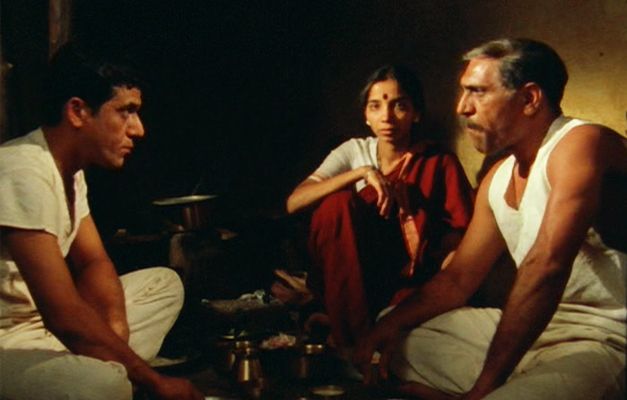

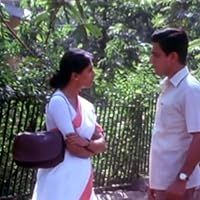
Ardh Satya (Half truth) is a 1983 film directed by Govind Nihalani and screenplay by Vijay Tendulkar. The film was based on the short story, ‘Surya’, by S. D. Panvalkar. Film based on a young policeman, forced to join the services by his father. A movie about a newly appointed police rookie deals with corruption, romance, and brutality.
The film opens at a party where Anant Welankar (Om Puri), a police officer, meets Jyotsna Gokhale (Smita Patil), a lecturer in literature at a local college. Anant is a sub-inspector with Bombay police. They seem to hit it off despite some initial skirmishing about ideology, and the friendship blossoms into a relationship.
Anant brings diligence, enthusiasm and a definite idealism to his job. But the job is harsh. There is a deep nexus between the local mafia, the cops and the corrupt politicians. Honest himself, Anant falls among the lower rungs of the police hierarchy and has very limited scope of authority on the state of affairs in his area.
When Anant arrests three common thugs, he is asked to meet with their boss, Rama Shetty, a don in the local mafia. Anant refuses all of Rama Shetty’s attempts to get his men out or to entice Anant to join him. Shetty decides to watch over Anant.
Some time thereafter, a local slum lodges a complaint about some ruffians who harass his wife. Anant finds them, locks them up, and administers a severe beating. As a fallout, the local MLA asks for Anant to be suspended.
Anant’s boss, inspector Haider Ali (Shafi Inamdar), explains to a mystified him that the ruffians were the MLA’s henchmen, providers of muscle during elections and political rallies. Anant is defiant with a clear conscience and ready to face a tribunal. Haider Ali explains that it will hardly get that far. Tribunals are either delayed indefinitely or rigged by corrupt politicians, and suspension is a permanent black mark on one’s record.
Anant is initially baffled but goes along with Haider’s plan to bring in Desai, a mediator or middle-man with connections in New Delhi, the “Centre” or national seat of power. Desai invokes higher powers to quietly cover up the matter. Anant’s morals are shaken by this incident.
When Anant finds one of Rama Shetty’s goons, badly beaten, burnt, and left to die. Anant brings the man into the hospital and takes his statement, naming Rama Shetty and others who inflicted this assault. Anant storms into Rama Shetty’s rooms to arrest him. But Shetty makes a simple phone call to a high-ranking cop who immediately asks Anant to back off. Anant cites the context and the overwhelming evidence but is still ordered to step away. Hapless Anant leaves, feeling intensely humiliated.
Haider Ali explains again, Rama Shetty plans to run for city council in the upcoming municipal elections and simply cannot afford to let a petty matter distract his ambitions. Anant is horrified and enraged and takes to drinking. His relationship with Jyotsna suffers. He is distraught when he is sent to provide security cover for Rama Shetty’s campaign rallies.
He suffers another career setback when he leads an assault team to capture a dangerous bandit in the hills outside Mumbai, and the credit for the arrest is ultimately handed to another officer. His relationship deteriorates further and he takes to drinking fairly heavily. When Jyotsna confronts him, he confides in her.
Things go completely out of control one night soon after as a small-time thief, accused of stealing a small radio, is brought into custody. Anant is very drunk, angry, and frustrated. He delivers a shocking and brutal beating to the thief – while continuing to drink – accusing him of “stealing the legitimate Rights of Others. The thief succumbs. The fallout leaves Anant suspended and facing charges of excessive force. Anant tries to invoke Desai again, but Haider Ali backs off, saying the situation has become too hot for most anyone. Haider Ali suggests, somewhat reluctantly, that perhaps the newly elected Rama Shetty can help.
After several days of deliberation, Anant decides to visit Rama Shetty in his betting den. Rama Shetty receives Anant cordially, and invites him into his inner sanctum alone – possibly aware that this righteous cop is finally on his knees before him. He agrees to help him only if Anant, in return, joins forces with him.
Anant, reflects upon his childhood. His father was a hard and violent man, quick to slap or beat his wife on the slightest pretext. When he graduates college, he expresses his desire to pursue higher education but is forced into joining the police force Every time he tries to do the right thing, arrest criminals and protect citizens, he comes face to face with the inevitability that he actually cannot help. The guilt of his childhood, muddled with the growing frustration of feeling the same feeling of helplessness, drives him to the brink of insanity.
Velankar gets inside the Chakravyuh, and he get beaten in the fight. When structures refuse to collapse, his morality, brick by brick, gets disintegrated. With his fall, the idea of absolute truth also gets broken. He has willingly challenged the system, shaken up the order, at the very centre of it, and is scared of his fate. His truth he believed in, is then only the half truth. The ardh satya.
In a powerful scene from the film, Velankar reads Dilip Chitre’s poem from which the film takes its title, his face, his voice, his body. The poem is his story.
The film is outstanding in the script, screenplay strongly written by Vijay Tendulkar, outstandingly directed by Govind Nihlani, dialogues by Vasant Dev. Om Puri in the role of Anant Velankar, Naseeruddin Shah in the role of Mike Lobo, a suspended cop, Sadeshiv Amrapurkar as Rama Shetty, a local mafia, Smita Patil as Jyotsna Godhale, Shafti Inamdar as Police Inspector Hider Ali, all of the gave as unforgettable performance.
The film has realistic dark Cinematography by Govin Nihlani. The music theme was composed by Ajit Verma. Film has an excellent presentation. Film features the theme of hatred, anger, and rage against the corrupt system.
Nihalani has been setting the audience up for the shock, a bottle crashes into the windows. The sound in film is that of the motorbike Anant uses in his police job. The sound of the motorbike with he astride it, riding across the streets of Mumbai wearing tinted glasses defines the evolution of the weak and cowardly young man.
Sadashiv Amrapurkar introduced in Ardh Satya played the hypnotic gang leader Rama Shetty. He had no airs, he was totally sincere and committed to his role. He understood his character and created a body language. He was playing a Kannada speaking character, and styled him accordingly. His hair short, gave him lungi and kurta. He added so much to the character and made it richer. The performance earned him awards, and much recognition.
Smita Patil, remains the symbol of all things pure and idealistic. She represents that breed of intensely committed women in starched cotton saris, who believe they can change the world through seminars and morchas. She is a middle class college lecturer, so she is bound to travel by buses.
Om Puri won National Film Award and Karlovy Vary International Film Festival for Best Actor. Film won Filmfare Award for Best Film, Best Director, Best Supporting Actor, Best Story, Best Screenplay and nominated for Best Actor.
Photos courtesy Google. Excerpts taken from Google.
 Writer Sunita