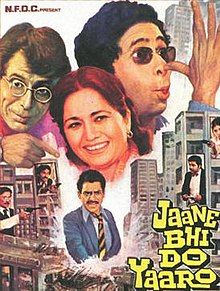
Jaane Bhi Do Yaaro (Let It Go, Mates) is a 1983 Indian Hindi language satirical black comedy film directed by Kundan Shah and produced by NFDC. It is a dark satire on the rampant corruption in Indian politics, bureaucracy, news media and business. Two photographers, who are employed by a magazine editor to expose the scandalous activities of the rich, come across corruption by a builder and accidentally photograph a murder.
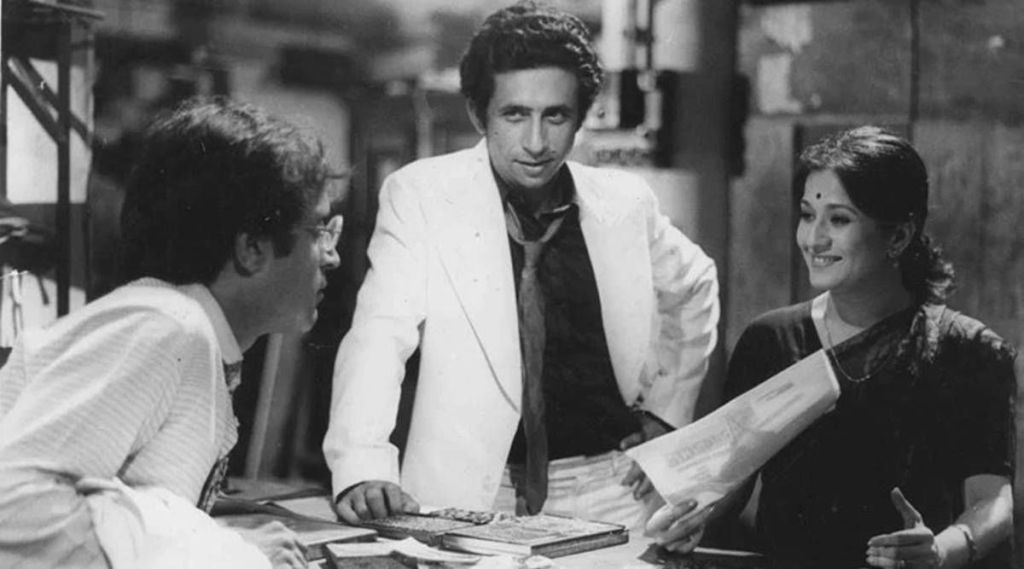
Professional photographers Vinod Chopra (Naseeruddin Shah) and Sudhir Mishra (Ravi Baswani) open a photo studio in the prestigious Haji Ali area in Bombay. After a disastrous start, they are given some work by Shobha Sen (Bhakti Barve), the editor of Khabardar magazine (khabar meaning news), a publication that exposes the scandalous lives of the rich and the famous. Impressed with their work, Shobha hires them for a story about the connection between the Municipal Commissioner D’Mello (Satish Shah) and Tarneja (Pankaj Kapur), a builder. They find Tarneja and his business rival Ahuja (Om Puri) working together to bribe D’Mello in order to win the contracts for construction of four fly-overs. Shobha asks the two photographers to create a rift between Tarneja and Ahuja. Tarneja to believe that Ahuja, with Shobha’s assistance, is trying to cheat him. Tarneja and Ahuja fight until Tarneja’s secretary Priya (Neena Gupta) arrives with Assistant Municipal Commissioner Srivastav (Deepak Qazir) and tells them that D’Mello has given the contracts to neither Tarneja nor Ahuja but to someone else.
Meanwhile, Sudhir and Vinod decide to enter a photography contest promising Rs. 5000/- and take photos all over the city. In one of the photos, they see a man shooting someone and after enlarging it, they realize that the killer is Tarneja. They return to the park where they shot that photo and eventually find out the crime scene. They find the body lying behind the bushes but before the duo can get to the body, it disappears, but they manage to retrieve one of a pair of gold cuff links.
Sometime later, Srivastav has become the new commissioner. Tarneja has built a fly-over, dedicating it to the memory of late D’Mello, who he says died of a terminal disease. Vinod and Sudhir attend the inauguration of the fly-over and discover the other cuff link there. They return at night and dig up the area and unearth a coffin containing the dead body of D’Mello. They take several photos but lose the corpse again. Shobha starts blackmailing Tarneja with the photos. He invites her, Vinod and Sudhir for dinner and plants a time bomb to kill them. The bomb explodes after the three escape. They later find out from the news that the fly-over built in the memory of D’Mello collapsed and the police suspect sabotage from Vinod and Sudhir. The duo learn about Shobha’s blackmail and disassociate from her.
Vinod and Sudhir find out that the body is with Ahuja who had, in an inebriated condition, carried the coffin to his farmhouse. They steal the corpse but not before Tarneja, Ahuja, Srivastav, Shobha and others also get involved resulting in a series of comic mix-ups.
Vinod and Sudhir show their evidence to the police. Tarneja threatens to take Ahuja, Shobha and Srivastav down with him. Srivastav brokers a deal between the four of them. He frames Vinod and Sudhir for the collapse of the bridge, jailing the two.
The story telling of this movie is amazing and how it transforms itself from comedy to drama to crime and corruption is enjoyable. The final scene where all they characters meet at a drama theater where Mahabharata is going on, they sabotage the drama and start to play different characters was the funniest scene to watch.
Kundan Shah gets together a talented ensemble, Naseeruddin Shah and Baswani shoulder the story. Supporting actors like Kaushik, Neena Gupta, Bhakti Barve and Om Puri pitch in efficiently. Pankaj Kapoor is hateful as the builder and it’ll be interesting to see the kind of work the actor takes on in future. Satish Shah is a riot as D’Mello. Cinematographer Binod Pradhan and editor Renu Saluja show immense promise. Film scene apart from a rib-tickling finale that is best discovered than described has Tarneja being interviewed by a bunch of journalists atop a newly-constructed skyscraper, while the camera captures the working class moving to and fro work. It’s a brilliant scene that remains consistent with the rest of the film.
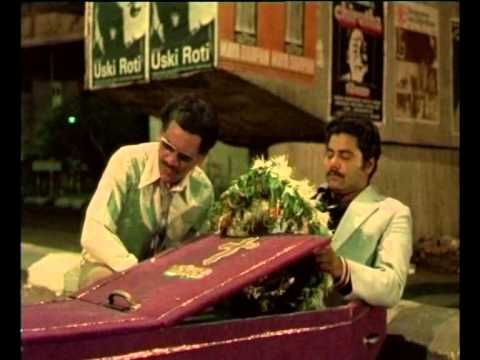
In one sequence the dead-drunk builder Om Puri driving into the coffin carrying the dead D’Mello thinking it’s another vehicle. The sequence is funny.
Bharve’s hard-nosed journalist’s act is astonishingly unladylike for those times. She uses her “charms” to outwit her male adversaries and to make Vinod putty in her hands.
Characters talk incessantly either about corruption or about being corrupt. The moral values in Indian politics and bureaucracy was already happening in a major way.
The film was not at once successful at the box office when released, but was eventually regarded as a cult classic, which is reflected in a recent comment by Indian Express that the film’s high recall value even after 37 years, is due to “it’s superb satirical depiction of the essential, timeless, human condition: supreme self-interest versus some moral or ethical anchor. What made the depiction particularly powerful was its setting: India of the early ’80s”.
Kundan Shah won the 1984 Indira Gandhi Award for Best Debut Film of a Director for his work. The film was part of the NFDC Retrospective at India International Film Festival in 2006.
Photos courtesy Google. Excerpts taken from Google.
 Writer Sunita