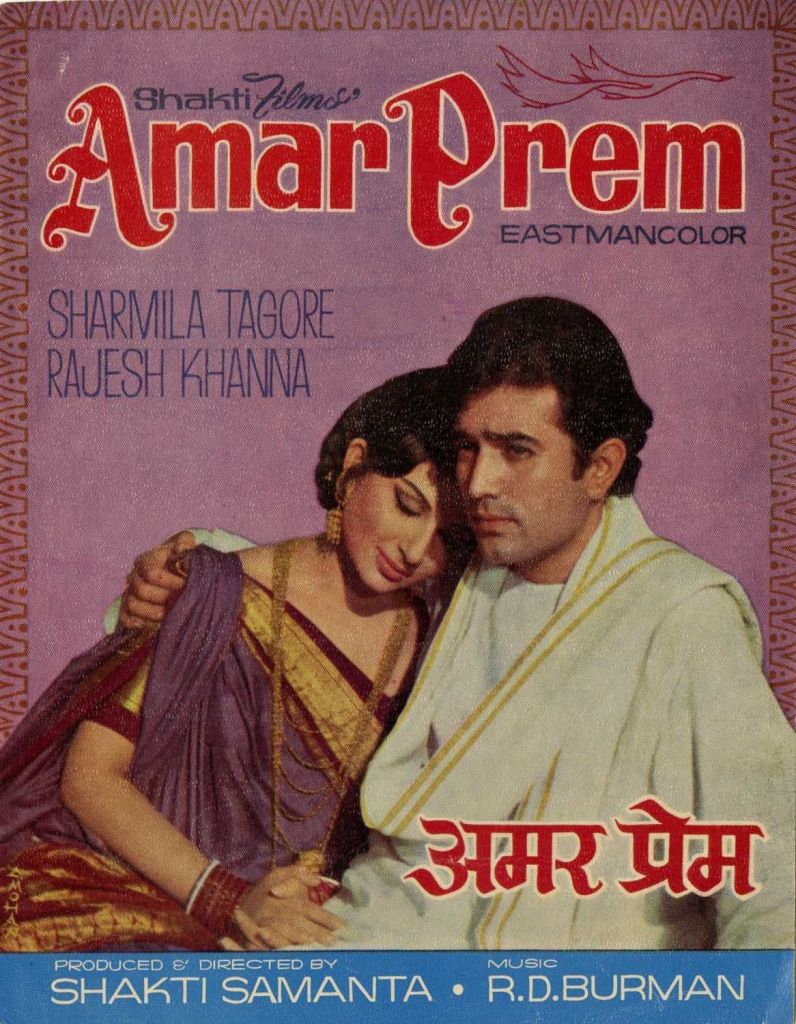
Amar Prem (Immortal Love) is a 1972 Indian Hindi romantic drama film directed by Shakti Samanta. It is a remake of the Bengali film Nishi Padma (1970), directed by Arabinda Mukherjee, who wrote screenplay for both the films based on the Bengali short story Hinger Kochuri by Bibhutibhushan Bandopadhyay.
The film portrays the decline of human values and relationships and contrasts it by presenting an illustrious example of a boy’s innocent love for a neighbourhood tawaif (courtesan). The movie is about a school boy, who is ill-treated by his step mother, and becomes friends with a courtesan neighbour.
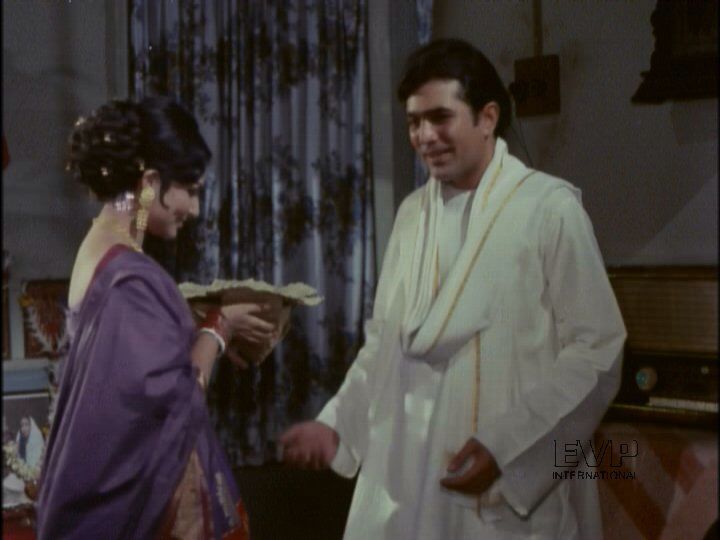
Pushpa (Sharmila Tagore) is expelled from her house by her husband and his new wife. When she refuses to leave, her husband beats her and throws her out. She goes to her mother for help, but her mother too disowns her. When she tries to commit suicide, she is sold to a kotha (brothel) in Calcutta by her village-uncle, Nepal Babu (Madan Puri). On her audition at the kotha, Anand Babu (Rajesh Khanna), a businessman seeking love, is attracted by her singing. Anand Babu is unhappily married and lonely and becomes her regular and exclusive visitor as love blossoms.
Later, a widowed man with his family, from the same village as her, moves in close to Pushpa’s place. The new neighbour’s son, Nandu, does not get any love at home, as his father works all the time and his stepmother does not care about him. Nandu’s father learns about Pushpa’s new life and forbids her from interacting with him and his family as he fears what people would say. However, Pushpa starts treating Nandu as her own son when she realises that he is mistreated at home, and often goes hungry. Nandu also comes to love Pushpa and starts to regard her as his mother. He visits her every day and comes upon Anand Babu, who also becomes fond of him becoming a father figure, calling him Pushpa’s son, seeing the way Pushpa loves the child.
One day, Anand Babu’s brother-in-law comes to see Pushpa and demands that she tell Anand Babu to stop visiting her. Pushpa agrees and she turns Anand Babu away when he comes to see her. It is then that the businessman realises that he is in love with Pushpa. When Nandu suffers from fever and his treatment is too expensive, Pushpa asks Anand Babu for help and he secretly finances the treatment and does not let anybody know. When the doctor asks him why is he so keen on helping Nandu, he replies some relationships have no names. However, when Nandu’s father asks the doctor who paid for the treatment, the doctor says that his mother did. Then Nandu’s father discovers that it was Pushpa who saved her son’s life and he thanks her and gives her the sari that he had bought for his wife, telling her that it was a gift from a brother to a sister. A touched Pushpa accepts.
Nandu’s family has to move to the village and Nandu plants a sapling of night-flowering jasmine at Pushpa’s home, making her promise to always take care of it. Pushpa cries and agrees.
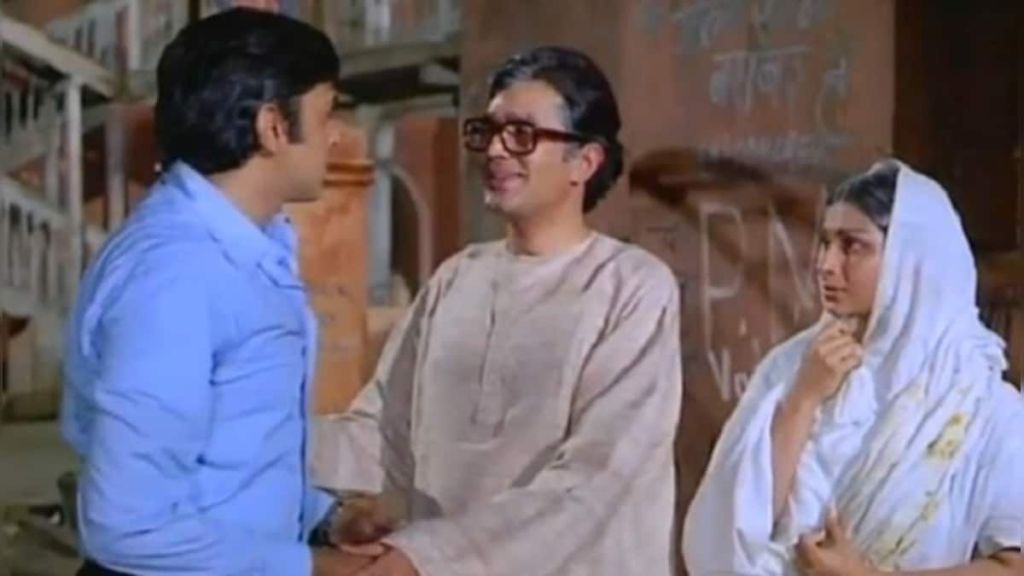
Several years later, Nandu grows up to become a government engineer posted in the same town. Anand Babu meets Pushpa, now working as a maidservant who is ill-treated and they both reconcile. Nandu unsuccessfully searches for her and gives up after inquiring in the neighbourhood. Nandu’s son gets sick and they go to the same doctor. Meanwhile, having met Pushpa, Anand Babu decides to catch up with all his old friends and meets the doctor. During the conversation, he reveals that he has stopped drinking and visiting brothels once he left Pushpa. He also tells him that he is now divorced/separated due to his wife’s partying ways, but is finally at peace and is happy with Pushpa’s love and affection in his heart. They talk about Nandu and the Doctor informs him that Nandu is in town. Nandu meets Anand Babu when he comes to meet the doctor to ask regarding the medicine, who takes him to meet Pushpa. Both of them, unable to see Pushpa ill-treated, stand up for her and in the end Nandu takes Pushpa home with him, like a son who is reunited with his long lost mother with Anand Babu looking on, crying happily.
Samanta asked Mukherjee who also wrote Nishi Padma‘s screenplay to write a Hindi version, with Ramesh Pant, The famous dialogue, “Pushpa, I hate tears” though also there in the original, was merely part of a dialogue, Both the writers of the film won Filmfare Awards in their respective categories.
The film was shot in Eastmancolor, entirely at Natraj Studios in Mumbai, including the famous song, Chingari koi bhadke. Film tells the story of relationships that have no name but the power to break hearts.
Anand and Pushpa’s love is never labelled, but is shown beautifully through small touches, such as the samosas and kachoris he starts bringing around for Nandu. This is another relationship that has no name and doesn’t need one. Anand doesn’t care what people think. When he sings the “Kuch Toh Log Kahenge, Logon Ka Kaam Hai Kehna“, a simple idea that becomes a way of life.
The song “Chingari Koi Bhadke” comes when Pushpa has just found out that her mother has been dead for a long time and no one told her. Anand sees her devastation and decides to take her out for a boat ride on the Hooghly, with the city’s iconic Howrah Bridge shimmering softly in the background.
One of the movie’s most heartbreaking song, the movie opens with S.D. Burman singing Doli Mein Bithai Ke, while Pushpa, her back burnt with iron rods courtesy her husband, is walking to her mother’s house. The idea of a doli or wedding palanquin is turned on its head as she walks, alone and injured, away from her husband, while Burman sings of broken dreams.
Years later, Pushpa, no longer a prostitute, works as domestic help and is routinely, again abused. In a strange twist of fate, one of the men staying in the complex where she works is her now blind, widowed, ailing husband who had abused, tortured and evicted her. His death brings about a strange sort of closure for her; when she breaks the wedding bangles that she never took off in all these years, Doli Mein Bithai Ke plays again.
Pushpa is now a greying, bent and constantly-abused dishwasher at a lowly restaurant. The film climaxes with a series of events vindicating Pushpa’s struggle, sorrows and sacrifices. Pushpa’s now-blinded husband dies in her arms. Anand babu, who has left ‘wine, women and wife’, returns to her life and orchestrates a meeting between Pushpa and Nandu, now a well-to-do engineer (Vinod Mehra). Nandu takes Pushpa home, symbolically, on the day when other people are taking Durga Ma’s idols home.
The score and soundtrack for film was composed by R. D. Burman, with lyrics by Anand Bakshi. S. D. Burman to sing “Doli Mein Bithai Ke Kahaar” in his typical bardic voice, was to become one of the most memorable songs of his career as a playback singer.
Film contends that true emotional fulfillment need not necessarily lie in a fructified relationship which ends with a marriage and the average two kids; it can also be found in a nameless bond between a man and a woman that transcends convention.
Samanta’s strong point is his ability to draw us directly into his characters’ lives. Though he resorts to a surfeit of cliches in establishing Pushpa’s relationship with Nandu, he handles Pushpa’s interdependent relationship with Anand Babu with commendable ease and maturity.
Film won Filmfare Awards for Best Screenplay, Best Dialogue, Best Sound Design and nominated for Best Actor, Best Actress, Best Music Director, Best Lyricist for song ‘Chingari Koi Bhadke’, Best Male Playback Singer.
Photos courtesy Google. Excerpts taken from Google.
 Writer Sunita