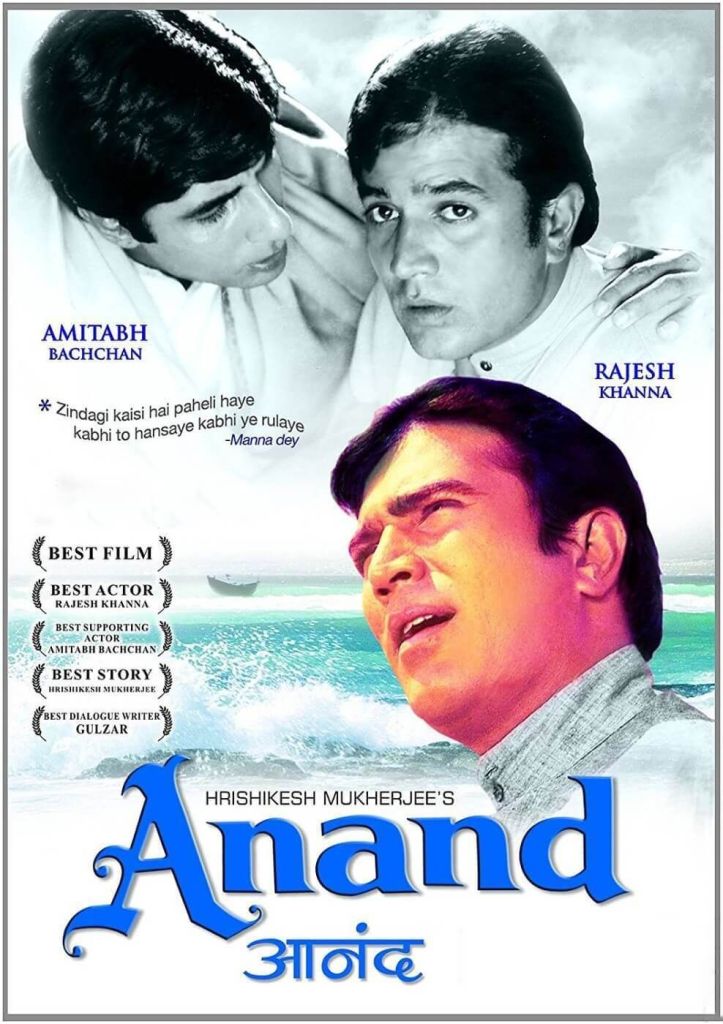
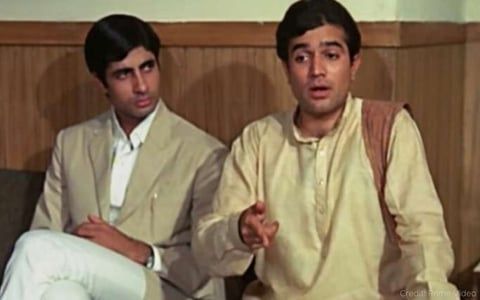
“Anand” (Joy) is a 1971 Indian Hindi-language film co-written and directed by Hrishikesh Mukherjee, with dialogues by Gulzar. The film stars Rajesh Khanna in the titular role, with a supporting cast that includes Amitabh Bachchan, Sumita Sanyal, Lalita Pawar, Ramesh Deo, and Seema Deo. The story revolves around a terminally ill man named Anand Saigal, who wishes to live life to the fullest despite knowing his end is near.
The narrative begins at an award ceremony in Mumbai, where Dr. Bhaskar Banerjee (Amitabh Bachchan) is honored for his first book, “Anand.” Bhaskar shares with the audience that the book is based on his diary entries about his friend Anand and begins recounting their time together.
Dr. Bhaskar Banerjee, an oncologist, is a dedicated doctor who often feels disheartened by his inability to cure all his patients. A realist and workaholic, Bhaskar is deeply affected by the suffering and poverty around him and refuses to treat the imaginary ailments of the rich. His friend, Dr. Prakash Kulkarni, on the other hand, treats wealthy patients for money and uses his earnings to help the poor.
One day, Dr. Kulkarni introduces Bhaskar to Anand Saigal (Rajesh Khanna), a cheerful, lively man who instantly lifts the spirits of everyone around him, including the usually dour Bhaskar. Despite being diagnosed with lymphosarcoma of the intestine, a terminal form of cancer, Anand remains upbeat and determined to spread joy in the little time he has left. His infectious positivity slowly begins to change Bhaskar’s outlook on life.
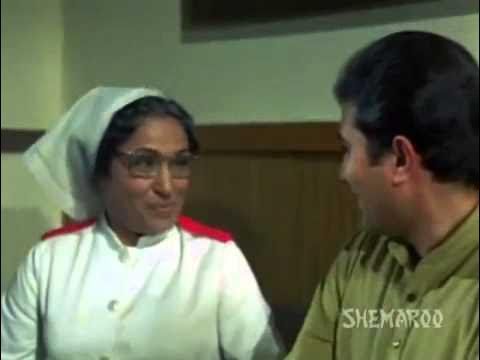
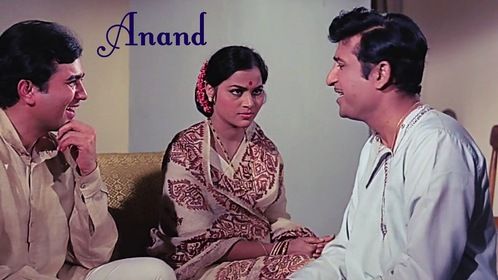
Anand befriends many people during his brief stay in Mumbai, including Isa Bhai Suratwala (Johnny Walker), a theater actor, and the stern but kind-hearted Mrs. D’sa. Anand’s presence also helps Bhaskar open up about his feelings for Renu, a woman he once treated, and he even facilitates their relationship, showing his selflessness and desire to see others happy.
As Anand’s condition worsens, he chooses to spend his remaining days outside the confines of a hospital, savoring every moment. He records a tape with Bhaskar, capturing their friendship and laughter. In his final moments, surrounded by his friends, Anand passes away, leaving behind a legacy of joy and the memory of a life lived to the fullest.
Analysis and Reception:
“Anand” is a masterpiece of Indian cinema, showcasing Hrishikesh Mukherjee’s storytelling prowess and Rajesh Khanna’s extraordinary performance. The film beautifully balances moments of joy, humor, and deep emotion, making viewers laugh and cry in equal measure. The dialogues, many of which have become iconic, emphasize the insignificance of death compared to the value of living a meaningful life.
One of the film’s most memorable lines, “Babumoshai, zindagi badi honi chahiye, lambi nahi” (“Life should be big, not long”), encapsulates Anand’s philosophy of embracing life fully. The supporting characters, such as Mrs. D’sa, Isa Bhai, and Dr. Kulkarni, are well-crafted and add depth to the narrative.
The music, composed by Salil Chowdhury with lyrics by Gulzar and Yogesh, complements the film’s themes perfectly. Songs like “Maine Tere Liye Hi Saat Rang Ke Sapne,” “Kahin Door Jab Din Dhal Jaye,” and “Zindagi Kaisi Hai Paheli” capture the essence of Anand’s optimism and zest for life.
“Anand” won several awards, including the Filmfare Award for Best Film in 1972, and continues to be celebrated as one of the greatest films in Indian cinema. In 2013, it was listed in Anupama Chopra’s book “100 Films To See Before You Die,” further cementing its status as a timeless classic.
Photos courtesy Google. Excerpts taken from Google.
 Writer Sunita