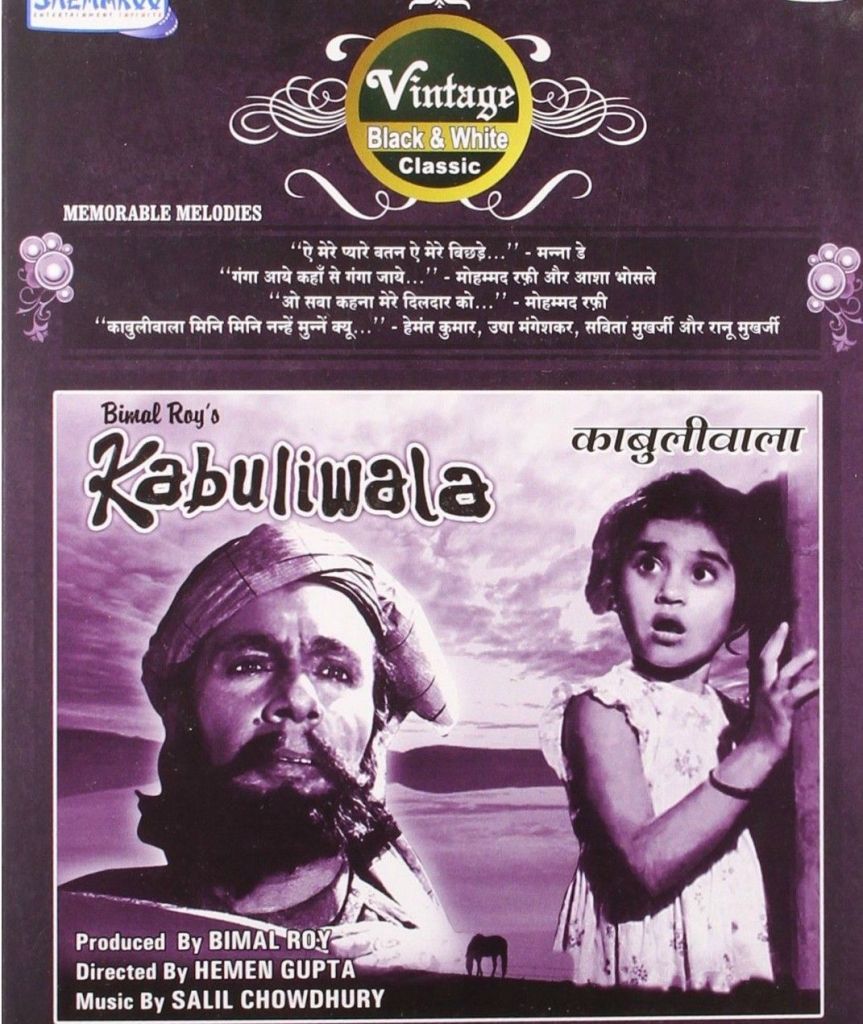
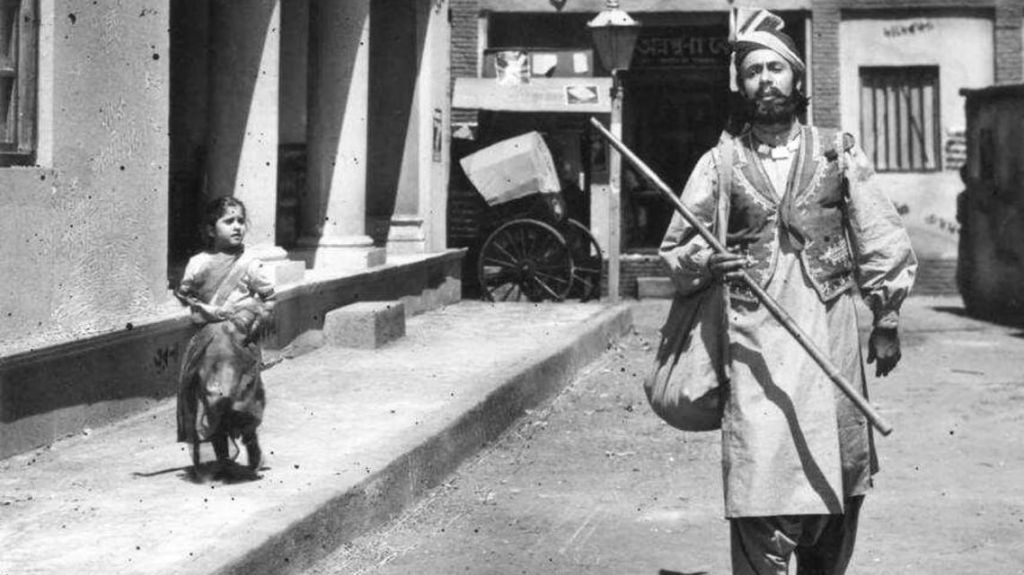
Kabuliwala is a 1961 Hindi film directed by Hemen Gupta, produced by Bimal Roy, based on the 1892 short story “Kabuliwala” by Bengali writer Rabindranath Tagore.
The story begins in Afghanistan, where a poor Pathan, Abdul Rahman Khan (Balraj Sahni), lives with his elderly mother and his little daughter, Ameena (Baby Farida). Khan is a widower and has had to mortgage his land and home to pay for Ameena’s treatment after a long illness. He realizes that the only way he can earn money to pay off his debts is to travel to India and take up some trade there. Ameena insists she will go along with her father to India, so her grandmother advises Khan to leave at night while Ameena is asleep. Khan takes a memory of Ameena with him, an imprint of her little hands on a piece of paper.
When Khan arrives in Kolkata, he befriends a little girl named Mini, who reminds him of his own daughter back home. Abdul visits Mini regularly, bringing her gifts and sharing stories, forming a deep bond with her that helps ease his homesickness. The friendship between Khan and Mini develops quickly; he adores the little girl, and when she informs him that her birthday is around the corner, he promises to buy her bangles as a gift. Mini’s mother and father, though embarrassed, comply, and Khan, obviously hurt but acquiescent, goes off.
Nobody realizes that Mini has missed Khan terribly and has kept aside a share of her birthday sweets for him. The next day, when he still doesn’t turn up, she goes off looking for him. When Mini’s absence is noticed, the household swiftly reaches a state of near-panic. Rama Mini’ mother is certain Khan has kidnapped her daughter. Mini’s father goes rushing off to the neighbor’s house, to the home of the doctor (Tarun Bose), and others, looking for his daughter. Khan, overhearing that Mini has gone missing, sets off to search for her on his own.
It has begun pouring rain in the meantime, and Khan takes shelter in a pavilion. When the rain finally stops, he discovers Mini lying asleep—drenched—under the staircase leading up to the pavilion. Bhola, who has been telling everybody that the Pathan has abducted poor Mini, sees Khan with Mini in his arms and raises the alarm.
Khan is thrashed by a mob, but Mini’s father, who arrives just in time, manages to rescue him. Mini, now burning with fever, is taken home. The doctor is fetched. He gives her medicine but is worried: she’s critically ill. Khan, who discovers the truth from Mini’s father, is distraught. Mini’s father, looking out, sees the Pathan on the pavement opposite their home, praying for Mini’s life. Khan keeps up an all-night vigil on the pavement, and the next morning—when Mini is much better—he comes to say hello to her from the window.
But trouble erupts all of a sudden a few days later. Khan has sold some goods on credit, including a relatively expensive shawl. When he goes to the owner’s home to demand payment, the man denies having bought anything from Khan. A quarrel breaks out. Khan loses his temper, pulls out a dagger, and stabs the man—and is immediately arrested, resulting in Abdul being imprisoned.
After several years, Abdul is released from prison and returns to Mini’s house, hoping to see her again. However, Mini has grown up and does not recognize him. Her father, moved by Abdul’s story and his longing for his own daughter, gives him money so he can return to Kabul to reunite with his family.
Kabuliwala is a touching portrayal of a father’s love for his child and the universal nature of parental affection, regardless of nationality or background. It also provides a poignant commentary on the immigrant experience and the pain of being away from one’s family while facing prejudice and suspicion in a foreign land.
Directed by Hemen Gupta, the film captures the essence of Tagore’s original story, highlighting the themes of love, loss, and the struggles of being an outsider. Film serves as a reminder of the power of kindness and empathy in overcoming cultural differences and the enduring strength of human connections. It’s a simple story, but well depicted and highly recommended. The setting very effectively brings to life Calcutta in a slower, quieter era when little girls wore saris, when the portrait of King George hung in courtrooms, and when people had the time to sit and chat with a child about imaginary elephants.
The characters are well-portrayed. Sahni’s Abdul Rahman, the two other characters Mini (Sonu) and her father (Sajjan). Sajjan, quiet, sensitive, with a sense of humor, is perfect as her father—and their interactions, with Mini sitting under his table at the novel he’s writing, are to be treasured.
Balraj Sahni’s performance as Abdul Rehman Khan is particularly moving, portraying the character’s deep emotions and unwavering affection for both Mini and his daughter. He’s at his best when he’s restrained; the scene where he presses the sleeping Ameena’s hands to a sheet of paper is hauntingly touching.
The music, composed by Salil Choudhary, is beautiful and complements the film’s emotional depth. “Ae Mere Pyaare Watan,” one of Manna Dey’s best songs, is particularly moving and adds to the film’s emotional impact.
Photos courtesy Google. Excerpts taken from Google.
 Writer Sunita