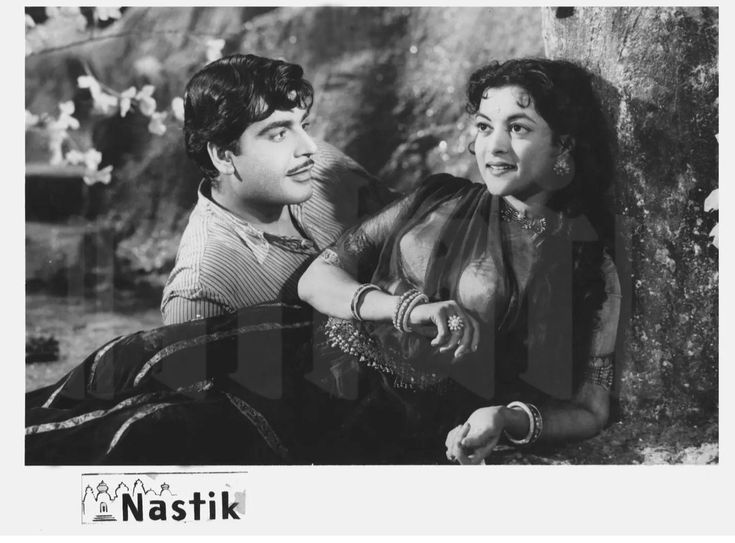


Nastik (The Atheist) is a 1954 Hindi-language crime drama film written and directed by I. S. Johar, produced by Filmistan Ltd., with cinematography by Dronacharya and choreography by Lachhu Maharaj and Narendra Sharma. The film begins with a philosophical verse from Kabir and is set against the backdrop of the Partition of India, using actual footage of refugees to depict the ensuing violence and turmoil.
The story follows Anil (Ajit), who loses his faith in God after his parents are murdered during the Partition riots. Fleeing with his sister Kamala and younger brother Munna, they seek shelter in a temple but are turned away by the priest Tulsiram (Ulhas), who refuses to help the dying Munna. Anil’s desperation leads to a confrontation with Tulsiram, resulting in Anil’s imprisonment. While Anil is in jail, Munna dies, and Kamala is forced into prostitution by Vinod Kumar (Raj Mehra). Upon his release, Anil discovers his brother’s death and his sister’s plight, leading to Kamala’s suicide out of shame. These events solidify Anil’s atheism and his vow for vengeance against Tulsiram and Kumar.
As Anil and his friend Joker (I. S. Johar) pursue Tulsiram on a pilgrimage, Anil encounters Rama (Nalini Jaywant), Tulsiram’s daughter. Seeing an opportunity for revenge, Anil manipulates Rama into marrying him, knowing that her father would never approve. After spending a night together, they are separated, and Rama later discovers she is pregnant, believing Anil to be dead.
Anil, still driven by his quest for revenge, adopts the guise of a god-man, Babaji. When Rama brings their sick child to Babaji for healing, Anil realizes the depth of his actions. The child’s recovery and Rama’s devotion lead Anil to a profound transformation, and he regains his faith in humanity and God.
The film critiques the hypocrisy of religious figures and societal norms, especially concerning caste discrimination, exemplified in a scene where Anil defends an untouchable boy from abuse by a priest. The film’s bold stance led to its initial ban, but it was later released in the 1960s and became a box-office success, running for fifty weeks (Golden jubilee).
The music, composed by C. Ramchandra with lyrics by Kavi Pradeep, features the iconic song “Dekh tere sansaar ki haalat kya ho gayi bhagwan
Kitna badal gaya insaan (See what has become of your world, O lord How much man has changed),” which poignantly comments on the moral decline of humanity.
Photos courtesy Google. Excerpts taken from Google.
 Writer Sunita