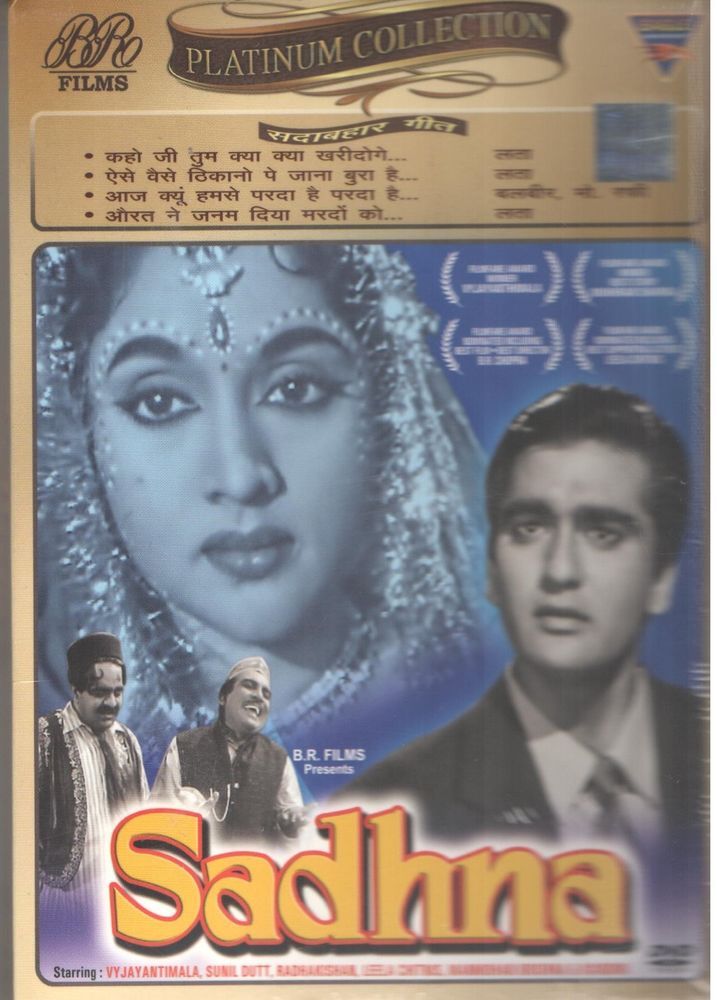
Sadhna (Realize) is a 1958 black-and-white Hindi film aimed at social reform, produced and directed by B. R. Chopra. The film stars Sunil Dutt and Vyjayanthimala in the lead roles. The story, screenplay, and dialogue were penned by Mukhram Sharma. The film addresses social reform, focusing on the rehabilitation of prostitutes and their integration into society, a bold and controversial topic for its time.
The story centers on Mohan (Sunil Dutt), a college lecturer who lives with his aging mother (Leela Chitnis). The film opens with Mohan delivering a lecture on the classic play Mṛichchhakatika, which tells the story of the nobleman Charudatt and his love for Vasantsena, a prostitute. This narrative appears to leave a deep impact on Mohan, as it mirrors his own unfolding story.
Mohan’s mother wishes to see him married before she dies. To fulfill her wish, Mohan’s neighbor, Jeevan (Radhakrishan), brings Rajni (Vyjayanthimala), a local prostitute known as Champabai, to pose as Mohan’s fiancée.
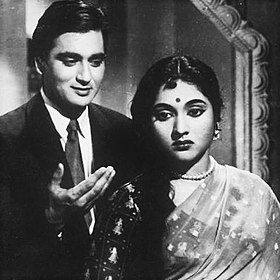
Initially, Rajni is indifferent to Mohan and his mother but is deeply moved by the kindness and respect they show her. This experience leads her to yearn for a life of dignity and respect. Over time, both Mohan and Rajni develop genuine feelings for each other.
When Mohan learns about Rajni’s true identity, he is devastated but eventually understands her circumstances and the coercion she faced. He decides to accept her for who she is, not for what she was.
The film’s climax deals with societal confrontation and Rajni’s eventual acceptance by Mohan’s mother, who realizes Rajni’s sincere transformation and love for Mohan. The story concludes on a hopeful note, with Rajni being welcomed into the family, symbolizing redemption and social acceptance.
Film was praised for its realistic portrayal of a sensitive topic and Vyjayanthimala’s powerful performance, which added depth and nuance to the character of Rajni. Her performance was praised for its depth and versatility, portraying a woman who navigates complex social dynamics while striving for redemption and acceptance. She was praised by the reviewer, whose performance was described as “gorgeous when she entertains the clients at her kotha” and “stunningly restrained when she assumes the character of a prospective wife”.
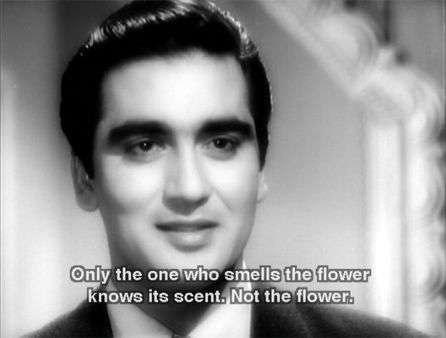
Sunil Dutt is convincing as the large-hearted lover. Radhakishen is a casting coup of sorts — his laced-with-comedy villainy provides a perfect antidote to the otherwise sombre tone of the film.
The hero of the show is undoubtedly Sahir Ludhianvi. Each song penned by him fits the situation like a glove. His lacerating lyrics familiarise us with the terrain of Champa’s mindscape. The film’s soundtrack, composed by Datta Naik was critically acclaimed.
Songs like “”Aurat ne janam diya mardon ko, mardon ne usse bazaar diya“” stand out for their powerful lyrics, which critique the commodification of women.
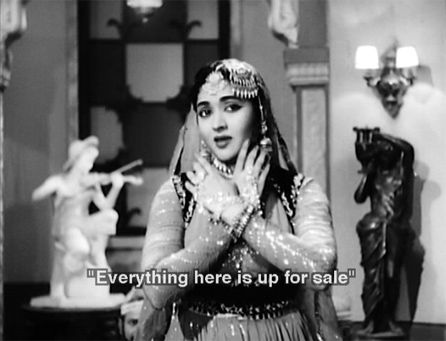
Vyjayanthimala’s introductory number, ‘Kaho ji tum kya kya kharidoge‘ for instance. She is dancing with gay abandon for an audience of note-throwing men. The song sounds risque on the first hearing. It is a scathing attack on the men who treat women as commodities. Sahir illustrates his point further with ‘Aaj kyon humse parda hai‘. The enlightening bhajan ‘Tora manwa kyon ghabraye re‘ arrives like the much-needed balm after the sting of the earlier two numbers.
The dialogue are functional and occasionally funny in the first half, but once the theme of the prostitute versus society gains momentum, Pandit Mukhram Sharma comes into his own.
But finally, the show belongs to Vyjayanthimala. Fetchingly frivolous in the first half, she is suitably serious in the second. She makes her need for acceptance palpable; her eyes emit twin lasers of anger and condemnation at those that exploit women.
Sadhna received largely positive reviews from critics and was one of the most critically acclaimed films of the year. Vijay Lokapally from The Hindu said: “Among the great movies made on the subject of helpless women versus society, Sadhna holds its own for its realistic portrayal and treatment of a subject, so aesthetically documented by Chopra and Vyjayanthimala”.
Rediff’s reviewer Dinesh Raheja has commented that “Sadhna was quite progressive in its approach, boldly dealt with a prostitute’s love story with a literature professor, it dared to portray not just the often seen tragic trajectory of a prostitute’s life and times, but a happy ending as well”.
Vyjayanthimala won Filmfare Awards for Best Actress and Mukhram Sharma for Best Story. Film nominated for Best Film, Best Director, Best Supporting Actress, Best Lyricist for song “Aurat Ne Janam Diya”
Photos courtesy Google. Excerpts taken from Google.
 Writer Sunita