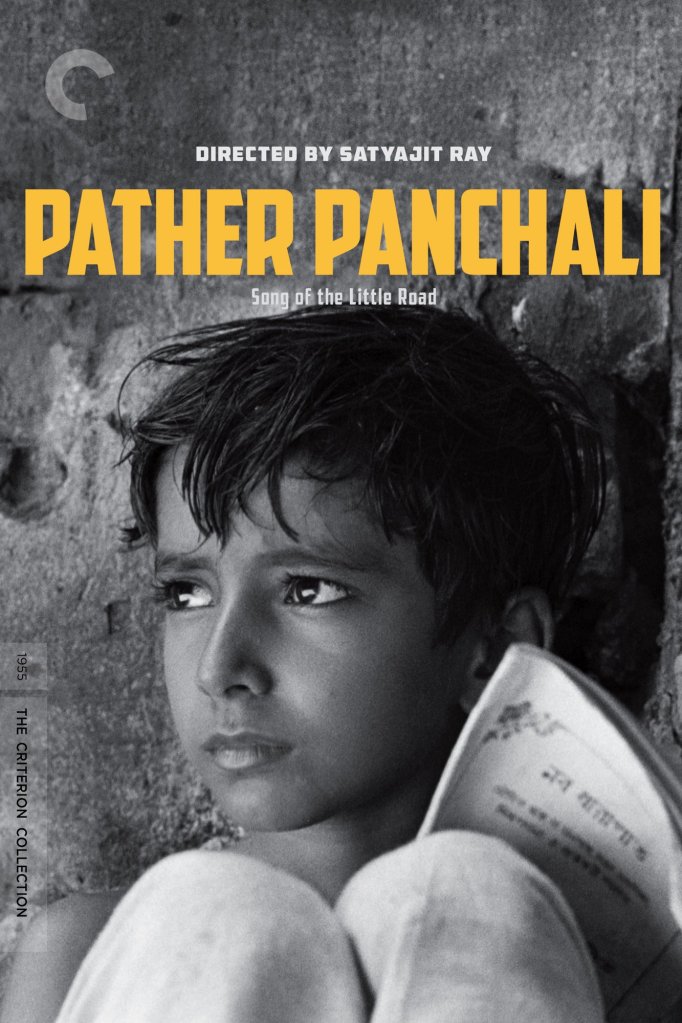

Pather Panchali (Song of the Little Road) is a 1955 Indian Bengali-language film written and directed by Satyajit Ray, produced by the Government of West Bengal. Adapted from Bibhutibhushan Bandyopadhyay’s 1929 novel of the same name, it marks the first entry in Ray’s acclaimed Apu Trilogy. The film stars Subir Banerjee, Kanu Banerjee, Karuna Banerjee, Uma Dasgupta, Pinaki Sengupta, and Chunibala Devi.
Pather Panchali beautifully portrays the childhood experiences of Apu and his elder sister Durga as they navigate the challenges of growing up in a poor rural village. Through a blend of mischief, discoveries, joy, and tragedy, Ray presents a poignant and lyrical exploration of life’s hardships and moments of grace.
In the 1910s, in the rural village of Nischindipur, Bengal, Harihar Roy, a pujari (priest), struggles to make ends meet while harboring dreams of becoming a successful poet and playwright. His wife, Sarbajaya, manages the household and cares for their children, Durga and Apu, as well as Harihar’s elderly cousin, Indir Thakrun. The family’s limited resources create tension, and Sarbajaya resents having to share their already modest home with the aging Indir, who occasionally takes food from their meager kitchen.
Durga, however, is fond of Indir and often sneaks her fruit, which she steals from a wealthy neighbor’s orchard. One day, the neighbor’s wife accuses Durga of stealing a bead necklace. Although Durga denies it, the incident sparks further resentment, and Sarbajaya is blamed for fostering Durga’s habit of stealing.
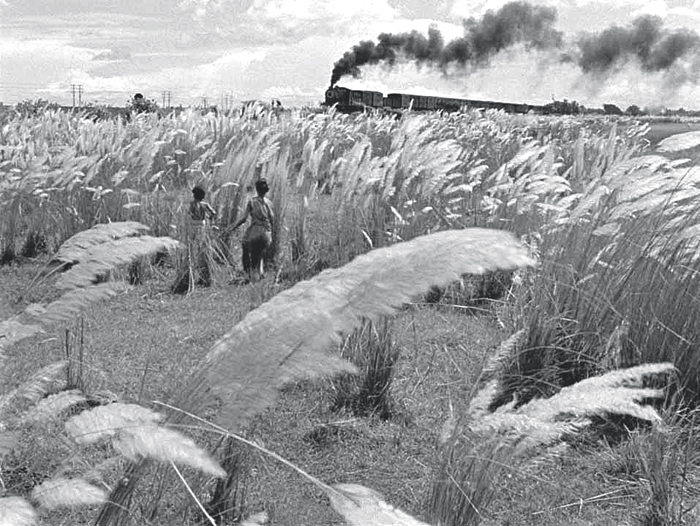
As the elder sibling, Durga cares for Apu with a blend of motherly affection and playful teasing. Together, they revel in the simple pleasures of their rural life—sitting quietly under a tree, marveling at the images in a travelling vendor’s bioscope, chasing after the candy man, and watching a jatra (folk theatre) performed by a local troupe. Each evening, they find joy in the distant sound of a train whistle, symbolizing a world beyond their village.
Meanwhile, Sarbajaya’s resentment toward Indir intensifies, leading to open hostility. Unable to bear the tension, Indir seeks temporary refuge with another relative. One day, while Durga and Apu race to catch a glimpse of the passing train, Indir, feeling unwell, returns home. When the children come back from their adventure, they are met with the sorrowful discovery that Indir has passed away.
With few opportunities left in the village, Harihar travels to the city in search of a better job, promising to return with enough money to repair their crumbling house. However, his absence extends far longer than expected, and the family’s situation worsens. As they sink deeper into poverty, Sarbajaya becomes increasingly desperate and anxious.
During the monsoon season, Durga plays joyfully in the rain but soon catches a cold that quickly develops into a high fever. As a violent thunderstorm ravages their fragile home, her condition deteriorates. By the next morning, Durga succumbs to her illness, leaving her family devastated.
When Harihar finally returns, he is initially unaware of the tragedy. He cheerfully shows Sarbajaya the goods he has brought from the city, but her silence soon overwhelms him. As she breaks down at his feet, Harihar is struck by the painful realization that their daughter has died, and he is overcome with grief.
The family decides to leave their ancestral home and start anew in Benaras. As they pack their belongings, Apu discovers the bead necklace Durga had been accused of stealing. Quietly, he throws it into a pond. The family departs the village on an ox-cart, leaving behind their now desolate home, while a snake slithers into the abandoned house.
Pather Panchali, a timeless masterpiece by Satyajit Ray, beautifully captures the essence of life in rural India. The film doesn’t feature a traditional villain, lead actor, or actress—just the simple story of a poor Bengali Brahmin family struggling to survive. As the narrative unfolds, we become emotionally attached to Apu and Durga, the innocent children of Harihar. Their playful teasing, mutual support, and shared love for their parents are portrayed with such tenderness that we can’t help but fall in love with them.
Satyajit Ray was a true magician in filmmaking. His charismatic direction, combined with Ravi Shankar’s exquisite sitar compositions, creates an immersive experience. Every character reflects the authenticity of village life, providing a poignant understanding of the hardships faced by the poor. Technically, this film is a brilliant achievement in Indian cinema, with flawless cinematography and sound design.
Speaking of sound, Ravi Shankar’s music fits seamlessly into each scene, heightening the emotional depth. Pather Panchali is more than a portrayal of poverty; it’s a meditation on life—how it continues to move forward, even in the midst of struggle. While some Western critics have commented on the theme of “endless sorrow” throughout the series, I don’t believe this was Ray’s intention. The sorrow depicted is simply a part of life in rural India at the time, and Ray presents it without sentimentality or a desire for pity.
The film’s ending shouldn’t be seen as a cliffhanger, but rather as a natural conclusion to the story. Ray’s casting choices were impeccable, with each actor contributing to the film’s realism. Much of the credit also goes to Bibhutibhushan Bandyopadhyay for his beautiful story and Ray’s exceptional adaptation of it.
The moment when Durga dies is incredibly emotional, and it truly melted heart. This film is a proud moment for both Bengalis and Indians.
While there are moments of sadness, the film emphasizes the beauty of the world around us. One of the most memorable characters is an elderly woman, possibly in her nineties, whose presence adds a profound layer to the story. The acting is powerful, the direction assured, and the film itself eloquent and moving. It’s a story one can revisit time and again, finding new layers with each viewing. Ray masterfully captures the simple joys of childhood and the universal dreams that make us all human.
Its premiere on 3 May 1955 at the Museum of Modern Art in New York, Pather Panchali was released in Calcutta later that year to an enthusiastic reception. A special screening was attended by the Chief Minister of West Bengal and the Prime Minister of India. Critics have praised the film for its realism, humanity, and emotional depth, though some have criticized its slow pace and accused it of romanticizing poverty. Scholars have highlighted the film’s lyrical quality and realism, influenced by Italian neorealism, as well as its portrayal of poverty and the small joys of everyday life. Darius Cooper has referred to the film’s central theme as the “epiphany of wonder,” underscoring its unique perspective on life’s simple moments.
Pather Panchali has won numerous national and international awards. At India’s 3rd National Film Awards in 1955, it was named Best Feature Film and Best Bengali Feature Film. The following year, it competed for the Palme d’Or at the Cannes Film Festival, where it won the Best Human Document award and received a Special Mention from the OCIC (International Catholic Organization for Cinema).
The film continued to garner accolades at festivals worldwide: it received the Vatican Award in Rome, the Golden Carabao in Manila, and the Diploma of Merit at the Edinburgh Film Festival in 1956. In 1957, it won the Selznick Golden Laurel for Best Film in Berlin, and in San Francisco, it was awarded both the Golden Gate Award for Best Director and Best Picture. More honors followed in 1958, including Best Film at the Vancouver Film Festival and the Critics’ Award for Best Film in Stratford.
The film was also nominated for Best Film at the 11th British Academy Film Awards in 1958.
Photos courtesy Google. Excerpts taken from Google.
 Writer Sunita