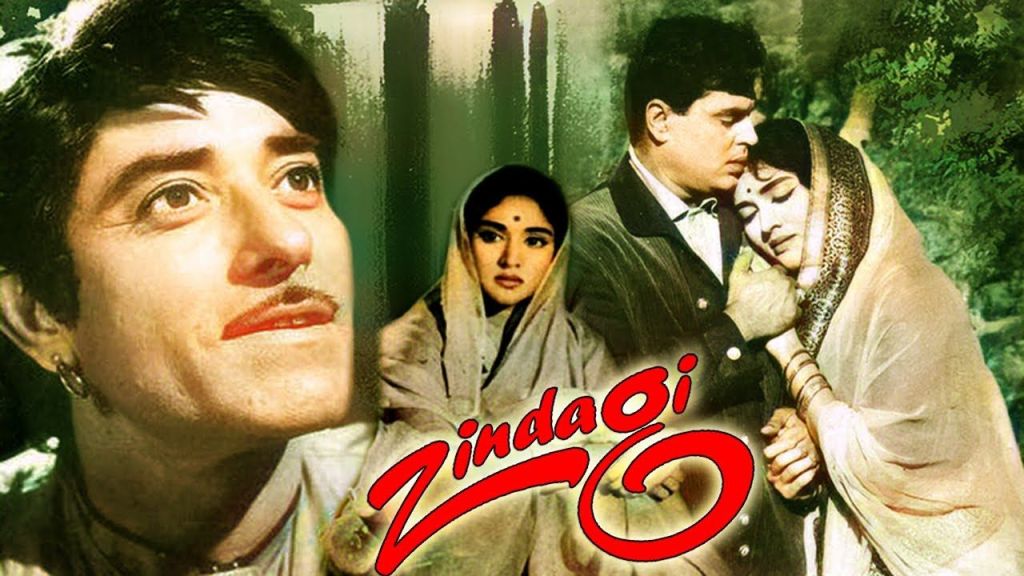
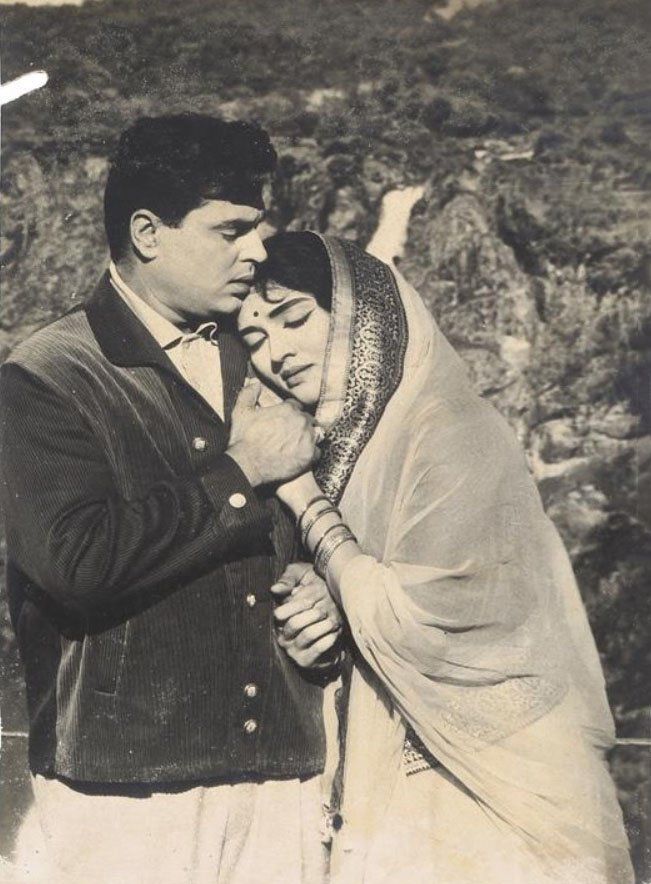
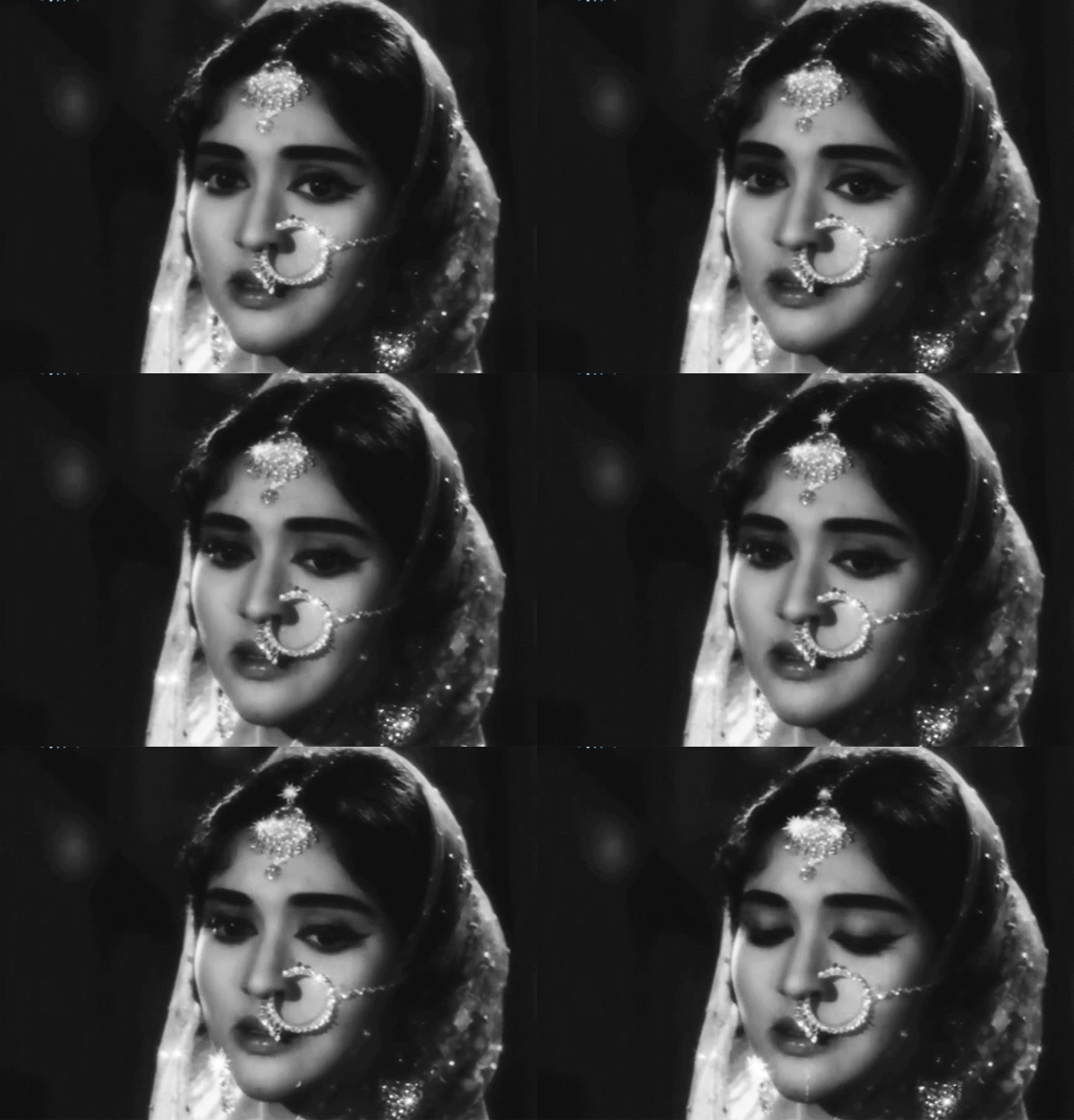
“Zindagi” (Life) is a 1964 Indian Hindi-language drama, produced by S. S. Vasan under the Gemini Pictures banner and directed by Ramanand Sagar. The film features an ensemble cast including Rajendra Kumar, Vyjayanthimala, Raaj Kumar, Prithviraj Kapoor, Mehmood, Jayant, Jeevan, Leela Chitnis, and Helen.
Beena (Vyjayanthimala), a stage actress, lives in poverty with her widowed mother (Leela Chitnis). Poet Gopal, the director of the play, harbored a deep affection for Bina, though she was unaware of his feelings. One evening, on her way home, she is harassed by Bankhe (Jeevan) and two men, but is saved by Rajan (Rajendra Kumar), the son of wealthy Rai Bahadur Gangasaran (Prithviraj Kapoor). They fall in love. When Rai Bahadur discovered his son wished to marry an actress, he was furious. After Rajan threatens to leave, Rai Bahadur agrees to their wedding. But he has a condition: Beena must promise not to ever meet Gopal again. This she does, when Gopal comes to the wedding, bearing a gift. Gopal is taken aback and somewhat hurt, but he acquiesces.
A few months later, Bina, now pregnant, is enjoying a blissful life with Rajan. However, the threat from Ratan Lal and Baanke still lingers. Ratan Lal, who has a history of lecherous behavior, had a heated confrontation with Gopal after Gopal confronted him over his misconduct. In a fit of rage, Gopal threatened to kill Ratan Lal, who has since been seeking revenge against both Gopal and Bina, plotting to kidnap her.
One evening, Bina and Rajan decide to go for a drive, unaware that Baanke has sabotaged their car by puncturing one of the tires. After a short distance, the car breaks down, and Rajan steps out, assuring Bina that he’ll find help and return soon.
As Rajan leaves, two of Baanke’s men approach the car. At the same time, a large and increasingly agitated mob gathers nearby, shouting slogans as tensions rise. The men warn Bina that the situation could turn dangerous, and rioting might break out at any moment. They urge her to get out of the car and take shelter.
Baanke’s men begin harassing Bina, and the crowd, which has now turned violent, adds to her growing fear. Desperate to escape, Bina flees down a narrow lane, chased by Baanke’s men, who make it clear they are targeting her. Panicked and searching for refuge, Bina runs into the nearest house with an open door.
To her shock, the house belongs to none other than Gopal. Though he has been drowning his sorrows in alcohol, Gopal is still alert enough to recognize Bina. Their reunion is awkward, given the circumstances, but before they can process the situation, the police arrive, breaking up the violent crowd and enforcing a curfew.
Bina insists she must return home, but Gopal warns her that the streets are too dangerous, and the police won’t allow anyone out. Ignoring his caution, Bina attempts to leave but is immediately stopped by the authorities, who strictly enforce the curfew. Realizing she has no other option, Bina reluctantly agrees to Gopal’s offer to stay the night.
The next morning, with the curfew lifted, Bina returns home. Rajan and his father, who have been deeply worried about her whereabouts, are immensely relieved to see her safe. Remembering her promise to her father-in-law not to meet Gopal, Bina conceals the truth. When they ask where she took shelter during the curfew, she simply says that “a good man” gave her refuge.
The truth cannot remain hidden for long. As the new day unfolds, the police arrive at Gopal’s house. Ratan Lal has been murdered, and since many had overheard Gopal’s heated threat to kill him days earlier, he becomes the prime suspect.
During their search of Gopal’s home, one of the officers discovers Bina’s earring, inadvertently left behind. This piece of evidence raises further suspicion, and the situation takes a sharp turn as it threatens to unravel Bina’s secret.
Gopal is arrested and put on trial for the murder of Ratan Lal. The trial is notably inadequate, as there is no concrete evidence linking Gopal to the crime—no murder weapon, fingerprints, or witnesses. The case seems to rely solely on the fact that Gopal had previously threatened Ratan Lal.
Rai Bahadur, who is the foreman of the jury, is aware that evidence indicates a woman was in Gopal’s house the night of the murder. He directly questions Gopal about the identity of this woman. Gopal, knowing that Rai Bahadur is Bina’s father-in-law, understands that revealing the woman’s identity—though it would exonerate him—would ruin Bina’s reputation. He chooses to remain silent, and as a result, the jury unanimously finds him guilty.
Unable to let an innocent man suffer, Bina testified in court, confirming she was with Gopal throughout the night. Although Gopal was acquitted, Rajan expelled Bina from their home. Pregnant and in distress, Bina and her mother left town. When Bina fainted along the way, Sher Khan (Jayant), a friend of Rai Bahadur, offered them shelter at his home in Shergadi, not recognizing Bina. There, Bina gave birth to a son.
As Sher Khan prepared for Rajan’s new marriage, he recognized Bina and realized her noble character. He rushed to stop the wedding, hoping to rectify the wrongs done to her.
Superb acting by all leading actors specially Rajendra Kumar, Vyjayanthimala, Raaj Kumar.
The songs in this film were penned by renowned lyricists Shailendra and Hasrat Jaipuri, with music composed by the iconic duo Shankar-Jaikishan. Some of the memorable tracks include:
- “Hum Dil Ka Kanwal Denge Jisko”
- “Ghungarwa Mora Chhamm-Chhamm Baaje”
- “Hum Pyaar Ka Sauda Karte Hain Ek Baar”
- “Pehle Mile The Sapnon Mein Aur Aaj Saamne Aaye”
- “Humne Jafa Na Seekhi, Unko Wafa Na Aaye”
These songs are integral to the film, adding emotional depth and enhancing the storytelling with their soulful lyrics and melodies.
Photos courtesy Google. Excerpts taken from Google.
 Writer Sunita