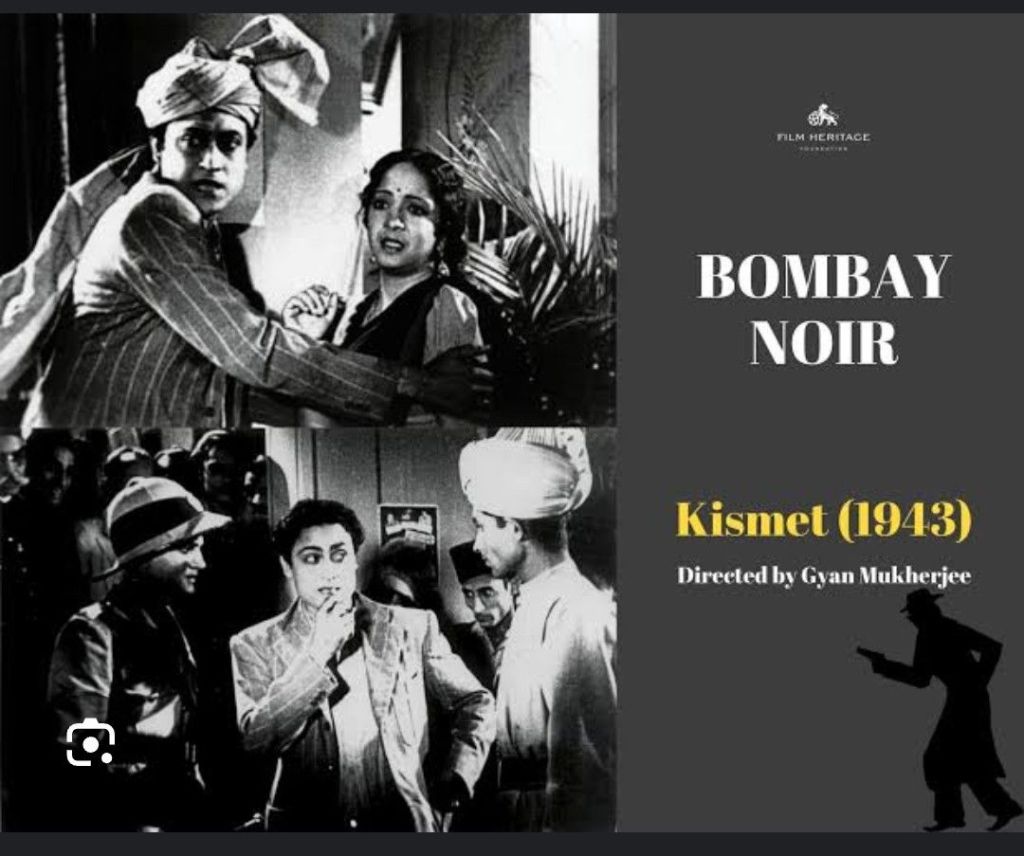

“Kismet” (1943) was a groundbreaking Indian drama film directed by Gyan Mukherjee, produced by Bombay Talkies. Released during the turmoil of World War II and a succession battle at Bombay Talkies following Himanshu Rai’s death, it became the first blockbuster in Indian cinema history. The film starred Ashok Kumar, Mumtaz Shanti, and Shah Nawaz and was notable for introducing bold themes, including an anti-hero character and the portrayal of an unmarried girl’s pregnancy—subjects that were revolutionary for Indian cinema at the time.
The plot of Kismet unfolds as an intriguing tale of fate, deception, and redemption, centering on Shekhar, a hardened pickpocket played by Ashok Kumar. After his release from prison, Shekhar shows no sign of reform and continues his life of crime. However, his encounter with a desperate old man leads him to the theater where he meets Rani, a talented performer and the daughter of the old man. The old man, once a wealthy theatre owner, has fallen into poverty due to the ruthless Indrajit, who now owns his former theater.
Shekhar’s growing affection for Rani and his compassion for her family’s plight lead him to stay at her house as a paying guest. He learns about Rani’s physical struggles due to a limp and her financial burdens, as she is the sole provider for her family, including her younger sister Leela. Things become more complicated when it is revealed that Leela is pregnant out of wedlock by Mohan, the son of none other than Indrajit, the very man tormenting Rani and her family.
To help Rani and provide for her treatment, Shekhar agrees to rob Indrajit’s safe, a plan proposed by another thief, Banke. The robbery goes wrong, but Shekhar escapes, leaving behind a personal chain. Indrajit recognizes the chain as belonging to his long-lost son, Madan, who had run away years earlier after a conflict with his father.
In a dramatic turn of events, Indrajit organizes a live performance featuring Rani, hoping to lure Shekhar (Madan) to the event. The performance serves as a grand reunion where Shekhar is revealed to be Indrajit’s estranged son. Overjoyed, Indrajit undergoes a moral transformation, forgives his former employer’s debts, and asks for the hands of both Rani and Leela for his sons, thus bringing the film to a climactic and redemptive resolution.
The song “दूर हटो दुनियावालों, हिंदुस्तान हमारा है” (“Go away, people of the world, Hindustan is ours”) from Kismet became an anthem of resistance during the mid-1940s. Released shortly after Mahatma Gandhi’s call for the Quit India Movement, the song’s patriotic message resonated deeply with Indian audiences, even though it was cleverly framed as being addressed to the Axis powers (Germany and Japan) with whom Britain was at war. Audiences, however, quickly grasped the underlying defiance aimed at the British colonial rulers.
The song’s immense popularity resulted in screenings of Kismet being frequently interrupted, as viewers demanded the reels be rewound to hear the song multiple times. Its bold and veiled anti-colonial sentiment captured the spirit of the time, when India was on the cusp of independence.
Fearing backlash from the British authorities, who could interpret the song as seditious, its lyricist, Kavi Pradeep, had to go into hiding to avoid arrest. This further fueled the song’s status as a symbol of India’s fight for freedom, cementing its place not just in cinematic history but also in the larger cultural memory of the independence movement.
The music of Kismet, composed by Anil Biswas, was revolutionary for its time, introducing the “full chorus” technique for the first time in Hindi cinema. Biswas’ innovative use of music played a pivotal role in enhancing the film’s appeal, with several songs becoming timeless hits. The patriotic anthem “Aaj Himalay Ki Choti Se” stirred strong nationalist sentiments, while the melancholic “Ghar Ghar Mein Diwali” captured the emotional depth of the characters’ struggles.
One of the standout songs was the lullaby “Dheere Dheere Aa,” a soothing duet sung by Amirbai Karnataki and Ashok Kumar, which became immensely popular and is remembered as one of Ashok Kumar’s finest musical performances. The success of Kismet‘s soundtrack, along with its pioneering musical elements, contributed to the film’s massive box office triumph and its lasting legacy in Indian cinema.
Film marked a pivotal moment in Hindi cinema, not only for its unprecedented commercial success but also for its bold exploration of themes that had rarely been tackled before. At the heart of this transformation was Ashok Kumar’s groundbreaking portrayal of Shekhar, a morally ambiguous pickpocket, which challenged the conventional hero archetype of Indian films. Kumar’s nuanced performance as a flawed, yet ultimately redeemable, anti-hero was a major shift from the typical virtuous protagonists of the time, introducing complexity and depth into the character’s arc.
Film is especially celebrated for its technical brilliance and stylistic choices, drawing from the Warner Bros. realist style with elements of “expressionism.” Two iconic scenes stand out: Shekhar’s daring escape from the police, where he disappears into a puff of cigarette smoke, and the tense, high-stakes final robbery sequence. These moments not only added cinematic flair but also highlighted the film’s innovative approach to storytelling.
The film’s massive success also helped redefine the boundaries of narrative structure in Indian cinema. It encouraged filmmakers to explore more intricate, layered characterizations, where moral ambiguity and complex human emotions could take center stage. Ashok Kumar’s fearless embrace of such unconventional roles showcased his versatility and established him as a trendsetter in the industry. His performance in Kismet captivated audiences in the 1940s and left a lasting impact on Hindi cinema, paving the way for more sophisticated and nuanced storytelling in the years to come.
The film’s success was attributed to its gripping story, innovative themes, and the powerful resonance of its patriotic songs, which struck a chord with audiences during India’s struggle for independence. Its bold portrayal of fate and redemption made it a cultural landmark in Indian cinema.
The film’s layered narrative, combined with its exploration of love, family, and fate, resonated strongly with audiences, contributing to its legendary status in Indian cinema. Film remains a timeless classic, remembered for its impact on the evolution of Hindi films, particularly in its portrayal of characters who exist in the gray areas between right and wrong.
Despite receiving harsh criticism, particularly from Babu Rao Patel of Filmindia magazine for glorifying crime and portraying a criminal sympathetically, film became a monumental success. Patel’s disapproval stemmed from the film’s depiction of Shekhar, an anti-hero, as a redeemable figure—a bold narrative choice for its time.
Despite the controversy, Kismet became a cultural landmark, running for an unprecedented three years at a single cinema in Calcutta. It is also considered an early example of the “lost and found” trope, a pre-Partition fairytale motif where family members separated by fate or villainy are eventually reunited.
Photos courtesy Google. Excerpts taken from Google.
 Writer Sunita