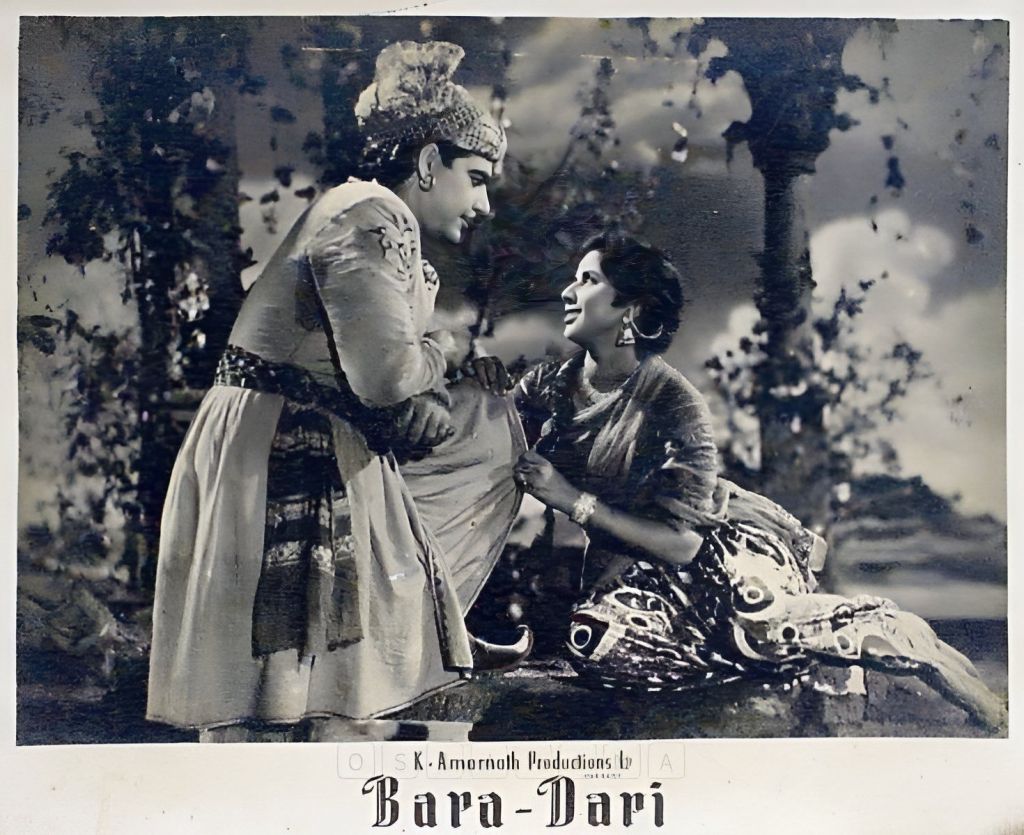
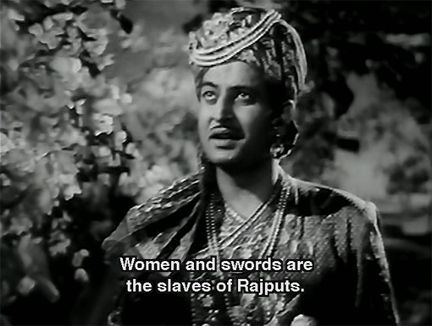

Ajit had a successful collaboration with director K. Amarnath, and Baradari (1955) is indeed a notable example of their partnership. This summary of film paints a vivid picture of the film’s classic melodramatic plot. The story revolves around the noble themes of Rajput pride, familial loyalty, sacrifice, and romance, all set against the backdrop of royal intrigue.
The beginning of a classic dramatic story, one filled with themes of loyalty, rebellion, honor, and superstition. Ranvir Singh’s (Ramayan Tiwari) stand against the oppressive land tax (lagaan) symbolizes the fight of the common man against unjust authority, while his tragic death adds a layer of emotional weight and injustice.
The introduction of superstition through the astrologer’s ominous prediction sets the stage for more conflict, leading to the separation of the prince from his royal family. The decision to give the prince to Shakti Devi (Amir Banu), based on the belief that he should be nurtured by a strong, courageous woman, adds an intriguing twist to the story.
Shakti Devi’s internal struggle and ultimate decision to nurture the prince despite her deep grief and anger towards the King. Her maternal instincts overpower her bitterness, showing that love and care for a child can transcend even the most intense personal grievances.
The scene where Shakti Devi returns the prince to the palace after raising him for 8 years—without any deception—further emphasizes her integrity and strength. Tearing up the papers relieving Ajaygarh of the land-tax, despite the King offering this as a reward, is a powerful moment. Her defiance in rejecting the King’s “payment” for motherly love adds a layer of nobility to her character. Her statement, “Meri mamta bikau nahin hai” (My motherly love is not for sale), is iconic in this context, showing that she values her principles and love for the children above material gain or the fulfillment of her late husband’s political struggle.
The emotional bond between Ajit, her biological son, and Vijay, the prince, also adds a layer of brotherhood and innocence to the story, which contrasts with the political and personal turmoil of the adults. Gauri’s attempt to comfort Ajit, likely through a sweet or cheerful interaction, is a touching moment in the midst of all the high drama.
The decision of Shakti Devi and Gauri’s mother to get Gauri and Ajit married signifies a moment of potential peace and happiness for the couple. However, this is immediately disrupted by the looming threat of the royal army, which reflects the constant tension between personal desires and the broader conflict.
Shakti Devi’s emotional manipulation to keep Ajit safe shows her deep fear of losing him, especially after her husband’s death. It’s a poignant moment where a mother’s protective instincts clash with her son’s sense of duty. Her fear of him getting involved in the ongoing political unrest shows her trauma from losing Ranvir Singh, and the stakes are personal for her as she desperately tries to shield Ajit from the same fate.
Ajit’s promise to Gauri to meet her every night at Baradari adds a romantic yet bittersweet element to the story. It’s a quiet promise of love in the midst of uncertainty, showing how, even in times of danger and upheaval, personal bonds persist. This sets up the expectation of a secret rendezvous, which may play a significant role as the story progresses.
On the other hand, Vijay’s birthday marks a significant turning point in his life, with the King deciding to entrust him with the kingdom’s rule. However, Karan Singh (Pran) immediately tries to sabotage this by planting seeds of doubt, manipulating the situation to create mistrust between Vijay and Ajit. Karan Singh’s subtle maneuvering shows his ambition and cunning, as he tries to undermine Vijay’s authority, likely to secure more power for himself.
Vijay’s disbelief in Karan Singh’s accusations against Ajit reflects the bond of trust between the two “brothers” who were raised together by Shakti Devi. This trust could be tested as Vijay heads to Ajaygarh to uncover the truth, setting the stage for a potential confrontation or misunderstanding between the two.
Hira Singh’s role as a Senapati seems more symbolic, as he doesn’t appear to be a central figure of authority, yet his presence with Vijay underscores the military pressure on Ajaygarh. Vijay’s arrival at Shakti Devi’s locked house adds to the tension, as he’s now drawn into the heart of the conflict.
Gauri’s kidnapping by Karan Singh’s men is a classic damsel-in-distress moment, but it allows for a heroic rescue by Ajit, Thakur Sangram, and Latu Singh. The secret tunnels and rotating doors add an adventurous, almost swashbuckling element to the mission. Thakur Sangram’s knowledge of the area reinforces his role as an old hand in this world of rivalries and power plays, which contrasts with Ajit’s more youthful, action-oriented heroism.
Karan Singh‘s ability to manipulate the Maharaja by casting doubts on Ajit’s intentions is a pivotal moment. His assertion that Ajit is driven by revenge for his father’s death creates a layer of suspicion, sowing mistrust between the royal family and Ajit. The idea that Ajit fled when Vijay came to visit sounds like a weak excuse, but the Maharaja’s willingness to entertain this theory shows how deeply Karan Singh has embedded himself in the royal court’s politics. His ability to manipulate the Maharaja while simultaneously covering his own tracks shows his cunning and dangerous influence over the kingdom.
Vijay’s instant attraction to Gauri introduces a romantic complication that adds to the drama. His depression after being called back to the palace and his obsession with Gauri, shown through his attempt to paint her portrait in the song “Tasveer Banata Hoon”, depicts him as deeply vulnerable and emotionally fragile. The Queen’s concern for her son’s happiness shows the tender side of the royal family, and her plea to the Maharaja highlights a mother’s desire for her child’s contentment above all else.
The Maharaja’s insistence on investigating Gauri’s background before agreeing to the marriage is a reflection of the strict societal hierarchies in place. His skepticism reflects the weight of royal duty and the need for alliances through marriage, as well as the concern for family reputation.
The message sent to Ajit about Vijay’s illness creates a moral dilemma. Ajit is on the verge of marrying Gauri, the woman he loves, yet his loyalty to Vijay leads him to drop everything and rush to his “brother’s” side. This speaks to Ajit’s sense of honor and commitment to both Gauri and Vijay, even though he unknowingly promises to help Vijay marry the very woman he himself is about to wed. This promise is bound to lead to intense emotional conflict and betrayal once the truth comes out.
The buildup to the upcoming confrontation between Ajit’s loyalty to Vijay and his love for Gauri is setting the stage for a dramatic twist. Ajit will handle the inevitable moment when he discovers that the woman Vijay has fallen for is Gauri.
A dramatic and emotional sequence in a film, where Gauri feels trapped despite being welcomed with joy by the royal family. The contrast between the royal family’s happiness and Gauri’s inner turmoil is heightened by the background music and songs, which reflect her emotional state. The scene paints a picture of conflict between outward celebration and personal despair, especially with Gauri’s attempted suicide emphasizing her distress.
Ajit’s rebellious nature and boldness in attacking the sarkari khazana (government treasure) definitely paints him as a folk hero. By opposing authority and standing up to corrupt figures like Karan Singh, Ajit becomes a symbol of resistance and justice, much like his father, Ranvir Singh, who died fighting against unjust taxation. This makes Ajit’s actions both a personal mission and a continuation of his father’s legacy, adding depth to his motivations.
Ajit’s selfless act of sacrificing his love for the sake of his brother epitomizes the timeless theme of sibling loyalty in Hindi cinema. This dynamic, often seen in classic films, resonates deeply with audiences, emphasizing the values of duty and family over personal happiness. The plot’s resolution may follow familiar patterns, but it delivers the emotional closure that viewers of that era expect, leaving them with a sense of fulfillment. The predictability here becomes a strength, offering comfort through the genre’s conventions and reaffirming the importance of familial bonds.
Ajit’s role as both protector and hero becomes more solidified in this scene, especially as he courageously defends Gauri from a predatory villain like Karan Singh. There’s a clear blending of romance, heroism, and feuds here.
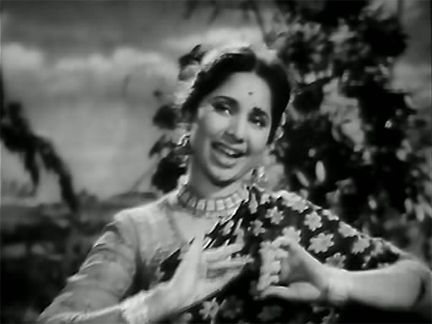
Geeta Bali’s performance as Gauri, and how she injects energy into the film, adds a key layer to its romantic dynamic. The song “Tasveer Banata Hoon” beautifully complements the emotional tension between the characters, particularly capturing Prince Vijay’s silent longing for Gauri. Talat Mahmood’s soulful voice helps express the emotions that words alone might not fully convey, enhancing the poignancy of this love triangle.
Karan Singh, on the other hand, remains a shadowy figure, possibly involved in smuggling or some form of betrayal. His association with the government wealth creates a layer of corruption that hints at larger systemic issues, as he is likely exploiting his position for personal gain. His role as the villain is reinforced by his confrontation with Ajit, making him not just an antagonist to the hero, but also a symbol of the corrupt authority Ajit fights against.
The contrast between Ajit’s fight for justice and Sangram’s obsessive desire for revenge highlights the different motivations driving the characters in this world, where personal honor and social justice often collide. This thematic exploration of ego, rebellion, and power makes the narrative rich and multifaceted.
Pran’s portrayal of Karan Singh seems more like a plot device, sparking the tension between Ajit and the royal forces rather than being a fully realized villain himself. His character might have benefited from more development to explore the depth of his motivations and how they tie into the broader themes of loyalty, betrayal, and honor.
Baradari beautifully capture how the music and performances are central to the film’s emotional impact. Naushad’s compositions, paired with meaningful choreography and the cultural layers added through qawwalis, elevate the viewing experience. The dynamic between Ajit and Gauri, particularly in songs like “Bhula Nahin Dena,” provides both lighthearted and deeply emotional moments, contributing to the film’s enduring appeal.
Photos courtesy Google. Excerpts taken from Google.
 Writer Sunita