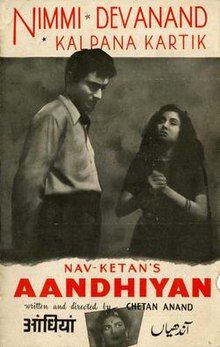
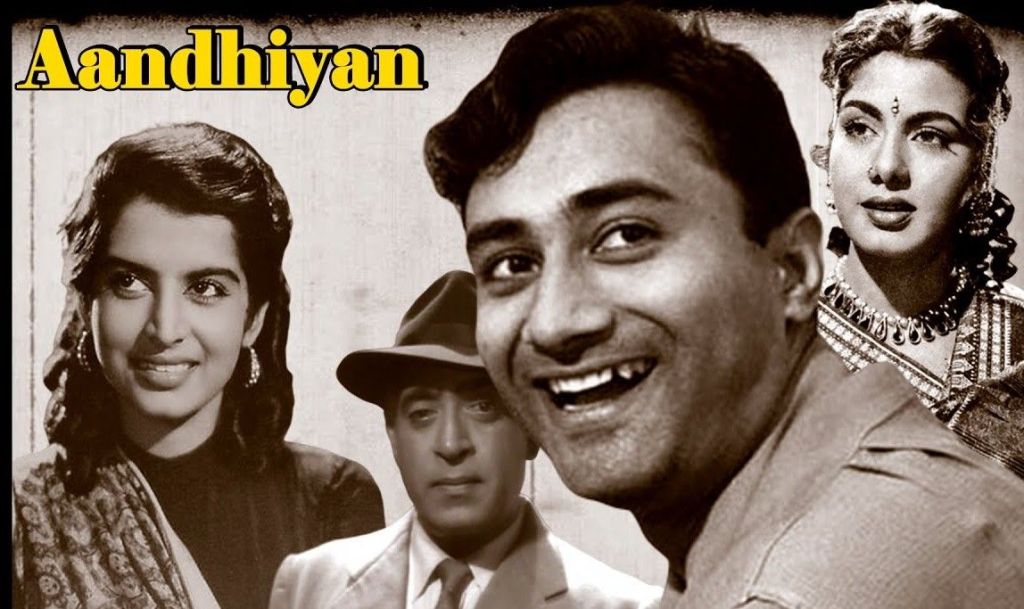
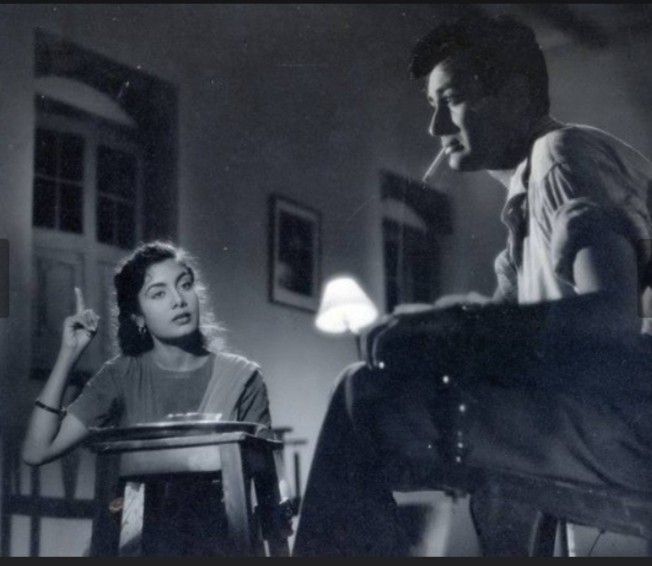
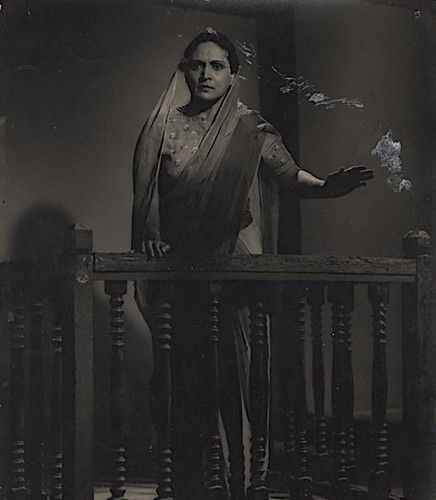
Andhiyan (1952), directed by Chetan Anand, is a Hindi drama that delves into the complexities of human emotions and societal norms. With a narrative rooted in a real-life event from Amritsar, the film brings together a talented cast, including Dev Anand, Kalpana Kartik, and Nimmi in lead roles. The collaboration of Chetan Anand and Hameed Butt as writers adds depth to the story, focusing on the turbulence and struggles faced by the characters, symbolized by the title, “Cruel Winds.”
Aandhiyan (1952), Ram Mohan (Dev Anand), an honest and hardworking lawyer, is deeply in love with Janaki (Kalpana Kartik), the beautiful daughter of Din Dayal, a businessman. Ram Mohan serves as Din Dayal’s legal advisor, and Din Dayal joyfully accepts his proposal for Janaki. Their engagement brings happiness to the entire neighborhood (mohalla), and celebrations begin in full swing. However, this joyous occasion becomes a source of deep sorrow for two individuals.
The first is Rami (Nimmi), the poor niece of Ram Mohan’s Munshi, who secretly harbors a deep love for the young lawyer. Despite her feelings, Rami knows that she could never hope for a match with Ram Mohan due to her social status. Stifling her heartache, she bravely joins in the festivities, hiding her pain behind a smile.
The second person affected by the engagement is Kuberdas (K. N. Singh), a wealthy and unscrupulous businessman. His lustful eye has fallen on Janaki, and despite being old enough to be her father, he is determined to marry her. When Din Dayal’s wife falls seriously ill, the family is plunged into financial distress, having already spent all their savings on the preparations for Janaki’s wedding. Desperate, Din Dayal turns to Kuberdas for a loan.
However, Kuberdas, instead of offering help, cruelly refuses to lend money and demands repayment of a previous loan. His condition is heartless: either Din Dayal must sell his home and assets to repay the debt, or he must agree to marry off his daughter Janaki to Kuberdas.
Janki faces a heart-wrenching dilemma when her family finds itself in desperate need of money for her mother’s medical treatment. Despite being deeply in love with Ram Mohan, she is compelled to sacrifice her own happiness for the sake of her family’s survival.
To secure the necessary funds, Janki agrees to marry an old moneylender, even though she does not love him. This selfless act showcases her inner strength and devotion to her family, as she puts their needs above her personal desires. Her sacrifice adds a tragic dimension to the story, as her love for Ram Mohan is overshadowed by her sense of duty and responsibility.
The neighborhood is outraged by Kuberdas’ evil plan. Led by Rami, who refuses to let Ram Mohan’s happiness slip away, the community rallies together to raise the money needed to free Janaki from Kuberdas’ clutches. Unfortunately, despite their best efforts, they arrive too late—the wedding rituals have already been completed.
Kuberdas, shielded by law and societal norms, has successfully married Janaki. The film suggests that no moral or social crime can survive forever. The story builds towards the downfall of Kuberdas, but the details of how he meets his reckoning and who becomes the instrument of his downfall are revealed as the dramatic events unfold on screen.
The narrative emphasizes the emotional turmoil Janki endures, as well as the societal pressures that force her into this sacrifice. It also highlights the impact of wealth and power dynamics, showing how they can manipulate and control the lives of vulnerable individuals. Ram Mohan, despite his efforts, must come to terms with this heartbreaking turn of events, adding depth to the film’s exploration of love, sacrifice, and moral dilemmas.
The film follows Ram Mohan’s struggles as he fights against Kuberdas’ manipulations, determined to protect Janki from an unwanted marriage and expose Kuberdas’ wickedness. The story, though simple, highlights themes of love, integrity, and perseverance, as Ram Mohan faces numerous obstacles to win Janki’s hand and ensure their future together.
The film portrays themes of love, sacrifice, social injustice, and the fight against exploitation, all set against a backdrop of strong emotions and moral dilemmas.
Aandhiyan is its extraordinary music, composed by the legendary classical musician Ali Akbar Khan. Known for his mastery of the sarod, Khan crafted a soulful and evocative soundtrack that perfectly complements the film’s emotional intensity. The lyrics, written by Narendra Sharma, enhance the musical compositions, creating a poetic and culturally rich backdrop to the narrative.
A notable figure in the music production was Jaidev, a student of Ali Akbar Khan from Lucknow, who would later rise to prominence as a distinguished music director in his own right. Jaidev began his career by assisting Khan in the composition of film music for Aandhiyan. The film’s background score also featured contributions from other renowned Hindustani classical musicians, including Pandit Ravi Shankar and flutist Pannalal Ghosh. This collaboration of musical giants brought an authentic classical depth to the film’s score, which resonated with its emotional and dramatic arcs.
Lata Mangeshkar, one of India’s most celebrated playback singers, lent her voice to the title song “Har Kahin Pe Shaadmani.” Out of deep respect for Ali Akbar Khan’s artistry, Mangeshkar chose not to charge any fee for her contribution, adding a layer of artistic integrity to the project.
The dances in the film were choreographed by Lakshmi Shankar, who also performed a song for the film. Gopi Krishna, a renowned dancer and choreographer, choreographed his own dance sequences, further enriching the film’s visual and cultural appeal.
With such a prestigious combination of talents, the music of Aandhiyan stands out as one of its most unique and memorable elements, adding layers of classical richness to the cinematic experience.
In Andhiyan, the storm sequence, shot by the talented cinematographer Jal Mistry, is indeed a masterclass in visual storytelling. The director and Mistry’s deep understanding of how atmospheric elements could heighten the film’s emotional gravity led them to wait patiently for seven days to capture the perfect red sky. This deliberate choice was not just for aesthetic beauty but was essential in amplifying the intensity of the scene.
The storm was a metaphorical extension of the characters’ internal struggles, and the red sky enhanced the foreboding mood, aligning with the chaos and emotional upheaval in the story. This natural phenomenon became an integral part of the film’s narrative, adding a layer of depth and tension that may not have been as palpable without it. Such dedication to capturing the right conditions shows the filmmakers’ commitment to their craft, ensuring that each visual element served to deepen the audience’s engagement with the film. The result is a sequence that lingers in memory, making Andhiyan even more impactful and resonant.
Photos courtesy Google. Excerpts taken from Google.
 Writer Sunita