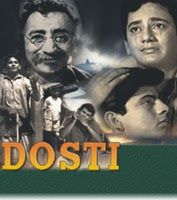
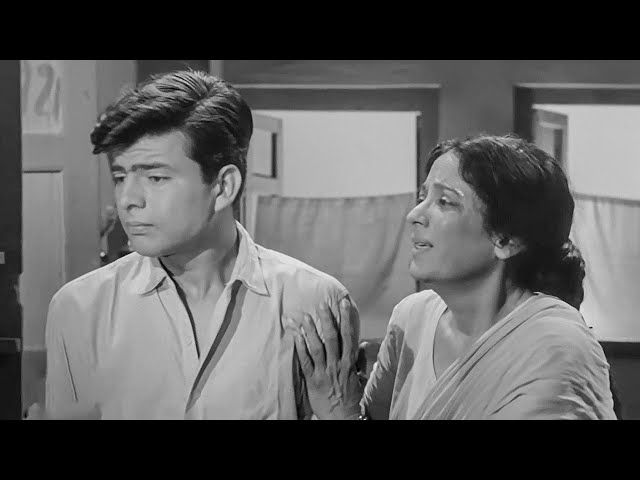
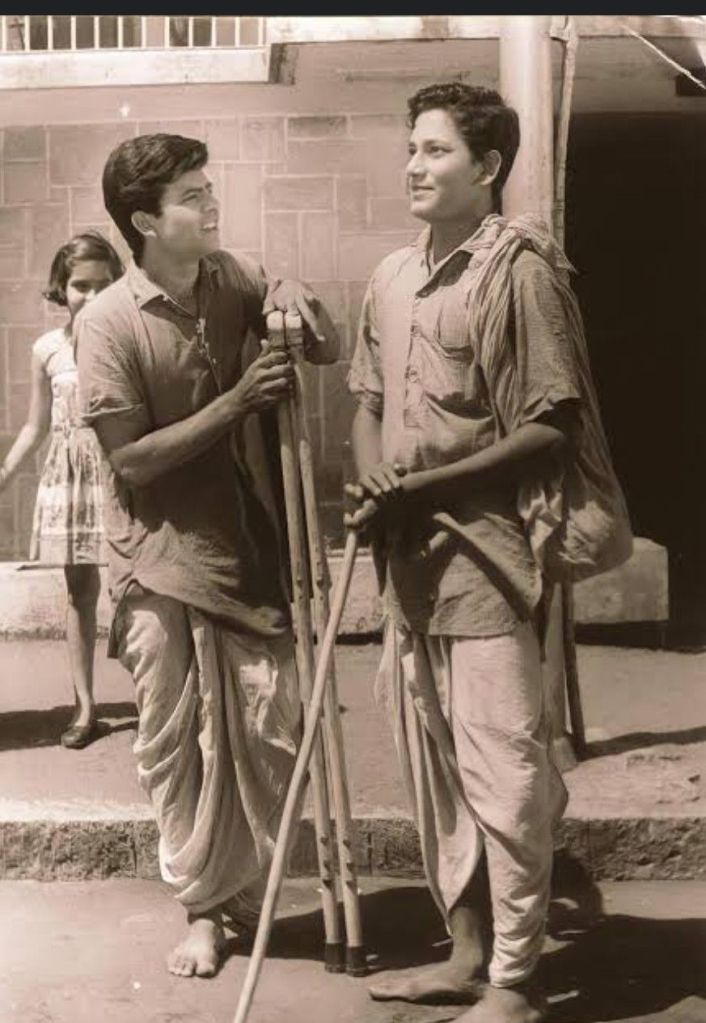
Dosti (1964) is a notable Indian Hindi-language drama film directed by Satyen Bose and produced by Tarachand Barjatya under the banner of Rajshri Productions. The film revolves around the deep bond between two marginalized boys: one blind (played by Sudhir Kumar Sawant) and the other physically disabled (played by Sushil Kumar). Through their friendship, they find companionship and support as they navigate a life filled with hardships and challenges.
Ramu’s journey begins with the tragic loss of his father in a workplace accident, which not only leaves him and his ailing mother without financial support but also triggers a series of unfortunate events. The company’s refusal to accept liability for his father’s death leads to his mother’s shock and collapse. Ramu’s own accident further adds to his misfortune, as he loses the use of his left leg after being run over by a car.
When he returns from the hospital, Ramu’s life is thrown into even deeper turmoil: his mother has passed away, and he is evicted from their home by the landlord. Now an orphan and crippled, Ramu finds himself penniless and alone in the streets of Bombay. His fateful meeting with Mohan, a blind young man, marks a turning point in his life. Together, they forge a friendship that allows them to survive by combining their talents—Ramu plays the harmonica while Mohan sings—earning money to get by in a world that has shown them little mercy. This backdrop adds significant emotional weight to the story, making their bond all the more meaningful.
Mohan’s sister, Meena, went to Mumbai to work as a nurse to fund his treatment, but they lost contact after the death of his caretaker, leaving Mohan alone. Despite their physical challenges, the two boys form a deep bond and create a way to survive by combining their talents: Ramu plays the harmonica, and Mohan sings, earning money on the streets from passersby.
Their friendship is further deepened by their shared dreams and goals. Ramu longs to complete his education, and both boys befriend Manjula (played by Baby Farida), the young sister of Ashok (Sanjay Khan), a wealthy man. Manjula, who suffers from rheumatic heart disease, offers them hope as they see a possible ally in her.
After being rebuffed by Ashok when they seek financial help for Ramu’s schooling, Mohan’s determination shines through as he raises the necessary sixty rupees through his singing. Ramu’s academic excellence, despite the ridicule and rejection from wealthier students, shows his resilience and unwavering pursuit of education. Even though Ramu faces humiliation for his background, his intelligence and dedication impress his teacher, Sharma Ji, who offers him both mentorship and guardianship.
Mausi, their kind neighbor in the slum, provides Ramu and Mohan with the warmth of a family they had lost, treating them as her own sons. The boys find solace and a sense of belonging in her presence, yet Ramu faces a dilemma when Sharma Ji suggests he move in with him to better focus on his studies. Ramu, loyal to Mohan, chooses to stay with his friend, reflecting the deep bond they share.
Mohan’s storyline takes a heartbreaking turn when he finally encounters his long-lost sister, Meena. Instead of the joyful reunion he hopes for, Meena, ashamed of Mohan’s poverty-stricken condition, refuses to acknowledge him. Her inner conflict between familial duty and societal expectations is palpable, as she later confesses her guilt and sorrow to Ashok, with whom she shares a budding romance. Mohan’s devastation is compounded by this rejection, and despite Ashok’s gesture of goodwill—giving Mohan Manjula’s chime in memory of her—Mohan feels utterly alone except for Ramu. The loss of his sister and Manjula further isolates him, making his friendship with Ramu all the more essential to his survival and emotional stability.
After being wrongly arrested during a burglary incident, Ramu’s life takes a drastic turn when his teacher, Sharma Ji, bails him out, but on the condition that Ramu must cut ties with Mohan. This creates a heartbreaking rift between the two boys, as Mohan, deeply hurt, roams the streets singing sorrowful songs, feeling abandoned by his only friend. Ramu’s forced separation from Mohan highlights the societal pressures to conform and the challenges of maintaining relationships amidst adversity.
When Sharma Ji suddenly dies, Ramu is left shattered, losing his mentor and support system. His decision to not take his final exams due to an inability to pay the fees reflects his despair, but Mohan’s unwavering loyalty shines through once again. Despite his own deteriorating health, Mohan raises the necessary money by singing on the streets and anonymously pays for Ramu’s exam fees. This selfless act of love demonstrates the depth of his friendship and the lengths he is willing to go for Ramu’s success.
The story reaches its emotional peak when Ramu, after placing first in his exams, learns of Mohan’s sacrifice. Overcome with guilt and gratitude, he rushes to the hospital to seek Mohan’s forgiveness. Their reunion is heartfelt, with Mohan assuring Ramu that he was never angry with him, emphasizing the strength of their bond, which remains unshaken despite the obstacles they’ve faced.
In a touching resolution, Mohan is also reconciled with his sister, Meena, who has been secretly caring for him during his illness. Her earlier rejection is forgiven, and the film concludes on a note of redemption and unity, with Ramu, Mohan, and Meena embracing in a final scene that symbolizes healing and the triumph of love and friendship over adversity.
This ending cements Dosti as a timeless story of resilience and emotional strength, where friendship proves to be the ultimate source of hope and salvation in a harsh world.
Dosti brings the emotional journey of Ramu and Mohan to a powerful and heartwarming conclusion, underlining the film’s themes of sacrifice, forgiveness, and the enduring strength of friendship. Mohan’s anger at his sister’s rejection, combined with his deep love for Ramu, reveals the film’s core message: friendship, not blood ties.
Dosti is widely appreciated for its emotional depth, highlighting themes of friendship, resilience, and empathy. Alongside its central characters, the film also features supporting roles by Sanjay Khan, Farida Dadi, Nana Palsikar, and Leela Mishra. The film’s music, composed by Laxmikant-Pyarelal with lyrics by Majrooh Sultanpuri, also played a significant role in its success, with timeless songs like “Chahoonga Main Tujhe Saanjh Savere” and “Rahi Manwa Dukh Ki Chinta.”
Dosti won several awards, including the prestigious Filmfare Award for Best Film, and is still remembered for its powerful portrayal of friendship and social issues.
Film was not only a critical success but also a major commercial hit, ranking among the top ten highest-grossing films of the year and being declared a “Super Hit” at the box office. Its emotional depth and portrayal of friendship resonated widely with audiences, contributing to its success both in India and internationally. The film was even showcased at the prestigious 4th Moscow International Film Festival, highlighting its global appeal.
In 1977, Dosti was remade in the Malayalam and Telugu languages under the title Sneham, further demonstrating its cultural impact across different regions of India.
The film’s success was reflected in the number of accolades it received. At the Filmfare Awards, Dosti won six awards out of seven nominations, making it one of the most celebrated films of the year. Its achievements included Best Film.
The music of Dosti played a significant role in the film’s success and is still remembered for its emotional depth and melodic richness. The lyrics, penned by the legendary Majrooh Sultanpuri, beautifully complement the narrative, capturing the essence of friendship, struggle, and hope. The musical score, composed by the famous duo Laxmikant-Pyarelal, became a pivotal point in their career. It was with Dosti that Laxmikant-Pyarelal won their first Filmfare Award for Best Music Director, catapulting them into prominence within the Indian film industry.
An interesting musical detail is that R. D. Burman, a celebrated music director in his own right, played the harmonica on the film’s soundtrack. This collaboration added an extra layer of richness to the score, especially in sequences featuring Ramu’s harmonica playing.
The film’s songs, primarily sung by Mohammed Rafi, are iconic and deeply cherished. Rafi’s soulful voice infused songs like “Chahoonga Main Tujhe Saanjh Savere” and “Rahi Manwa Dukh Ki Chinta” with profound emotion, making them timeless classics. His ability to evoke the characters’ inner emotions through his singing was a key element in elevating the film’s music to legendary status.
Photos courtesy Google. Excerpts taken from Google.
 Writer Sunita