
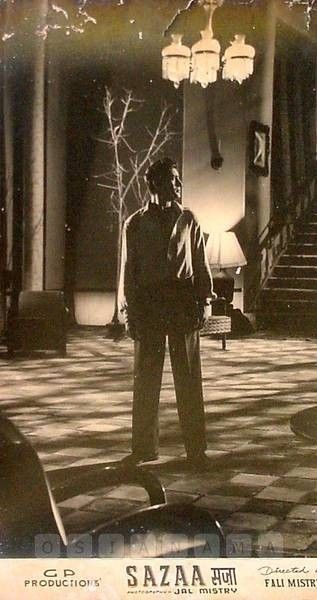
Sazaa (1951) is a Hindi-language film directed by Fali Mistry, with cinematography by Jal Mistry. It features Dev Anand in the lead role, along with Nimmi and Shyama as the female leads. The film, like many of that era, is a blend of romance, drama, and suspense. Dev Anand’s charismatic screen presence, combined with the performances of Nimmi and Shyama, added to the film’s appeal.
The plot of film weaves a complex narrative of love, family secrets, and identity, centered around Dev Anand’s character, Ashok. His accident and the ensuing recovery, followed by Kamini’s (Shyama) unwavering attention, sets the stage for Ashok’s life to intertwine with several key characters.
Ashok’s love for Asha (Nimmi), a maidservant at Kamini’s house and his childhood friend, brings a romantic twist to the story. This bond between Ashok and Asha serves as the emotional core of the film. The tension arises from Ashok’s wealthy and controlling father, Major Durjan (K. N. Singh), who harbors deep resentment toward Ashok due to a family secret involving Rani Ma (Durga Khote). Rani Ma, who resembles Durjan’s deceased wife, adds to the emotional intensity of the film, as her grudge against Ashok is rooted in the abandonment of her daughter.
The narrative intensifies as Major Durjan’s attempt to imprison his son creates a dramatic buildup. However, the culmination of the plot leads to Ashok and Asha’s reunion and eventual marriage, providing a resolution to the tensions between love and familial obligations. This resolution not only brings closure to Ashok’s personal journey but also unites him with Asha, solidifying their love amidst the dramatic circumstances.
The music of Sazaa, composed by the legendary S. D. Burman with lyrics by Sahir Ludhianvi, holds a special place in the film’s legacy. Known for their harmonious collaboration, the duo crafted songs that were both melodious and meaningful. Suresh Kohli, a film critic from The Hindu, praised the songs for their “thoughtful lyrics” that conveyed depth and emotions, which continue to resonate with listeners. The combination of Sahir Ludhianvi’s poetic words and S. D. Burman’s timeless compositions gave the soundtrack a sense of enduring appeal, further enriching the film’s narrative.
In film, S. D. Burman introduced a new dimension to playback singing for Dev Anand with the voice of Hemant Kumar. The song “Ae Gupchup Gupchup,” sung by Hemant Kumar and Sandhya Mukherjee, became a significant moment for Burmanda’s musical experiment, as Hemant Kumar’s voice successfully matched Dev Anand’s on-screen persona. The duet showcased not only the beautiful melody but also the effective use of a chorus, adding richness to the composition.
The music played a significant role in underscoring the emotional tone of the film, complementing the dramatic moments and the romantic subplot between Ashok and Asha. It’s this synergy between music, lyrics, and the film’s themes that has helped Sazaa remain memorable for its soundtrack.
The aesthetic created by Jal Mistry’s cinematography in film is particularly striking, especially in black-and-white films of that era. In the opening scene of Sazaa, Jal’s camera work brings an eerie, suspenseful atmosphere to life. The grand living room, bathed in shadows cast by a swaying chandelier, sets a tone of tension and anticipation before any dialogue or significant action takes place. The haunting visual, coupled with the scream that follows, heightens the suspense, drawing the viewer into the narrative with a sense of unease.
Mistry’s use of light and shadow creates a dreamlike quality, capturing the emotional and psychological undertones of the scene. The way the visuals communicate the tension before any actual event occurs showcases Mistry’s skill in using the black-and-white medium to evoke mood and atmosphere. His ability to manipulate the visual language contributed significantly to the film’s overall tone, making it a memorable and visually captivating piece of cinema.
Suresh Kohli, in his critique, highlighted the performances of the film cast, noting that despite the “limited scope of the script,” the actors delivered commendable performances. He specifically praised Nimmi, who, with her “dreamy-eyed” portrayal of Asha, stood out in the film. Nimmi’s performance, characterized by her expressive eyes and emotive presence, added depth to her role as Ashok’s childhood friend and love interest. Her ability to convey vulnerability and sincerity in her romantic scenes with Dev Anand’s character was particularly well-received, making her one of the film’s strongest points.
Photos courtesy Google. Excerpts taken from Google.
 Writer Sunita