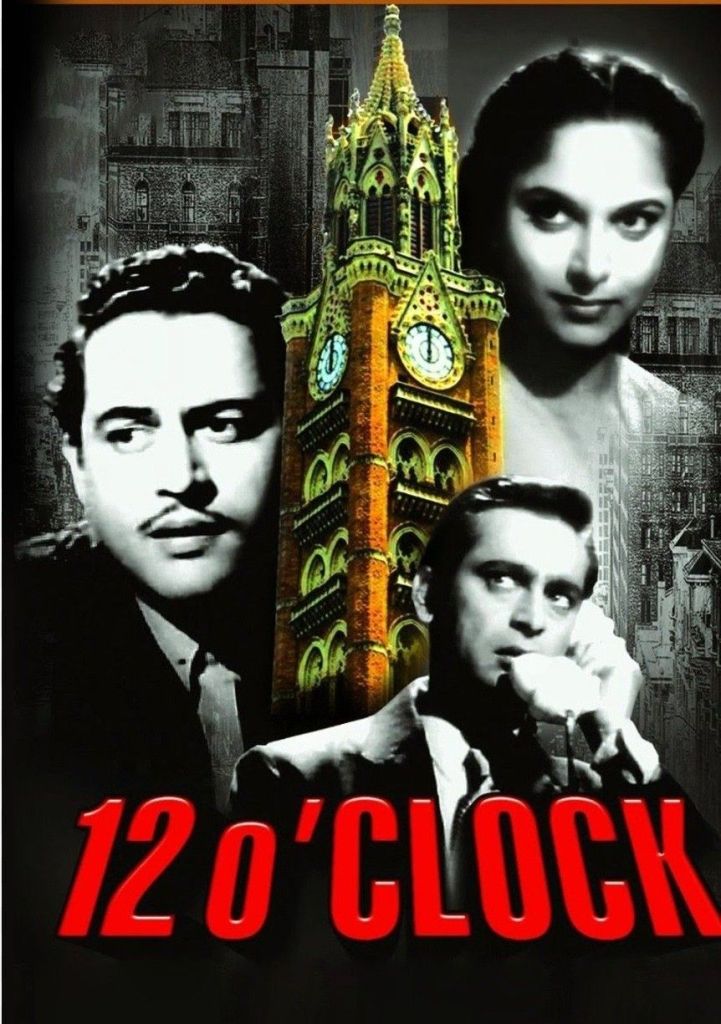

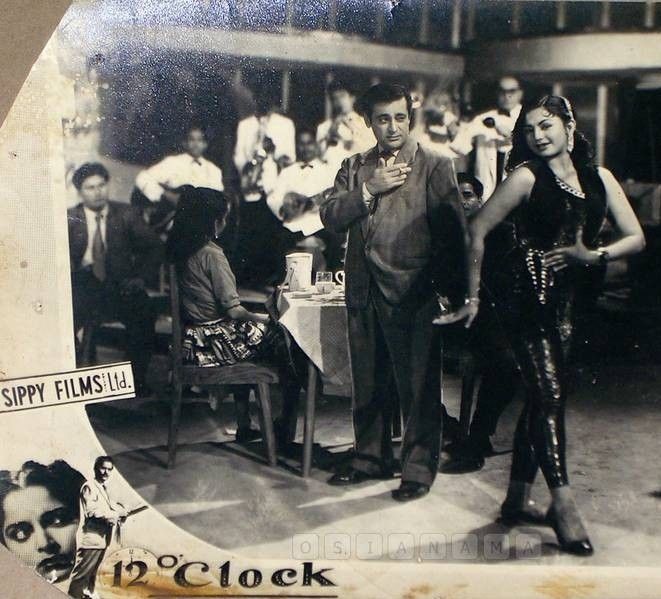
12 O’Clock is indeed a 1958 thriller and mystery film featuring Guru Dutt, Waheeda Rehman, and Rehman. Produced by G. P. Sippy and directed by Pramod Chakravorty, the film revolves around suspenseful themes and showcases the talents of its leading actors. Guru Dutt’s performance, along with Waheeda Rehman’s charm, adds depth to the narrative.

The opening of 12 O’Clock effectively sets the stage for the film’s tension and character dynamics. Baani Chowdhury’s abrupt exit down the staircase symbolizes her emotional turmoil and discontent with her current situation. The dialogue between her and Rai Mohan introduces key themes of familial relationships and estrangement.
Baani’s frustration about Maya’s silence highlights feelings of neglect and abandonment, suggesting a deeper rift in their relationship. This initial conflict serves as a catalyst for the unfolding mystery and intrigue, inviting viewers to explore the complexities of these characters and the hidden motivations behind their actions.
Baani’s arrival at her mamaji’s home introduces a new setting and potential for character development. Her uncle’s warm welcome contrasts sharply with her earlier interactions, suggesting a refuge from her troubled relationships. The mention of her new job as a secretary to lawyer Ajay (played by Guru Dutt) opens up a pathway for her character’s independence and agency.
Working for Ajay could lead to new dynamics between them, especially considering Guru Dutt’s reputation for playing complex characters. This job also serves as a plot device that could intertwine her personal struggles with professional challenges, especially in the context of the thriller and mystery genres.
On the night when the train is due, Baani arrives at Rai Mohan’s place, her demeanor still cold and distant towards him. She bluntly informs him that once her didi, Maya, returns, she plans to claim the inheritance their chachaji left behind. Rai Mohan, ever the smooth talker, tries to reassure Baani with his charming smile, telling her that of course she will get what is rightfully hers. He suggests they go to the station together to meet Maya. Baani, though suspicious, seems intrigued, while Rai Mohan, hiding his true intentions, maintains his suave and composed exterior.
At the station, as the train pulls in and stops, Maya appears at the door. Baani, feeling flushed and disoriented, reaches into her bag for a handkerchief, but to her shock, she pulls out a pistol instead. At the same instant, Khanna, who had alighted earlier, fires at Maya. The gunshot echoes through the platform, and Maya collapses, fatally wounded.
In a panic, Baani—still clutching the pistol—accidentally pulls the trigger. Though she’s unsure if her shot hits anyone, the sound of the second gunshot only intensifies the chaos. As Maya lies dead, Khanna flees on a motorbike, but his escape is cut short when he’s struck by a vehicle and killed in the crash.
The authorities arrive quickly, finding Baani with the gun in hand. She’s immediately arrested. During the subsequent interrogation, Baani is a wreck, tearfully insisting she didn’t kill Maya. She’s overwhelmed by fear and confusion, unable to explain how the pistol ended up in her bag or why she fired it in the first place. Her words come out in disjointed sobs as she pleads her innocence.
Ajay is called in, and he rushes to the police station to support Baani, hoping to understand what went wrong. But Baani, caught in a whirlwind of shock and grief, has no clear answers for him. The more they try to unravel what happened, the deeper the mystery becomes, leaving Ajay, Baani, and the investigators with a tangled web of confusion and suspicion.
Baani is now fully ensnared in Rai Mohan’s meticulously crafted trap. With Maya out of the picture and Baani conveniently implicated in the murder, Rai Mohan’s devious plan to seize his late wife’s wealth is falling into place. The pistol in Baani’s bag, the coincidental timing of the shots, and Khanna’s quick demise—all of it has been orchestrated with precision to not only eliminate Maya but also remove Baani as an obstacle.
Rai Mohan’s charming facade and carefully laid schemes have worked perfectly. By framing Baani, he ensures that suspicion falls entirely on her, allowing him to gain control of Maya’s inheritance. With Baani seemingly guilty of murder, her protests of innocence are drowned out by the overwhelming circumstantial evidence, leaving her trapped in a web of deceit and betrayal.
As the police investigation unfolds, it becomes clear that Rai Mohan has left no loose ends. His plan is clean, efficient, and coldly calculated, designed to leave Baani with no way out.
Rehman delivers a masterful performance as Rai Mohan, a suave yet utterly ruthless criminal whose every move is coldly calculated. His character’s charm hides the dangerous manipulator beneath—a man driven solely by greed and ambition. Rai Mohan doesn’t even care for Neena, the woman he’s strung along with promises of love and devotion. To him, she’s just a pawn in his elaborate game, a means to an end. All he truly wants is a child, one he can falsely claim as his and Maya’s, to secure the inheritance he so covets.
Rehman’s portrayal of Rai Mohan exudes charm, especially in his interactions with Baani. He plays the concerned brother-in-law perfectly, feigning worry over her well-being while secretly orchestrating her downfall. His mourning for his wife Maya is an elaborate performance, designed to elicit sympathy and divert suspicion from his true motives. With his smooth facade and effortless deceit, Rehman as Rai Mohan moves through the narrative with calculated precision, pulling off every manipulation with consummate ease. His ability to maintain his composure while weaving his web of lies makes him the standout antagonist, ruthlessly focused on securing Maya’s wealth at any cost.
Ajay Kumar’s urgent rush to Baani’s side establishes him as her primaryally and sets the stage for his character’s arc as a determined lawyer. His commitment to uncovering the truth adds a layer of urgency to the plot, emphasizing the race against time to prove Baani’s innocence. The introduction of his assistant, Motilal Sharma (played by Johnny Walker), not only provides comic relief but also serves as a practical partner in the investigation, showcasing a dynamic that can balance tension and humor.
Ajay and Motilal start their quest for clues, the film’s pacing likely picks up, intertwining moments of suspense with potential twists as they uncover the deeper layers of the story. This setup suggests an exploration of themes like loyalty, justice, and the quest for truth, as Ajay navigates both the legal system and his personal feelings for Baani.
Baani’s subsequent arrest and her emotional breakdown convey her innocence, making her a sympathetic character caught in a web of deceit. Ajay’s arrival adds an emotional layer, as he tries to support her, yet both are enveloped in confusion and fear. This sequence not only raises the stakes but also sets the tone for the unraveling mystery.
It sounds like a keen eye for how commercial elements can influence the storytelling in Hindi suspense films. Jonny Walker’s humor is indeed a highlight, and his chemistry with Guru Dutt adds a unique charm to their collaborations.
The nuances in character portrayal and plot development add depth to the film, especially with Rehman’s role as a cunning villain. Rehman’s performance as the manipulative brother-in-law must add a compelling layer to the story, especially in a genre that thrives on complex characters and moral ambiguity. The subtleties in storytelling, like Helen’s cameo and the courtroom scenes, contribute to a more engaging narrative. It sounds like the film balances suspense and character dynamics effectively.
The music in the film, composed by the legendary O.P. Nayyar with lyrics by Sahir Ludhianvi and Majrooh Sultanpuri, stands out as a key highlight. Among the tracks, Tum Jo Hue Mere Humsafar has garnered the most recognition over time, becoming one of the more iconic romantic numbers in Nayyar’s repertoire. Its melodious composition and heartfelt lyrics have made it a memorable classic.
However, there are several other songs in the soundtrack that deserve appreciation. Arre Tauba is a lively, playful tune with a distinctive rhythm, showcasing Nayyar’s knack for blending energetic beats with catchy melodies. Main Kho Gaya Yaheen Kaheen is a haunting, introspective song, reflecting deeper emotions with its gentle melody and evocative lyrics. Kaisa Jaadoo Balam Tune Daara stands out for its whimsical and enchanting quality, capturing the listener’s attention with its charm.
Each of these songs showcases the collaborative genius of Nayyar, Ludhianvi, and Sultanpuri, who together crafted a rich musical experience that complements the film’s narrative while standing the test of time.
Photos courtesy Google. Excerpts taken from Google.
 Writer Sunita