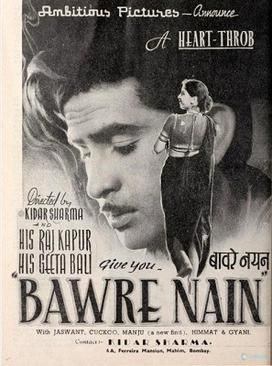
Bawre Nain (1950), directed by Kidar Nath Sharma, is a classic Indian Hindi-language romance film produced under the Ambitious Pictures banner.
The film stars Raj Kapoor, Geeta Bali, and Vijayalaxmi in lead roles, with notable supporting actors such as Darpan, Prakash, Pessi Patel, Jaswant, and Cuckoo. Both Raj Kapoor and Geeta Bali were launched by Sharma in earlier films—Neel Kamal and Sohaag Raat, respectively—further cementing his reputation as a director who nurtured talent.
This plot appears to be from the film, which tells the story of Chand and Tara, two individuals whose romantic connection is tested by separation, misunderstandings, and the arrival of a third person. Chand, after being evicted from his home due to unpaid rent, relocates and meets Tara. Their mutual attraction blossoms, but Chand is unable to find stable employment and moves again, leaving Tara behind.
Tara, hopeful and determined to rekindle their relationship, sets out to find Chand after months of silence. However, she is met with a shocking revelation: Chand is now with Rajni, a woman who claims to be his betrothed, and they are supposedly on the verge of getting married. This twist introduces themes of love, betrayal, and the complexities of relationships.
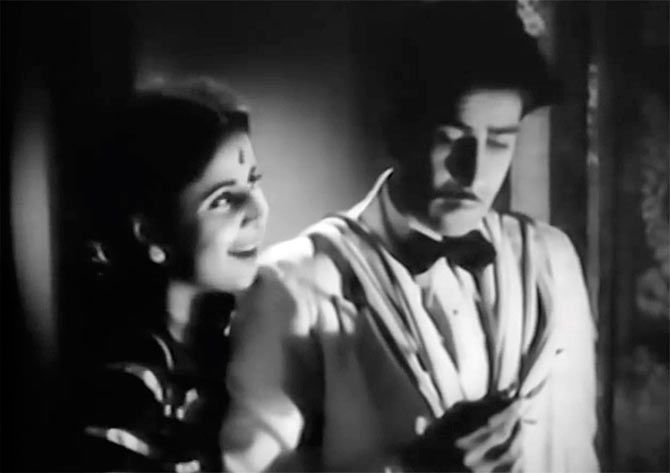
In Bawre Nain, this central conflict is enhanced by the film’s emotional depth, supported by beautiful music and performances, particularly by Raj Kapoor and Geeta Bali as Chand and Tara. Their characters’ journey is filled with emotional challenges, further enriched by the melodious and soulful soundtrack, which is integral to the storytelling.
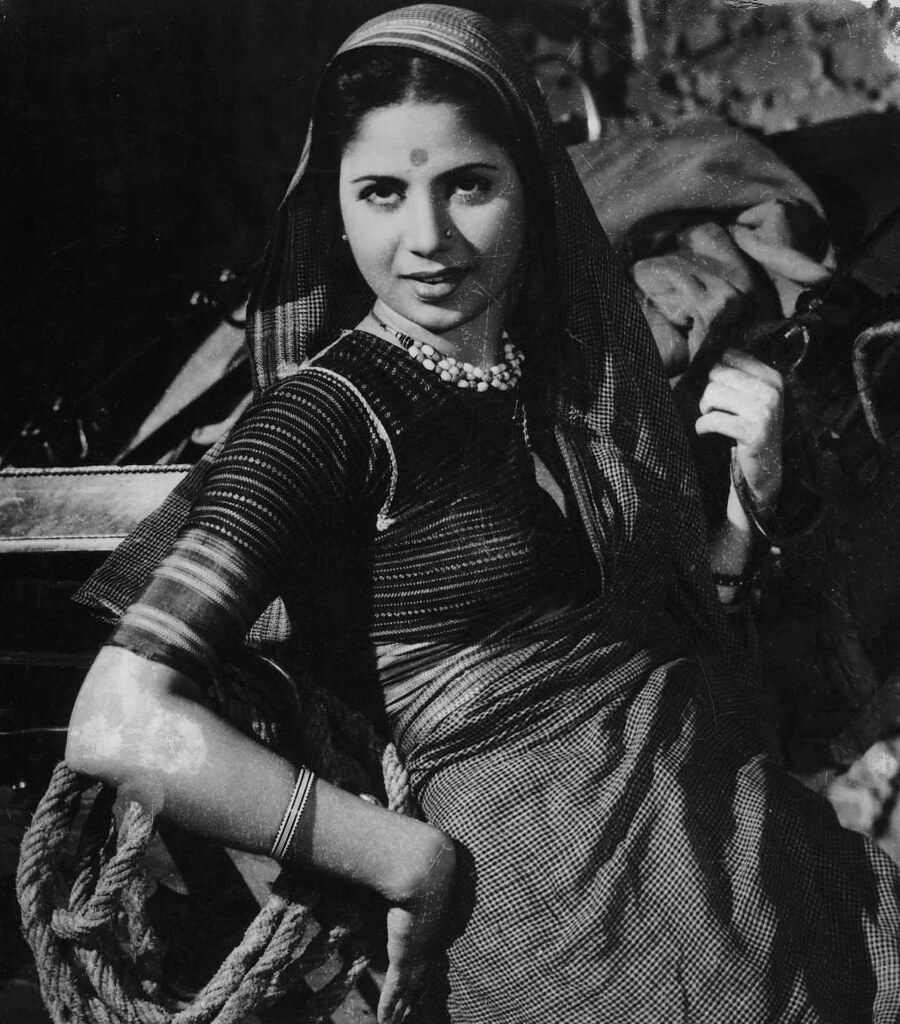
According to author S. M. M. Ausaja, Geeta Bali received widespread acclaim for her performance in Bawre Nain, especially for her portrayal of the village belle, Tara. Bali’s natural charm and expressiveness resonated with both audiences and critics, solidifying her reputation as a versatile and engaging actress. Ausaja also highlights that the music of Bawre Nain played a significant role in its success, elevating the film to classic status.
Despite initial skepticism from distributors regarding Roshan’s potential as a music composer—following the commercial failure of Neki Aur Badi (1949)—Sharma stood by him. This decision proved fruitful, as the film’s music played a pivotal role in its success, marking Roshan’s first major hit as a composer. Songs like “Khayalon Mein Kisi Ke” became beloved by millions, and the film solidified Roshan’s place in Indian cinema, launching him on a successful career as a music director.
Mukesh’s vocal versatility and soothing tonal quality were masterfully utilized in the song “Teri Duniya Mein Dil Lagta Nahin” from Bawre Nain. Composed in Raag Darbari Kaanada, this song effectively captured the melancholic and introspective mood of the narrative, highlighting Mukesh’s ability to convey deep emotions through subtle variations in his voice. The song played a crucial role in Mukesh’s growth as a playback singer, helping him gain recognition and popularity, particularly as the voice of Raj Kapoor. This collaboration marked the beginning of Mukesh’s strong association with Kapoor, which would continue through many memorable songs in Indian cinema.
Rajkumari’s rendition of the song “Sun Bairi Balam Sach Bol Re” in film was another standout number from the film. Her powerful and emotive singing matched Geeta Bali’s vibrant on-screen energy, capturing the essence of the character and enhancing the emotional depth of the scenes. This song further contributed to the film’s musical success.
In addition, Mohammed Rafi and Asha Bhosle lent their voices to the duet “Mohabbat Ke Maaron Ka Haal,” which was also popular. The combination of Rafi’s soulful voice and Bhosle’s expressive singing added a playful dynamic to the song, showcasing the versatility of the film’s soundtrack. Together, these songs helped Bawre Nain become a musical classic, with a rich variety of emotional tones.
Raj Kapoor was given his first major break in the film industry by Kidar Nath Sharma, who hired him as an assistant director and later cast him in acting roles. Sharma was instrumental in shaping Kapoor’s early career, creating “highly stylized romantic characters” for him, including the character in film, which became Kapoor’s second collaboration with Sharma after Neel Kamal.
Geeta Bali was another talent discovered by Sharma. In his book The One And Lonely Kidar Sharma, he recounts how he met Bali and her family, who were living in humble circumstances at the time. Impressed by her charm and potential, he cast her in her debut film and later chose her for the role of Tara, the village girl in film, where she played a woman searching for her lost love. Bali’s performance in Bawre Nain became a defining moment in her career, earning her critical acclaim and establishing her as a significant actress in Hindi cinema.
In film, Vijayalaxmi portrayed Rajni, a “modern” and educated woman, a character often associated with the archetype of the “vamp” in Hindi films of that era. Such characters were typically used to contrast the traditional, virtuous female leads, often seen as more rooted in rural or cultural values. Rajni’s modernity, sophistication, and assertiveness in claiming Chand as her betrothed reflect the common trope in classic Hindi cinema, where the “vamp” was portrayed as a foil to the simpler, more traditional heroine, in this case, Geeta Bali’s village belle, Tara. This dynamic helped to heighten the emotional tension and conflicts in the narrative.
Photos courtesy Google. Excerpts taken from Google.
 Writer Sunita