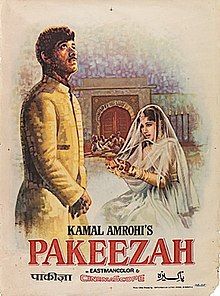
Pakeezah (1972) is an iconic Indian musical romantic drama, directed, written, and produced by Kamal Amrohi, with Meena Kumari in one of her most memorable roles. The film centers on Sahibjaan, a tawaif (courtesan) from Lucknow, whose beauty and grace captivate those around her, but whose profession creates barriers in her personal life.
The story of Pakeezah begins with the poignant tale of Nargis (portrayed by a bronze-haired, grey-eyed Meena Kumari), a tawaif who elopes with her lover, Nawab Shahabuddin (played by Ashok Kumar). Defying societal norms, Shahabuddin brings Nargis to his home, but his “honourable” family rejects her due to her profession. Heartbroken and shamed, Nargis leaves Shahabuddin’s household and finds refuge in a graveyard, where she spends the final months of her life.
Alone in the desolate graveyard, Nargis gives birth to a daughter. Overcome by sorrow and isolation, she passes away soon after childbirth. Her sister, Nawabjaan (played by Veena), learns of Nargis’s fate and arrives at the graveyard, where she takes the infant daughter under her care, vowing to raise her as her own.
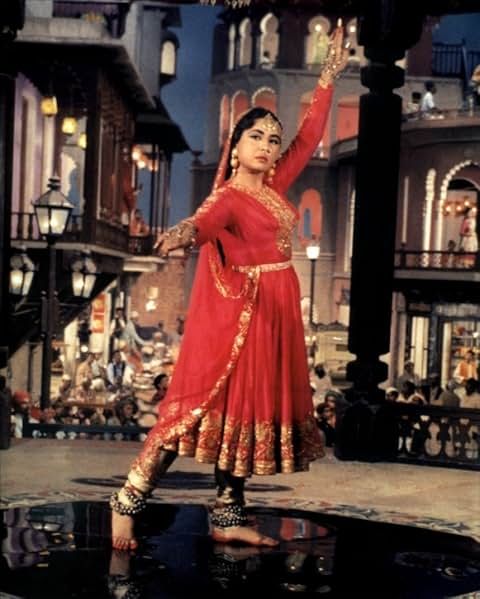
Seventeen years later, Shahabuddin—who has long been unaware of his daughter’s existence—comes across a letter written by Nargis on her deathbed. The letter reveals the existence of their child, which prompts Shahabuddin to rush to Nawabjaan’s kotha (courtesan house) to claim his daughter, Sahibjaan (now also portrayed by Meena Kumari, this time without the distinctive bronze wig and grey lenses). However, Nawabjaan, now the matriarch of the kotha, informs him that Sahibjaan is currently occupied performing a mujra (a traditional dance performed by courtesans) and suggests he come back in the morning to meet her.
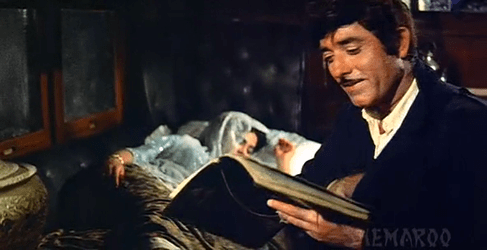
Nawabjaan, unwilling to surrender her beloved niece to Shahabuddin, takes matters into her own hands and quickly spirits Sahibjaan away before Shahabuddin can claim her. The two travel overnight by train, seeking to evade him. During their journey, as both Nawabjaan and Sahibjaan sleep in their compartment, a fellow passenger accidentally boards their compartment. Unable to disembark until the next station, the note left by Salim (Raaj Kumar) on the train, admiring Sahibjaan’s feet and asking her not to let them touch the ground, serves as a poignant symbol of both hope and irony in Pakeezah. His words—“Aap ke paon dekhe, bahut haseen hai. Inhe zameen par mat utariyega—maile ho jayenge” (“I saw your feet. They are really beautiful. Please do not step on the ground … avoid making them dirty”) —are filled with reverence and admiration, elevating her beauty in a way that no one else in her life has done. Before departing the train, he takes a multicolored feather—used by Sahibjaan as a bookmark—as a keepsake. For Sahibjaan, who has spent her entire existence as a courtesan (tawaif), this note stands in stark contrast to the objectification and exploitation she endures daily. It offers her a fleeting glimpse of purity and respect, something she has long been denied.
The irony lies in the fact that, as a tawaif, Sahibjaan’s profession literally demands that she place her feet on the ground, not in any sacred or revered manner, but to perform mujras for the pleasure and entertainment of men. In doing so, she “dirties” her feet, both literally and metaphorically, by dancing for patrons who see her only as an object of desire, not as a person worthy of respect or love. This cruel contradiction—between Salim’s idealized view of her feet and the reality of her profession—underscores the inner conflict Sahibjaan experiences throughout the film.
The note gives her hope because it is the first time someone has admired her in a way that transcends her role as a courtesan. It represents the possibility of a different life, one where she can be loved and valued for who she is, not what she does. As she holds onto this note, it becomes a symbol of her longing for escape from the oppressive world of the kotha and the chance at a more dignified existence, even as she continues to navigate the unwelcome advances and attention from her patrons.
Meanwhile, Sahibjaan’s life as a tawaif continues. Nawabjaan purchases a grand haveli (mansion) to serve as both a residence and a stage for Sahibjaan to perform her art. Under the supervision of the more experienced Gauharjaan (played by Nadira), Sahibjaan dances and sings for wealthy patrons, among whom is a nawab (portrayed by Kamal Kapoor). Gauharjaan, ever shrewd, immediately recognizes the nawab‘s deep infatuation with Sahibjaan and sees an opportunity to secure wealth through him.
However, while Sahibjaan performs for these men, she remains emotionally distant. Her heart belongs to the memory of the unknown stranger who left her the note on the train. In secret, she dreams of him, the one man who admired her without seeing her as merely a courtesan, giving her a fleeting glimpse of love and respect in a life otherwise steeped in societal shame and objectification. This longing for her mysterious admirer becomes Sahibjaan’s private refuge amidst the demands of her profession.

Sahibjaan’s life takes a dramatic turn during a fateful barge trip down a river with the lecherous nawab. As the barge sails, disaster strikes when rampaging elephants cause the vessel to wreck. In the chaos, the nawab meets a tragic end, but Sahibjaan survives, washing ashore near an empty tent. Exhausted and disoriented, she seeks refuge in the tent, only to be struck by a powerful sense of déjà vu when she discovers something familiar—a multicolored feather bookmark, the same one that was taken from her by the stranger on the train.
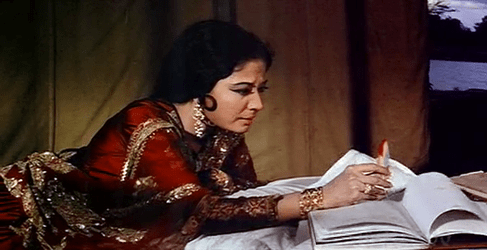
Curious and intrigued, Sahibjaan searches the tent and comes across a diary. As she reads through its pages, she finds an account of herself—her beauty, her grace, her hennaed feet—seen through the admiring eyes of the man who wrote the note on the train. The diary is filled with longing and admiration, and Sahibjaan realizes that the tent belongs to Salim, the man who left her the note that has occupied her thoughts for so long.
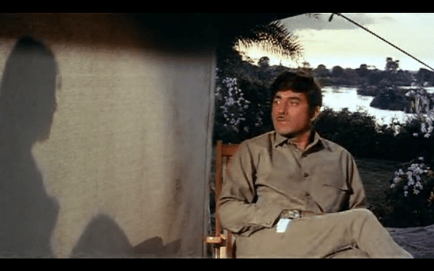
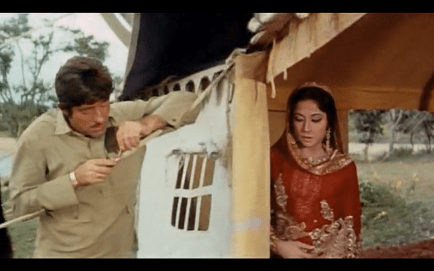
When Salim returns to his tent, he is pleasantly surprised to find Sahibjaan there, the woman who has been haunting his dreams ever since that night on the train. Their reunion, though technically their first actual meeting, is shy, tentative, but also filled with happiness and relief. Both have been longing for this moment, and now, face to face, the connection between them feels magical and predestined.
For the first time, Sahibjaan feels free—free of her life as a tawaif, unburdened by societal expectations, and in the company of a man who truly loves her for who she is, not what she represents. This moment fills her with hope, and she dares to believe that happiness is finally within reach. In the presence of Salim, she imagines a future where she is loved, respected, and no longer bound by the stigma of her past. Everything feels gloriously romantic, and for a fleeting moment, it seems that her dreams may actually come true.
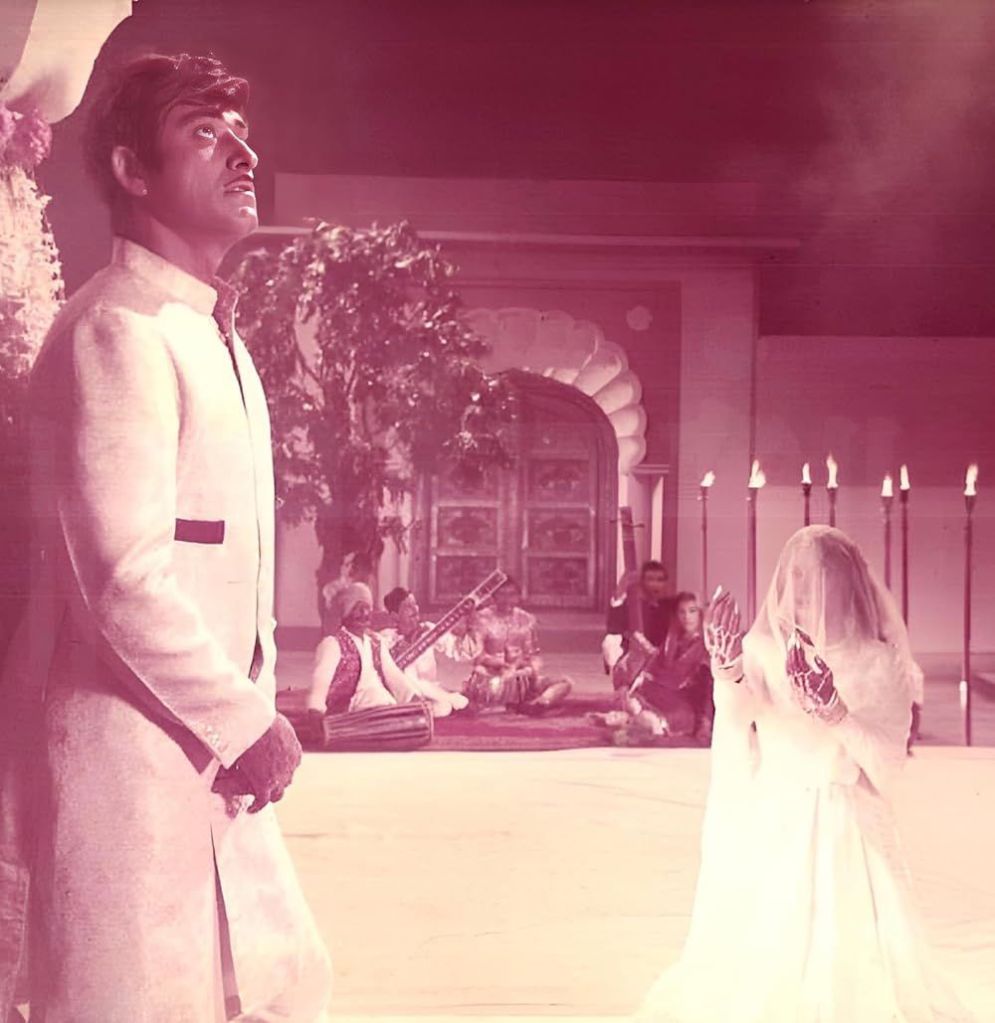
The pivotal moment where Sahibjaan, who initially refuses to marry Salim, suddenly agrees to perform at his wedding feels especially contradictory. If she had already rejected him, her decision to perform a mujra—a dance that essentially evokes the bitterness of their shared past—feels puzzling. Instead of remaining consistent in her refusal, she uses the dance as a way to confront Salim, reminding him of their love and the obstacles they faced, which raises questions about her motivations. It is as if her earlier defiance was meant to assert independence, yet this public display of her pain undermines that stance.
Nawabjaan’s sudden change of heart is difficult to reconcile with her previous actions. Having gone to great lengths to keep Sahibjaan away from Shahabuddin and the prospect of reuniting with her father, Nawabjaan’s reversal feels abrupt and unearned. After the climactic mujra at Salim’s wedding, she suddenly supports Sahibjaan’s reunion with Shahabuddin, a decision that contradicts her earlier protectiveness and the elaborate efforts she made to shield her niece from that life.
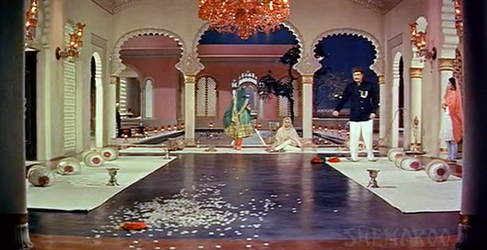
The essence of Pakeezah and its ethereal setting, the visual grandeur of Gulabi Mahal, with its chandeliers, fountains, and delicate curtains, mirrors the intricate emotional layers of the narrative. Kamal Amrohi’s direction, indeed, blends the opulence of the surroundings with the complex emotions of the characters, creating a world where the setting and story are inseparable. The maximalist visuals contribute to the film’s almost dreamlike quality, where every frame feels both lavish and poetic.
Kamal Amrohi’s use of sound motifs in Pakeezah highlights a crucial aspect of the film’s emotional depth and storytelling. The train’s whistle serves as a powerful symbol of Sahibjaan’s yearning for freedom and love, evoking the presence of her mysterious admirer and offering a glimmer of hope in her otherwise confined and melancholic life. Each time the whistle sounds, it is a reminder of an escape, a promise of something beyond the restrictions of her existence.
Similarly, Lata Mangeshkar’s haunting alaap perfectly mirrors Sahibjaan’s internal sorrow and longing. The alaap isn’t just background music; it becomes a reflection of her innermost feelings, underscoring moments of deep emotional turmoil and isolation. Amrohi’s use of these two motifs—one signifying hope and the other sadness—creates a rich auditory landscape that enhances the visual splendor of the film.
The interplay between symbolism and mood in Pakeezah, highlighting Kamal Amrohi’s craftsmanship in layering the film with meaning. The bird with clipped wings and the snake in the kotha are poignant metaphors for Sahibjaan’s life of entrapment and danger. These external symbols echo her internal struggles, making her journey a battle not only with societal confines but also with her own desires for freedom. Amrohi’s use of symbolism, such as the torn kite caught in the tree, may seem heavily emphasized, but it speaks to his desire to leave no ambiguity about the gravity of Sahibjaan’s situation—her fate is not her own, much like the torn kite that cannot fly freely.
Amrohi’s mood-setting, is masterful. By collaborating with Bombay Talkies veterans like German Wirsching and R.D. Mathur, he ensures that every frame is a visually striking tableau, meticulously designed to evoke a particular atmosphere. The camera work, with its careful attention to light, shadow, and composition, transforms the screen into a series of eloquent paintings, each telling its own story. This elevates Pakeezah from a simple narrative to an immersive experience where every visual element is infused with meaning, mood, and emotion.
Aaj Hum Apni Duaon Ke Asar Dekhenge beautifully captures the emotional and musical complexity of the song. This track is indeed a powerhouse in the way it channels Sahibjaan’s deeply suppressed pain and longing, encapsulating the core themes of Pakeezah—the conflict between love, despair, and societal entrapment.
The use of Raga Khamaaj gives the song its haunting quality, with its ability to express both love and sorrow. Lata Mangeshkar’s voice, imbued with heartbreak, carries the weight of Sahibjaan’s suppressed emotions. The lyrics, penned by Kaif Bhopali, serve as a poignant reminder of the wounds love can inflict. The phrase “Teer-E-Nazar,” typically associated with a lover’s gentle gaze, is repurposed as something sharp and destructive, transforming love into a weapon. This linguistic twist adds an extra layer of intensity, aligning perfectly with Sahibjaan’s situation.
Ghulam Mohammed’s composition deserves every bit of praise for its intricate layering of instruments that reflect the evolving emotional state. The pakhawaj, strong and powerful at the beginning, sets a commanding tone, followed by the tabla, which takes over, subtly accompanying Sahibjaan’s inner turmoil. The ghungroos, symbolic of her life as a courtesan, further accentuate the sense of entrapment, as her dance on broken glass becomes both a literal and metaphorical act of enduring pain for love. The song ends in a majestic, yet heart-wrenching crescendo, leaving an indelible impression of pain and unfulfilled love.
This track, is a tribute to the musical and emotional brilliance of Pakeezah. It’s a song that doesn’t just accompany the story but is an integral part of Sahibjaan’s narrative, expressing what words cannot.
Pakeezah was a monumental film in many aspects, and its accolades further cemented its legacy. Meena Kumari’s portrayal of Sahibjaan earned her a then record-setting nomination for the Filmfare Award for Best Actress, showcasing her ability to embody the vulnerability, grace, and emotional complexity of the character. Her performance remains one of the most iconic in Indian cinema, resonating deeply with audiences for its depth and subtlety.
The film also garnered a Special Award at the Bengal Film Journalists’ Association Awards, recognizing its artistic and technical brilliance. Kamal Amrohi’s direction, which masterfully blended rich visual storytelling with emotional gravitas, earned the film nominations for Best Film and Best Director at the Filmfare Awards. Though it did not win in these categories, the nominations alone are a testament to Amrohi’s visionary craftsmanship.
One of the film’s technical triumphs was its stunning set design, for which N. B. Kulkarni won the Filmfare Award for Best Art Direction. The intricate, opulent sets, such as the Gulabi Mahal, played a crucial role in creating the film’s dreamlike, otherworldly atmosphere, and Kulkarni’s meticulous attention to detail helped transport viewers into the ethereal world of Pakeezah. These achievements highlight the film’s artistic impact, both in terms of performance and technical mastery.
Photos courtesy Google. Excerpts taken from Google.
 Writer Sunita