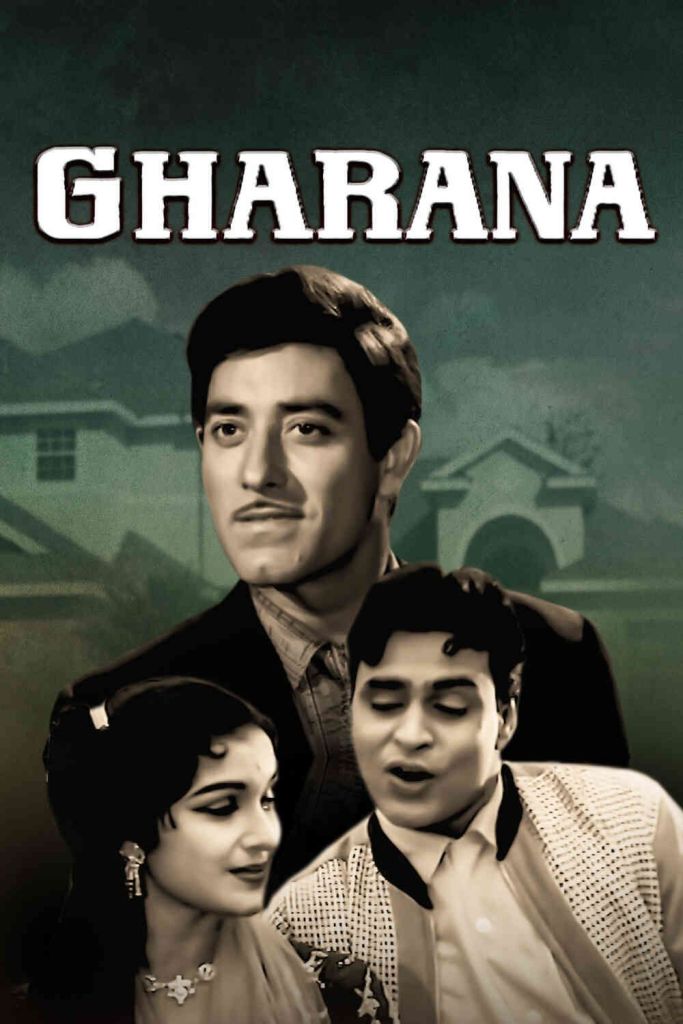
Gharana (1961) is a Hindi family drama film directed by S. S. Vasan and produced by Gemini Studios. It features an ensemble cast led by Raaj Kumar, Rajendra Kumar, and Asha Parekh.
Gharana revolves around the themes of family, tradition, and conflict between modern and traditional values. The story focuses on a middle-class family with strong ties to their cultural traditions. The film captures the tension and eventual resolution between the older generation, which adheres to strict customs, and the younger generation, which seeks to embrace more modern ideas.
The film Gharana presents a compelling family drama centered around a large household ruled by the tyrannical matriarch Shanta (Lalita Pawar). The plot dives deep into family dynamics, generational conflicts, and interpersonal tensions, showcasing various facets of human relationships within a traditional Indian family.
At the core of the story is Shanta, the dominating mother who runs the family with an iron fist. Her husband, Ramdas (Bipin Gupta), is a religious and submissive figure who lets Shanta control the household without opposition. This imbalance in power affects everyone in the family, from their children to their in-laws, setting the stage for tension.
The eldest daughter-in-law, Gauri, is a widow, left to raise her two young sons in an environment dominated by Shanta. Gauri’s situation emphasizes the hardships faced by widows in traditional settings, where they must navigate life with little autonomy or support.
Raaj Kumar plays the middle son, Kailash, who is married to Sita (Devika), a devoted and loving wife. Their seemingly happy marriage starts to unravel due to misunderstandings fueled by Bhairavi (Shubha Khote), Shanta’s daughter. Bhairavi is shown as spoiled and manipulative, taking full advantage of her mother’s indulgence. Her discontent in her own married life leads her back to her parental home, where she sows discord, particularly between Kailash and Sita.
The youngest son, Kamal (Rajendra Kumar), represents the new generation, as he is a college student in love with Usha (Asha Parekh). Their romance serves as a subplot but eventually becomes intertwined with the family drama when Bhairavi plants doubts in Kailash’s mind about his wife, Sita, and Kamal having an affair. This seed of suspicion drives Kailash to drastic actions, including separating from his wife and attempting suicide.
Kailash’s mental turmoil due to the unfounded suspicion leads him to contemplate suicide, but he is saved by Ragini, a dancer and a respected friend. Despite Ragini’s admiration for Kailash, she maintains a platonic relationship with him, understanding his vulnerabilities and guiding him back to reason. However, Kailash’s emotional instability leads him to pursue Ragini romantically, even though she only sees him as a friend. This subplot emphasizes the themes of loyalty and the boundaries of relationships.
The climax of the film revolves around Kailash’s realization of his mistake, and the family slowly mends the fractured relationships. The misunderstandings are cleared, and Kailash reconciles with Sita, understanding the importance of trust and communication in a marriage.
The music for Gharana was composed by the legendary duo Ravi and Ghulam Mohammad, with lyrics by Shakeel Badayuni. The film’s soundtrack became immensely popular, especially songs like:
- “Husnwale Tera Jawab Nahin” translates to “O beautiful one, there is no comparison to you.” The song is a flirtatious and playful exchange between the leads, expressing romantic admiration. It showcases Kamal’s lighthearted nature and Usha’s grace, symbolizing the romantic chemistry between them.
- “Dadi Amma Dadi Amma Maan Jao” is a popular, light-hearted song sung by Asha Bhosle and Kamal Barot, this delightful number features the younger members of the family playfully teasing their grandmother (Dadi), trying to convince her to give in or agree to something. A lighthearted song featuring Lalita Pawar. The song is iconic for its catchy, playful tune and the humorous interaction between the younger generation and the elder, highlighting generational differences in a fun, musical way. The lyrics are simple and light, making it a favorite of many during that era, and even today, it’s remembered as a charming, evergreen song that reflects the innocence of youth and familial relationships.
- The song “Jay Raghunandan Jay Siyaram” from the movie Gharana (1961) is a devotional piece, performed in praise of Lord Rama and Goddess Sita. It is a traditional bhajan that highlights themes of devotion. This song is a pivotal moment in the film, reflecting the spiritual atmosphere of the household. The characters use the song to seek divine blessings and guidance amidst the challenges they face in their family life. The devotional tone of the song contrasts with the more dramatic and emotional elements of the story, offering a moment of spiritual reflection and peace.
The songs became a huge hit, and the film’s music played a significant role in its success.
Gharana is primarily about family unity and the generational divide, where old values are challenged by new, more liberal ideals. The film reflects the social changes occurring in Indian society in the early 1960s. The elder matriarch, played by Lalita Pawar, symbolizes tradition and orthodoxy, while the younger generation, represented by Rajendra Kumar and Asha Parekh, brings forth a desire for progress and change.
Shekhar’s character stands out due to his seriousness and sense of responsibility, and Raaj Kumar’s performance adds emotional depth to the film. He portrays the internal struggles of a man trying to balance family expectations with personal desires, contributing significantly to the film’s overall drama. Raaj Kumar’s role as Shekhar brings gravitas and intensity to the family drama.
Gharana effectively contrasts traditional values with modern outlooks through its characters. Shanta represents the old guard, maintaining strict control over the family and resisting change, while Kamal and Usha’s romance symbolizes the younger generation’s desire to break free from these constraints.
Film won Filmfare Best Music Director Award by Ravi and Best Lyricist Award by Shakeel Badayuni for the song “Husnwale Tera Jawab Nahin. “Filmfare Nomination for Best Supporting Actress Shobha Khote and Best Playback Singer, Mohammed Rafi was nominated for the song “Husnwale Tera Jawab Nahin.”
Photos courtesy Google. Excerpts taken from Google.
 Writer Sunita