
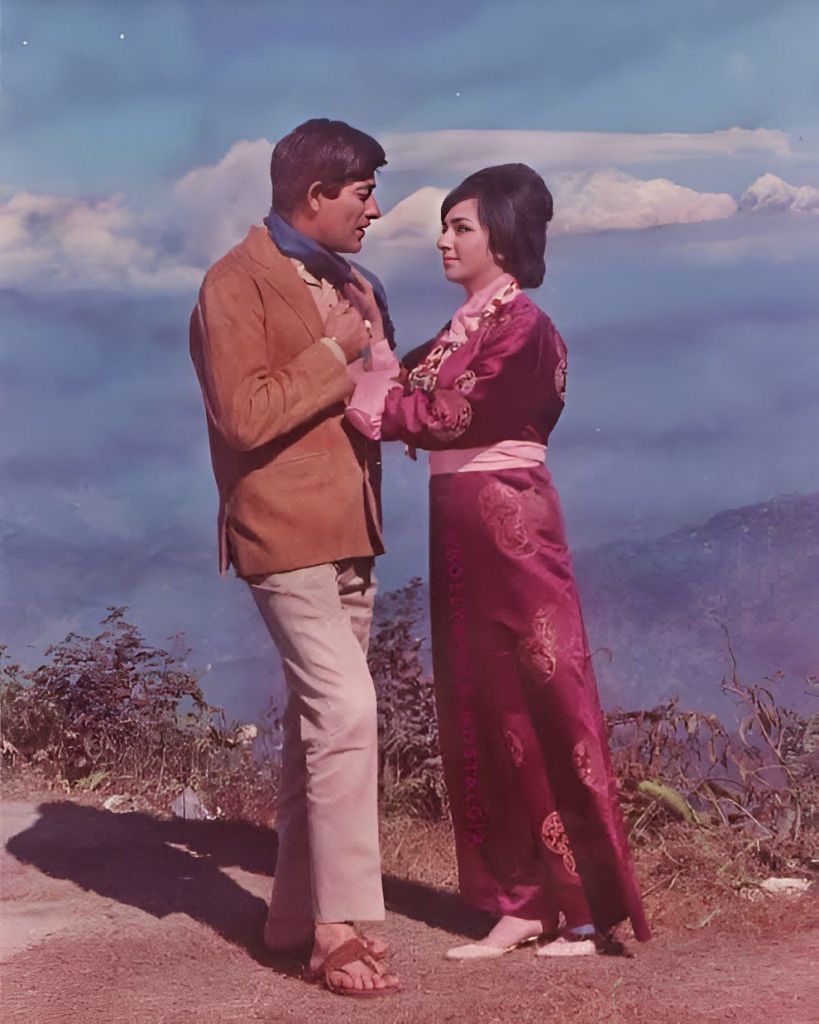
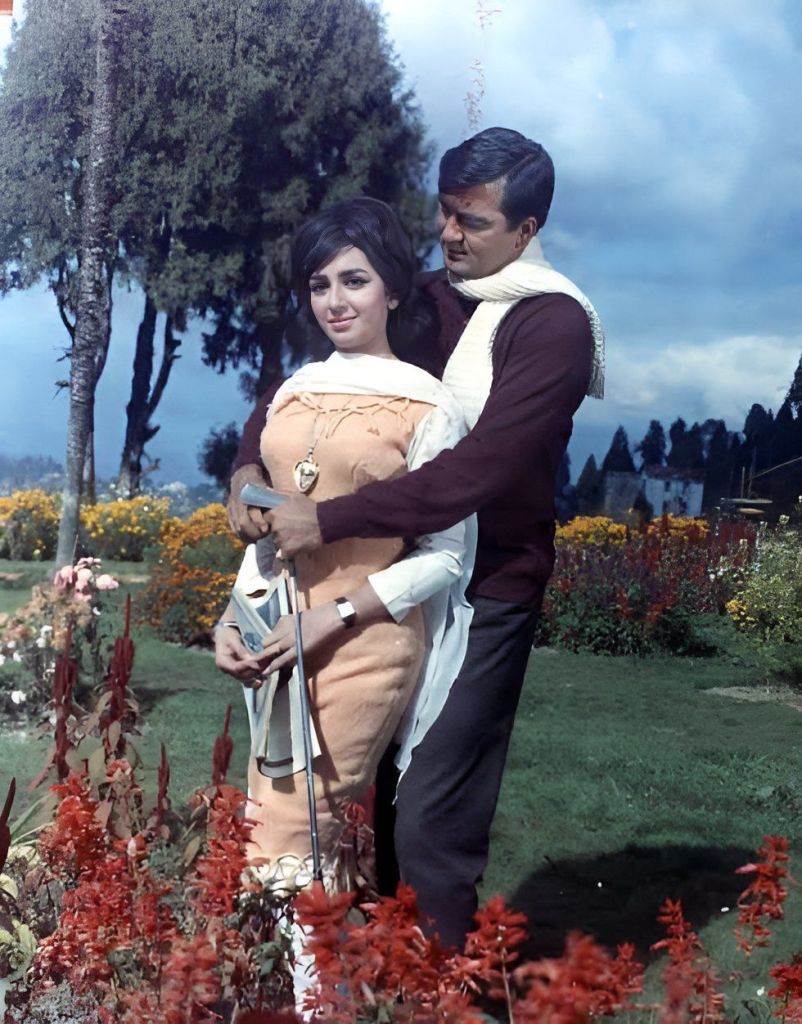
Hamraaz (1967) is a classic Bollywood suspense thriller directed by B. R. Chopra, known for his penchant for crafting socially relevant and gripping narratives. Written by Akhtar-Ul-Iman, the film features an ensemble cast, with Sunil Dutt playing a stage actor, Raaj Kumar as a brooding figure, and Vimi as the mysterious woman who becomes the center of the plot. Supported by Mumtaz, Balraj Sahni, Madan Puri, Jeevan, and Sarika, the film expertly balances intrigue, romance, and drama.
The plot revolves around the stage actor Sunil Dutt, who falls in love with a reclusive woman in the scenic locale of Darjeeling. After marrying her, he finds himself ensnared in a murder mystery that unravels layers of deception, secrets, and unexpected twists. The suspense builds as the narrative delves into uncovering the truth behind the crime, leading to a gripping climax.
In Hamraaz, the story takes a dramatic turn after the marriage of Kumar (Sunil Dutt) and Meena (Vimi). While their life initially seems blissful, a deep secret begins to unravel when Meena’s father, a wealthy military contractor named Verma (Manmohan Krishna), reveals on his deathbed that Meena had given birth to a baby girl. This event had occurred before her marriage to Kumar, and Verma had concealed the child to secure Meena’s future. He urges Meena to keep this a secret from Kumar and provides her with documents as proof of the child’s existence.
After Verma’s death, Meena’s decision to bring her daughter home from the orphanage stems from her overwhelming sense of responsibility and love. However, Kumar’s refusal, driven by his lack of knowledge about Meena’s secret, forces her into an agonizing dilemma. Meena, bound by the promise she made to her father to keep the child’s existence hidden, is left helpless. She cannot disclose the truth to Kumar, which leads to an emotional strain in their marriage.
This concealed truth becomes a ticking time bomb, heightening the film’s tension. As Meena returns the child to the orphanage, her suppressed guilt and emotional turmoil grow. This conflict becomes the core of the unfolding drama, setting the stage for the eventual murder mystery that shakes their lives.
The tension in Hamraaz escalates significantly when Meena, now trapped in a blackmail scheme, faces Mahender (Anwar Hussain), Rajesh’s (Raaj Kumar) friend. Mahender holds incriminating letters that Meena had written to Rajesh in the past, which he uses to manipulate her. His constant calls to meet at a hotel push Meena into a precarious position, forcing her to keep secrets from Kumar. As Meena begins avoiding accompanying Kumar to his stage performances and making excuses about her health, Kumar grows increasingly suspicious.
Sensing something is amiss, Kumar devises a plan to uncover the truth. He pretends to go on a trip to Pune but, instead, adopts a disguise by growing a beard and assuming the alias S. N. Sinha. He checks into a hotel under this false identity and begins his investigation, eager to discover who Meena is secretly meeting.
The mystery takes a tragic turn when, upon returning home one night, Kumar finds the front door open. Before he can make sense of the situation, he hears a gunshot. Rushing into the room, he is met with a horrifying sight—Meena lying dead, shot in the chest. This shocking incident propels the film into its central murder mystery, leaving Kumar to grapple with the devastating loss of his wife and the sinister circumstances surrounding her death.
Kumar’s desperation following Meena’s death sets off a sequence of tense and dangerous decisions. Initially enraged and ready to call the police, he quickly realizes that doing so would implicate him in her murder. His fingerprints are on the gun, he was in disguise as the bearded S.N. Sinha, and he’s been caught near the crime scene. Fearing arrest, Kumar abandons the idea of reporting the murder and instead returns to the hotel where he had checked in under the false identity. There, overwhelmed by the situation, he smokes heavily, leaving behind a crucial trail of evidence.
The case is soon assigned to Inspector Ashok (Balraj Sahni), who begins his investigation with a sharp eye. When Kumar “returns” to Bombay the next day, Ashok immediately picks up on a suspicious detail—Kumar knows the exact room in which Meena’s body was found, even though no one had told him. This raises the first red flag in the inspector’s mind.
The plot thickens as more clues pointing toward Kumar’s guilt emerge. A coconut seller near Kumar’s house testifies to seeing a bearded man lurking around on the night of the murder. Further, the owner of the hotel where Kumar checked in as S.N. Sinha alerts the police about the mysterious bearded guest. The cigarettes Kumar smoked at the hotel are handed over to Inspector Ashok, and when Ashok visits Kumar at home the next day, Kumar unwittingly offers him the same brand of cigarettes. This seemingly innocent gesture only intensifies Ashok’s suspicion.
As the investigation progresses, these mounting clues place Kumar at the center of the murder case, making it increasingly difficult for him to prove his innocence. The walls are closing in on Kumar, as all evidence points to him being the killer, adding to the suspense as the audience is left questioning whether Kumar truly committed the crime or if he is being framed.
The plot reaches its gripping climax as Kumar, overwhelmed by suspicion and fear, chooses to flee from Inspector Ashok’s ever-growing scrutiny. His lawyer friend Jagmohan (Iftekhar) warns him that there’s no way out, and Kumar will likely be implicated as the murderer. In a desperate bid to prove his innocence, Kumar stumbles upon a crucial clue at his home—a key with a room number to a hotel. This key leads him to his final chance of uncovering the truth.
Kumar checks into the hotel room, where he unexpectedly meets Captain Rajesh. Rajesh, calming the frantic Kumar, reveals startling truths: He is Meena’s first husband, who was thought to have died in action. Rajesh explains how he had wanted Meena to reclaim Sarika, their illegitimate child, as she couldn’t have raised her openly due to societal constraints. Rajesh, however, insists that neither he nor Kumar is the real killer.
Rajesh then tells Kumar that Sarika, Meena and Rajesh’s daughter, had witnessed the murder because she had been in the room with her mother when the crime occurred. They were playing together, unaware of the impending danger, and a video camera had been recording their activities during the fateful moment. Realizing that Sarika holds the key to identifying the murderer, Kumar and Rajesh join forces to track her down, eventually tracing her to Ooty.
Unbeknownst to them, Inspector Ashok has been tracking their movements. Just as Kumar and Rajesh think they’ve found the lead they need, Ashok, with the help of the Ooty police, arrests them. In the ensuing confrontation, Kumar manages to explain the situation, and they turn their efforts toward locating Sarika. They soon discover that she is staying with a man named Tejpal.
However, Tejpal (Madan Puri), knowing his time is up, attempts to flee with Sarika. In a dramatic showdown, Shabnam (Mumtaz) and Jagmohan arrive with a crucial piece of evidence—a videotape from the night of Meena’s murder. The tape confirms that Tejpal is the real killer. Cornered but unwilling to surrender, Tejpal grabs Sarika and threatens to shoot her if anyone tries to stop him.
This tense moment serves as the film’s suspenseful finale, where the fate of Sarika, and the truth about Meena’s murder, hang in the balance.
In the climactic final moments of Hamraaz, Captain Rajesh courageously steps in to save his daughter Sarika from the clutches of the villainous Tejpal. During the rescue, Rajesh is shot twice by Tejpal, but his brave actions ensure Sarika’s safety. With Rajesh wounded, Inspector Ashok seizes the opportunity and shoots Tejpal, killing him. Kumar rushes to Rajesh’s side as he lies dying, grateful for his sacrifice.
As the dust settles, the tragic death of Captain Rajesh marks the end of the conflict, and Sarika is finally safe. However, the emotional toll weighs heavily on Kumar. Overwhelmed by grief for his late wife Meena, he tells Shabnam that he can no longer work as a stage actor, as Meena was his sole source of inspiration. In a poignant and heartwarming gesture, Shabnam directs Kumar’s attention to Sarika, who is sitting in Meena’s seat. This symbolic moment signifies the continuation of Meena’s legacy through her daughter, and it offers Kumar a sense of hope and solace.
This pivotal scene in Hamraaz intensifies the suspense by unraveling the carefully woven layers of deception and betrayal that have gripped the characters. As secrets emerge, misunderstandings multiply, and the stakes rise, the film’s narrative becomes even more complex. This buildup of emotional and psychological tension pushes the characters to a dramatic climax, where personal revelations threaten to upend their lives.
Hamraaz stands out in the genre of suspense thrillers because of its intelligent storytelling and the way it blends mystery with deeply personal stakes. The film’s gradual unveiling of truths keeps audiences on edge, while the web of intrigue adds depth to the narrative, making it more than just a conventional whodunit. The emotional undercurrents—driven by love, guilt, and desperation—play a crucial role in cementing Hamraaz as an unforgettable and multi-layered thriller that resonates with audiences long after the final scene.
Ravi’s music, paired with Sahir Ludhianvi’s poignant lyrics, plays a vital role in deepening the emotional resonance of Hamraaz. The soundtrack not only enhances the suspenseful and romantic atmosphere but also underscores the emotional turmoil faced by the characters.
The song “Neele Gagan Ke Tale” from Hamraaz is one of the film’s most memorable tracks, sung by Mahendra Kapoor. This poignant song captures the themes of love, longing, and the vastness of life under the blue sky, making it a standout moment in the film. The lyrics convey a deep sense of yearning and reflect the emotional struggles of the characters, particularly in relation to love and separation.
The song “Na Muh Chhupa Ke Jiyo” from Hamraaz is another beautiful track that showcases the film’s emotional depth. The lyrics express themes of honesty, vulnerability, and the struggle to face one’s emotions openly. This song serves as an emotional reflection of the characters’ internal struggles, especially in relation to love and trust. It emphasizes the importance of being true to oneself and one’s feelings, making it significant to the character arcs.
Each song is strategically placed, adding layers to the narrative without disrupting the flow of the thriller. The haunting score serves as a perfect backdrop to the film’s unfolding mystery, creating an immersive experience for the audience. The film remains a standout for its ability to balance commercial appeal with artistic depth, especially through its music.
Hamraaz (1967) garnered several prestigious awards for its technical brilliance and musical excellence:
- 1968 Filmfare Best Male Playback Award: Mahendra Kapoor won this award for his powerful rendition of the song “Neele Gagan Ke Tale,” which remains one of the film’s most iconic tracks.
- 1968 National Film Award for Best Cinematography: M. N. Malhotra received this honor for his outstanding work in capturing the film’s visual splendor, particularly the scenic beauty of Darjeeling and the intense suspense sequences.
- 1968 Filmfare Best Cinematographer Award: M. N. Malhotra also earned this award at the Filmfare ceremony, further recognizing his excellent cinematographic contributions to the film.
These accolades reflect the film’s significant impact on both the artistic and technical fronts.
Photos courtesy Google. Excerpts taken from Google.
 Writer Sunita