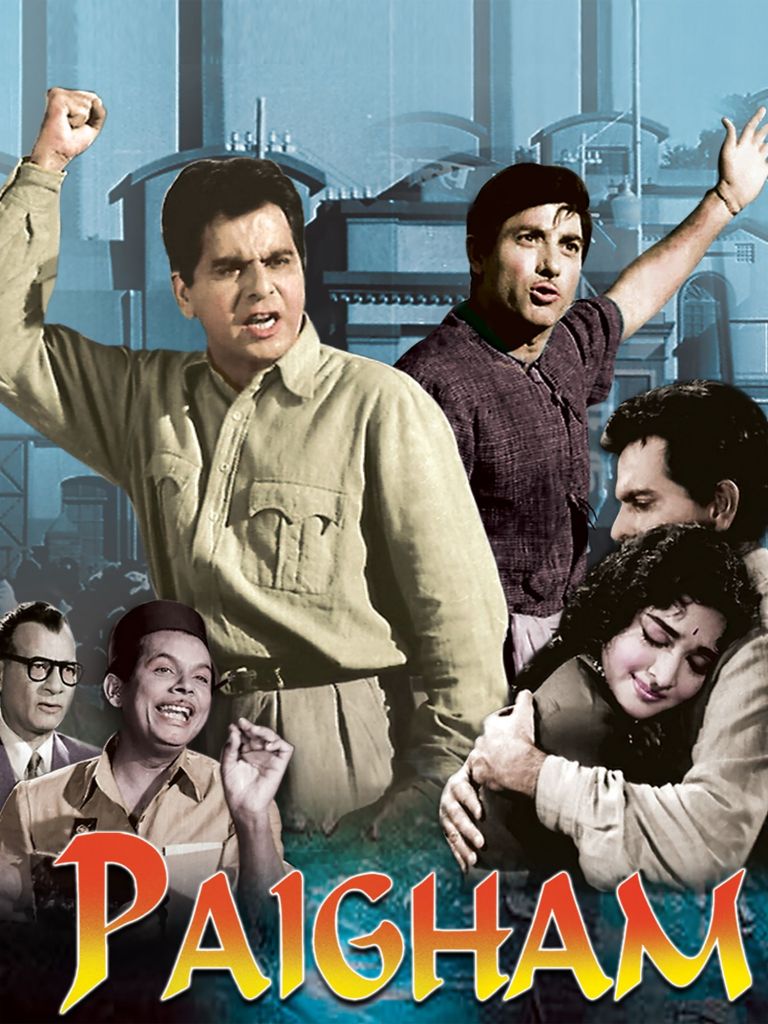

Paigham (1959) is a notable Hindi-language drama film directed by S. S. Vasan, featuring an ensemble cast led by Dilip Kumar and Vyjayanthimala. This film marked the first on-screen collaboration between Dilip Kumar and Raaj Kumar. The film features strong supporting performances by Pandari Bai, B. Saroja Devi, Motilal, and Johnny Walker. Story is two brothers who work in the same mill fall on opposite sides of a labor dispute, things get complicated between them.
In Paigham (1959), the film begins by establishing the friendship between Manju (Vyjyanthimala) and Malti (B. Saroja Devi), two recent college graduates with contrasting academic performances. Manju excels, graduating at the top of her class, while Malti, carefree and unconcerned, finishes at the bottom. Their differing priorities are further highlighted by their backgrounds—Manju is hardworking and ambitious, while Malti, the daughter of the wealthy Seth Sewakram (Motilal), enjoys the luxuries her father’s position as a successful cotton mill owner affords her.
Despite their differences, Malti remains a supportive friend, offering to secure Manju a job at her father’s mill in Rangpur, knowing that Manju’s practical education in shorthand and secretarial work can help her start a career. This initial setup introduces themes of class disparity and friendship, setting the stage for the unfolding drama as the film delves deeper into the industrial and social conflicts in Rangpur.
When Malti drops Manju off at her home, the two friends share a lighthearted moment, but tension quickly builds when Manju’s mother (played by Vasundhara Devi) meets Malti. Upon learning that Malti is the daughter of Seth Sewakram, Manju’s mother is visibly disturbed. Her reaction is extreme, with fear and shock overcoming her, suggesting that Sewakram may have a significant and troubling connection to her past.
Once Malti leaves, the gravity of the situation becomes clear as Manju’s mother collapses from the shock. Concerned and panicked, Manju immediately sets out to find a doctor, showing her care and devotion as a daughter.
Manju’s urgent quest for a doctor leads her to an unexpected encounter with Ratan (played by Dilip Kumar), a rickshaw-wallah unlike any other. When Manju first sees him, he’s engrossed in reading Mahatma Gandhi’s autobiography, a detail that immediately sets him apart and hints at his intellect and principles. As they seek out a doctor for her mother, Ratan shows a surprising assertiveness. When the doctor hesitates to come, demanding an additional fee for the late-night visit, Ratan sternly reprimands him—even doing so in English, which adds to the intrigue surrounding his character. Without hesitation, Ratan pays the doctor the extra fee himself, emphasizing his sense of responsibility and compassion.
In the chaos of the moment, Manju forgets to pay Ratan for his help. Despite this oversight, Ratan leaves a strong impression on her due to his unusual demeanor and kindness. A few days later, Manju is both surprised and pleased to encounter Ratan again, this time at Sewakram’s cotton mill, where she has taken a job in the office—despite her mother’s unexplained protests.
Ratan’s return to Rangpur is greeted with joy and excitement by his family. After finishing college in the city, he reunites with his elder brother Ram Lal (Raaj Kumar), their mother (Pratima Devi), and the rest of the family, including Ram Lal’s wife (Pandari Bai) and their children. The family is particularly thrilled about the upcoming engagement of Ram Lal’s daughter Kamla, which adds to the festive atmosphere.
Ratan’s homecoming leads him to visit the cotton mill where Ram Lal works. As Ram Lal shows his younger brother around, an unexpected problem arises—a critical machine breaks down. The mechanic, after examining it, informs Sewakram and the mill’s manager (played by S.N. Bannerjee) that the damaged part will need to be imported, causing a two-week halt in mill operations. This puts Sewakram in a difficult position, as the mill cannot function without the replacement part.
Ratan, who has been quietly observing the situation, steps forward and offers a surprising solution: he reveals that he is a trained engineer and can manufacture the part himself.
Ratan’s engineering skills are swiftly proven when he successfully crafts the vital machine part by the end of the day. The film takes care to show the technical process involved, from pouring molten metal into a mold to working on the grooves, which adds a sense of realism and highlights Ratan’s craftsmanship. His success impresses Sewakram, who rewards him with a job at the mill, and everything seems to be falling into place for Ratan, professionally and personally.
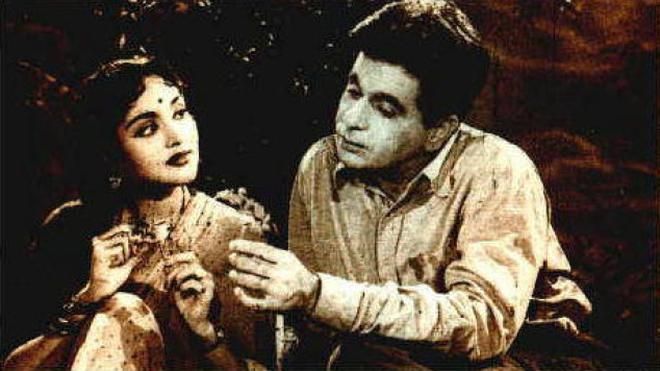
With Ratan now working at the mill, he and Manju begin to spend more time together, and over the next few days, they fall in love. However, not everything is as harmonious as it seems. Malti, once Manju’s close friend, grows increasingly jealous of the developing romance between Manju and Ratan. This jealousy begins to unravel the friendship between the two women, sowing seeds of discord.
Meanwhile, Ratan’s idealistic view of the world clashes with the capitalist mindset of Sewakram, who turns out to be a selfish businessman, far from the servant of society that his name suggests. Ratan’s awakening to Sewakram’s exploitation occurs during the Diwali bonus incident, when the mill workers are asked to sign for a bonus of three months’ pay but are only given one month’s wages. The workers, grateful even for this partial bonus, fail to recognize the injustice. Ratan, however, is outraged by this blatant manipulation.
Fueled by this injustice, Ratan organizes the workers and forms a trade union to challenge Sewakram’s exploitation. He finds support in Manju, who stands by him, and Nandu (Johnny Walker), a servant in Sewakram’s household, who also joins the fight for workers’ rights. Ratan quickly rises to prominence as the leader of the workers, becoming a symbol of their struggle for fair treatment.
The conflict intensifies when Ratan discovers that Sewakram, the mill-owner, has been defrauding the mill employees. Outraged by this exploitation, Ratan decides to take a stand by forming a workers’ union, advocating for their rights. However, this move creates a rift within his own family, as his elder brother Ram, who has been loyal to Sewakram and holds him in high regard, strongly opposes Ratan’s decision. Ram believes in maintaining loyalty to the mill-owner and the status quo, which puts him in direct conflict with Ratan’s sense of justice.
As tensions rise, the workers at the mill decide to go on strike, further deepening the divide between the two brothers. In a dramatic turn, Ram, feeling betrayed by Ratan’s actions, decides to expel him from the family home. Ratan’s defiance against Sewakram earns him a reputation as a troublemaker, leading to his blacklisting in the industry, which isolates him further.
The family’s troubles do not stop there. Sheela, their unmarried sister, who was engaged to Kundan, the son of Sitaram, faces the cancellation of her marriage due to the family’s now tarnished reputation. The family’s loss of prestige and credit within the community adds to their woes, and they struggle to regain their standing amidst the social and economic fallout. The film portrays not only the personal consequences of standing up for what is right but also the larger societal challenges faced by those who challenge authority and corruption.
The film explores class conflicts, workplace dynamics, and family ties, set against the backdrop of industrial labor, highlighting the differences in aspirations between the two brothers and the challenges they face.
In Paigham, the soundtrack, composed by C. Ramachandra with lyrics by the renowned Kavi Pradeep, plays a significant but subtle role in the film. One song that stands out, particularly for its melancholic and reflective mood, is “Jawaani Mein Akelepan Ki.” This track captures the essence of loneliness and emotional isolation during youth, a theme that resonates with the inner turmoil of the characters, particularly Ratan as he navigates his personal struggles and his fight for justice.
“Yahi Paigam Hamara” is one of the memorable songs from Paigham. The song’s lyrics convey a message of unity, brotherhood, and harmony, reflecting the film’s themes of social justice and cooperation among workers. The song emphasizes the importance of togetherness and collective strength, resonating with the struggles depicted in the film, especially regarding the formation of the workers’ union and the fight against exploitation.
At the 7th Filmfare Awards, Paigham received notable recognition for its performances and writing. Ramanand Sagar won the Filmfare Award for Best Dialogue, highlighting the film’s impactful and well-crafted dialogues, which played a key role in conveying its social and family themes. Raaj Kumar was nominated for Best Supporting Actor for his strong portrayal of Ratan, while Dilip Kumar, who delivered a compelling performance as the loyal and conflicted Ram, was nominated for Best Actor. These accolades reflect the film’s excellence in both writing and acting, contributing to its success and lasting legacy.
Photos courtesy Google. Excerpts taken from Google.
 Writer Sunita