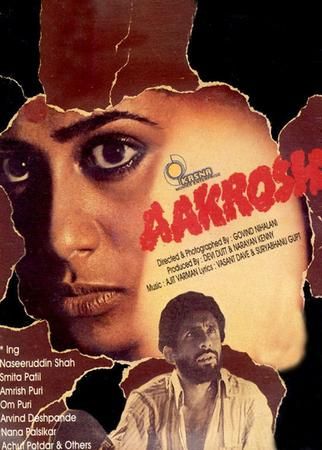
Akrosh is a 1980 Indian Hindi-language legal drama film directed and shot by Govind Nihalani in his debut, with a powerful script written by renowned playwright Vijay Tendulkar. The film stars Naseeruddin Shah, Om Puri, and Amrish Puri in pivotal roles, delivering intense performances that bring to life the harsh realities of India’s marginalized tribal communities during the 1980s.
The story of Aakrosh offers a haunting portrayal of systemic oppression, injustice, and the devastating cycle of exploitation endured by India’s tribal communities. The central character, Lahanya Bhiku (Om Puri), a tribal peasant, is arrested and charged with the murder of his wife, Nagi (Smita Patil), after she is driven to suicide following her rape by a foreman. The foreman not only violates Nagi but also frames Lahanya for a crime he did not commit, highlighting the cruelty of the powerful landowners and their ability to manipulate the law.
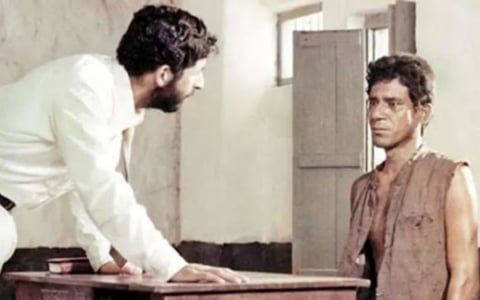
Bhaskar Kulkarni (Naseeruddin Shah), a young and idealistic lawyer, is appointed to represent Lahanya in court. With aspirations of success and a deep sense of duty to uphold justice, Bhaskar is soon confronted by the harsh reality of the situation: Lahanya refuses to cooperate or speak in his own defense. His silence, stemming from years of systemic oppression and trauma, becomes a symbol of the voicelessness of India’s tribal communities.
As Bhaskar delves deeper into the case, his investigation leads to shocking revelations about the social and legal injustices faced by Lahanya and his family. Through his journey, Bhaskar comes to understand the hopelessness that has consumed Lahanya, whose life has been marked by exploitation, betrayal, and loss.
The film reaches its shattering climax when Lahanya, shackled and escorted by the police to his father’s funeral, is confronted with yet another moment of unimaginable horror. He witnesses the same foreman who raped his wife now eyeing his young sister with lust. Realizing that his sister is doomed to a similar fate of abuse and degradation, Lahanya takes a desperate, tragic step—he kills her with an axe to save her from the endless cycle of exploitation and suffering that has destroyed his family.
In the aftermath of this act, Lahanya unleashes a primal, guttural scream of anguish, his silence finally breaking as he confronts the overwhelming oppression and cruelty that has suffocated his life. His scream echoes not just his personal pain but the collective rage of the marginalized and downtrodden.
Aakrosh is indeed based on an incident that was reportedly buried in a small section of a local newspaper, but its portrayal of corruption, judicial failure, and the victimization of the marginalized makes it a scathing critique of the Indian legal and social systems. The film serves as a grim satire, exposing how the powerful exploit the powerless, especially in India’s tribal communities.
The central character, Lahanya Bhiku, remains almost entirely silent throughout the film. His stunned, hollow expression reflects the deep psychological trauma and oppression he has endured. Lahanya’s silence becomes a powerful symbol of the voicelessness experienced by the oppressed, people whose humanity is systematically violated and who are denied any real recourse to justice. The judicial system, far from protecting him, is complicit in his suffering, leaving him unable to express his pain, anger, or helplessness in words.
This silence is punctuated only twice in the film. The first time occurs in a flashback, when Lahanya tries and fails to save his wife, Nagi, from being raped by the foreman—a moment that foreshadows his later helplessness in the face of injustice. His inability to prevent her death compounds his guilt and rage.
The second and most significant time Lahanya’s voice is during the film’s tragic climax, where his years of pent-up anger and frustration explode into violence. After witnessing the foreman cast lustful glances at his young sister during their father’s funeral, Lahanya, fearing she will face the same fate as his wife, beheads her in an act of desperate rage and protection. In this climactic scene, Lahanya lets out a primal scream, finally breaking his long silence, but only after the horrors of oppression have driven him to an irreversible act of violence.
Aakrosh is a deeply unsettling exploration of social injustice, and through its narrative of silent suffering, it critiques the failure of the judiciary and society at large to protect the most vulnerable. By centering the story on a man who is forced to bear his suffering in silence until he can no longer contain it, the film offers a stark reminder of the human cost of institutional oppression and the tragic consequences when justice is denied to the marginalized.
Akrosh masterfully weaves together themes of powerlessness, caste discrimination, and institutional corruption. It critiques the way the legal system fails to protect the most vulnerable members of society, while also highlighting the cyclical nature of violence and oppression that traps communities like Lahanya’s in perpetual suffering.
Nihalani’s gritty direction, combined with Vijay Tendulkar’s an accomplished playwright and script writer, his consistent engagement with human aggression made him a distinguished social scientist, who peeled the causes and impact of violence in our society.
Aakrosh owes a great deal of its emotional power and success to Govind Nihalani’s brilliance as a cinematographer. His visual style plays a crucial role in immersing the audience in the oppressive, bleak atmosphere of the film, creating a visceral impact that lingers long after the movie ends.
Nihalani’s use of lighting and close-ups is masterful. By playing with stark contrasts of light and shadow, he visually emphasizes the grim reality of Lahanya’s world, where the marginalized live in the shadows, oppressed and unseen. His style of using a light source to play on the images of the characters, creating shock effects etc. where cleverly used in the movie. The half lit faces adds so much to the movie, whether its the angry Lahanya or the beautiful smita. Nihalani’s framing of the actors’ faces in moments of silence, especially Om Puri’s, allows the audience to feel the weight of Lahanya’s emotional turmoil without him having to utter a single word.
This technique of focusing on the smallest details—the flicker of an eye, the trembling of lips—magnifies the internal struggle of the characters, allowing viewers to empathize deeply with their silent suffering. Aakrosh remains a standout for its seamless blending of cinematography and narrative, making it one of the most emotionally and visually powerful films in Indian parallel cinema. His camera work, combined with the haunting silences and use of natural sound, creates a heavy, oppressive mood that reflects the bleakness of the lives depicted.
Performances of the cast, make Akrosh a landmark in Indian parallel cinema, known for addressing serious social issues. Om Puri’s portrayal of the oppressed tribesman, silent yet brimming with suppressed rage, is one of the most memorable aspects of the film, and Amrish Puri adds to the film’s gravitas in his role as the corrupt and callous lawyer.
The character played by Mahesh Elkunchwar represents a Marxist who attempts to galvanize the tribal community for collective action against the oppressive forces that have long exploited them. His presence in the film adds a layer of political consciousness and highlights the class struggle faced by the underprivileged tribals. As a Marxist, he advocates for the empowerment of the working class and marginalized people, urging them to rise up and resist the entrenched power structures symbolized by the landowners, corrupt officials, and the exploitative judicial system.
Elkunchwar’s character is important because he serves as a voice for the ideological battle against oppression. He seeks to organize the tribals into a unified force capable of challenging their exploiters, a strategy grounded in Marxist principles of class solidarity and revolution. However, the character’s role also reflects the broader limitations of ideological solutions in the face of overwhelming systemic oppression. The tribals, represented by Lahanya, are so beaten down by years of exploitation that they are unable or unwilling to join the struggle, as seen in Lahanya’s passive silence throughout most of the film.
Among the most notable honors, Aakrosh won the Golden Peacock for Best Film at the 8th International Film Festival of India, a significant achievement that highlighted the film’s international appeal and the relevance of its themes beyond India. The movie’s raw depiction of societal issues resonated deeply with both Indian and international audiences, who appreciated the film’s bold stance against systemic injustice.
The film also won the National Film Award for Best Feature Film in Hindi, underscoring its importance within the Indian cinematic landscape.
Photos courtesy Google. Excerpts taken from Google.
 Writer Sunita