
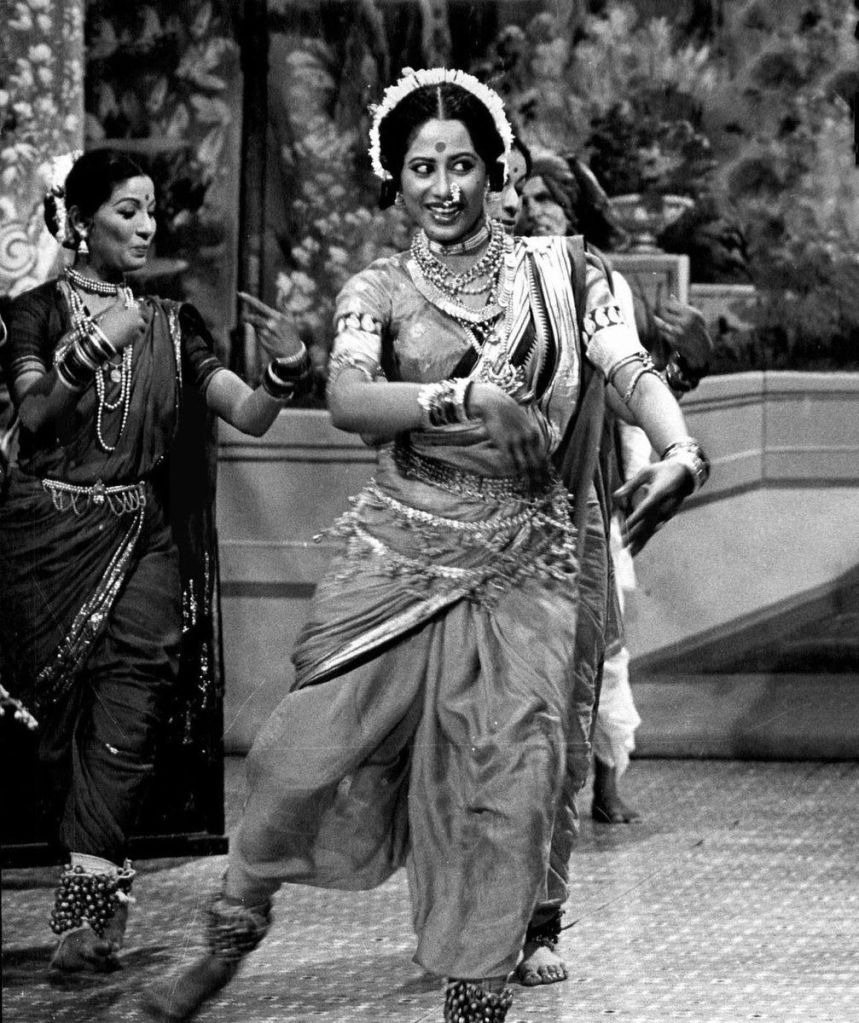
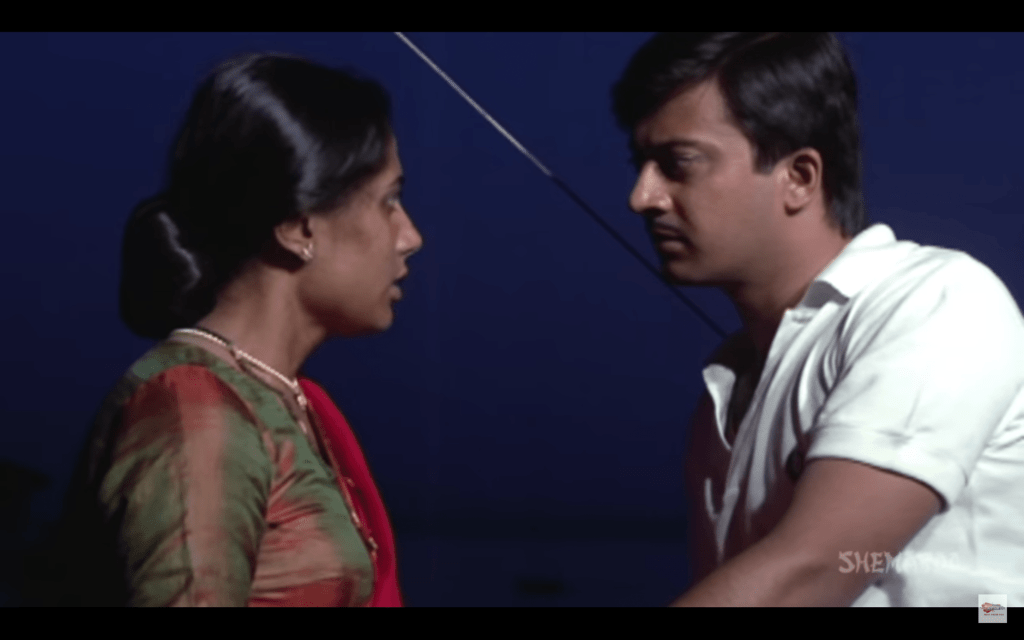
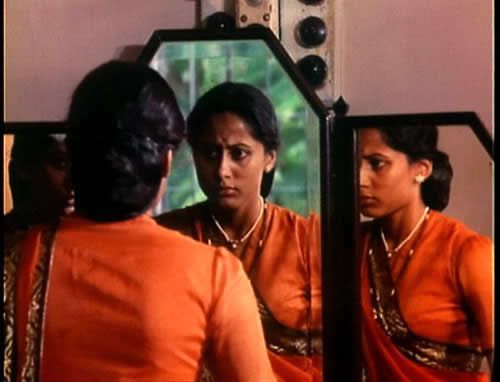
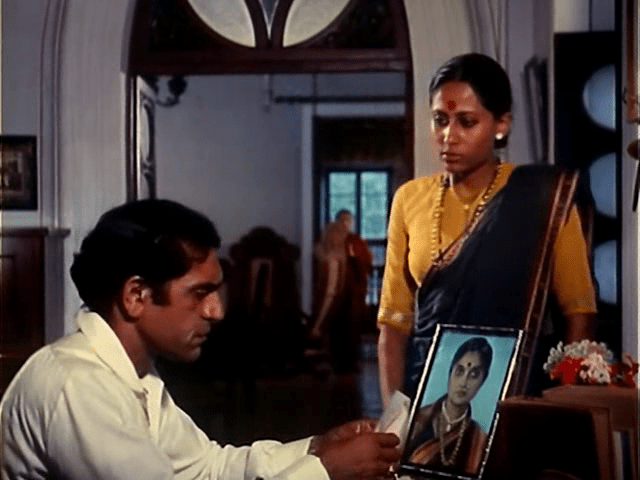
Bhumika (1977), directed by Shyam Benegal, is a powerful exploration of identity and self-fulfillment, based on the memoir Sangtye Aika (“Listen, and I’ll Tell.”) by Marathi actress Hansa Wadkar. The film traces the tumultuous life of Usha, played by Smita Patil, from her early days as a spirited teenager to a disillusioned and wounded middle-aged woman. Usha, like Wadkar, challenges societal norms, leading a life filled with personal and professional conflicts as she navigates her roles as an actress, wife, and mother.
In Bhumika, Usha (Smita Patil) emerges from a tumultuous and challenging background, rooted in the traditions of the Devadasi community in Goa, to become a successful actress. Her journey begins with her strained relationship with her mother (Sulabha Deshpande), who disapproves of Usha’s career aspirations and later, her love life. Usha’s mother, scarred by her own experience with an abusive and alcoholic husband, opposes Usha’s involvement in cinema, seeing it as a disreputable profession. Her disdain for Keshav Dalvi (Amol Palekar), a family hanger-on, stems from his caste and her belief that he does not represent a suitable match for her daughter.
Keshav, who has watched Usha since childhood, takes her to Bombay against her mother’s wishes, where Usha auditions and succeeds as a singer, marking her first step into the world of cinema. This career, which delights her grandmother, horrifies her mother, as it symbolizes a break from the traditional values Usha was raised with. Usha’s rapid rise to stardom follows, leading her to an ill-fated marriage with Keshav, a man who appears unattractive and much older, yet who has a complex hold on her.
Usha’s motives for pursuing this relationship with Keshav are ambiguous. Her decision could stem from a sense of indebtedness to him for his unwavering loyalty to her family and his role in launching her career, or she may view him as a way to escape the oppressive atmosphere of her childhood home. Furthermore, Usha’s headstrong and rebellious nature seems driven by a desire to break free from her mother’s control and to defy societal norms, relishing the independence that her acting career affords her. However, this relationship, resulting in a pre-marital pregnancy, turns out to be deeply flawed, leading to Usha’s eventual disillusionment with both her personal life and career.
Bhumika delves deeper into Usha’s turbulent marriage to Keshav, where her personal and professional lives become deeply entangled. After their marriage, Usha is shocked to find that Keshav continues to manage her career, treating her more like a financial asset than a partner. He arranges roles for her, particularly opposite heartthrob Rajan (Anant Nag), who harbors unrequited love for her. As Keshav’s own business flounders, the family becomes completely reliant on Usha’s income, creating tension in their relationship. Keshav, whose fragile ego is bruised by his dependence on his wife, grows resentful, jealous, and abusive. He pressures Usha into taking roles she dislikes, dismissing her desires to settle into domestic life after the birth of their daughter.
The toxic marriage unravels further as Keshav’s jealousy is stoked by rumors of an affair between Usha and Rajan, which is partly true. Caught in this emotionally abusive relationship, Usha is torn between her roles as a wife, mother, and actress. Her yearning for freedom and fulfillment leads her into two fleeting and unsatisfactory relationships.
The first is with director Sunil Verma (Naseeruddin Shah), who is a nihilistic and emotionally detached figure. Their relationship culminates in a failed suicide pact, which Usha initiates in her desperation. Sunil, however, backs out at the last moment, leaving Usha feeling even more disillusioned and trapped.
Next, Usha turns to Vinayak Kale (Amrish Puri), a wealthy businessman who offers her a different kind of life as his pampered mistress. On his sprawling estate, Usha initially finds some semblance of respectability, even gaining the admiration of Kale’s mother, son, and bedridden first wife. However, this arrangement comes at a great personal cost. Usha soon realizes that she has traded one form of confinement for another. Kale’s feudal, patriarchal control over her movements and decisions leaves her with no real freedom, reinforcing her sense of entrapment. Even small acts, like taking Kale’s son to a nearby fair, are forbidden, highlighting the stifling nature of her new life.
In a moment of desperation, Usha turns to the one person she despises but who represents her only way out—her estranged husband, Keshav. He takes her back to Bombay, a city adorned with billboards bearing her image, but she finds herself returning to the same drab existence in a lonely hotel, devoid of true emotional connection. Kale’s bedridden wife encapsulates Usha’s fate in a poignant remark: “The beds change, the kitchens change. Men’s masks change, but men don’t change.” This line speaks to the unchanging nature of the patriarchal control Usha faces, regardless of the different men in her life.
The film concludes on a melancholic note. Usha’s grown daughter, now married, invites her to live with her and her husband, offering Usha a chance at familial connection. However, Usha refuses, seemingly resigned to her solitary existence. The final scene shows Usha alone in her hotel room, answering a phone call from Rajan, leaving her future unresolved and her search for identity and freedom incomplete. The film ends with Usha still caught between the roles imposed on her and her unfulfilled desire for self-determination.
For Bhumika, Shyam Benegal brought together an exceptional team of writers to craft the film’s intricate and layered narrative. He enlisted the help of renowned screenwriter and playwright Girish Karnad to co-write the script. Karnad’s sharp insight into human psychology and his experience in storytelling played a crucial role in shaping the film’s exploration of identity, freedom, and the complexity of relationships.
The film’s dialogues were written by another distinguished figure from the theatre world, Satyadev Dubey. Dubey’s dialogue writing contributed significantly to the emotional depth of the characters, particularly Usha, as she navigates her tumultuous personal and professional life. His ability to capture the nuances of human interaction helped ground the film’s characters in authenticity, adding weight to Usha’s conflicts with Keshav, her lovers, and society at large.
Bhumika employs a non-linear narrative, moving back and forth between flashbacks of Usha’s early life and her present struggles. This structure allows the film to delve into Usha’s formative years, giving context to her choices and desires as an adult. The fragmented timeline adds layers to Usha’s character, making her journey toward self-realization more compelling as it unveils the forces—both familial and societal—that shaped her unconventional path.
The cinematography for Bhumika was handled by the acclaimed cinematographer Govind Nihalani. His work in the film is known for its subtle, yet powerful visual storytelling, which enhances the emotional depth of Usha’s journey. Nihalani’s collaboration with director Shyam Benegal was instrumental in creating the film’s rich, atmospheric imagery, blending the flashbacks and present-day scenes seamlessly to reflect the shifting emotional states of the protagonist.
Nihalani’s cinematography in Bhumika captures both the vibrancy and the confinement of Usha’s life, using lighting, framing, and color palettes to highlight her internal struggles and the stark realities of the world around her. His contribution added a profound visual dimension to the film, which complemented the powerful performances and the intricately woven narrative.
The scene, where Usha is drawn into an adjoining hotel room by the sound of her grandmother’s voice, is a poignant moment that subtly enhances the film’s exploration of patriarchy. The contrasting responses of the businessmen reflect different facets of the male gaze—Mohan Agashe’s character embodying desire and Amrish Puri’s character representing moral judgment. This scene exemplifies how Bhumika critiques patriarchal structures through nuanced interactions.
Smita Patil’s transformation throughout the film is particularly powerful. Her ability to convey the journey from a lively, innocent girl to a more mature yet emotionally scarred woman is a testament to her exceptional acting range. Patil captures the internal struggles of her character with remarkable authenticity, making Usha’s story not just a personal one but emblematic of the larger issues faced by women in a patriarchal society. The film’s strength lies in its layered portrayal of a woman torn between her desires for independence and the constraints imposed on her by family and society.
Supported by a stellar cast, including Amol Palekar, Anant Nag, Naseeruddin Shah, and Amrish Puri, Bhumika presents a nuanced narrative about the complexities of a woman’s life in the entertainment world of the 1940s.
Here are the key awards and nominations for Bhumika (1977):
- National Film Awards (1977):
- Smita Patil – National Film Award for Best Actress – Won
- Satyadev Dubey, Shyam Benegal, Girish Karnad – National Film Award for Best Screenplay – Won
- Filmfare Awards (1978):
- Lalit M. Bijlani, Freni Variava – Filmfare Award for Best Film – Won
- Smita Patil – Filmfare Award for Best Actress – Nominated
These accolades reflect the film’s critical success, particularly recognizing Smita Patil’s powerful performance and the strength of the screenplay.
Bhumika not only gained critical acclaim in India but also garnered significant international recognition. The film won the Golden Plaque at the Chicago Film Festival in 1978, a prestigious award that highlighted its artistic merit on the global stage. It was also showcased at various international film festivals, including the Carthage Film Festival and the Festival of Images in Algeria in 1986.
Photos courtesy Google. Excerpts taken from Google.
 Writer Sunita