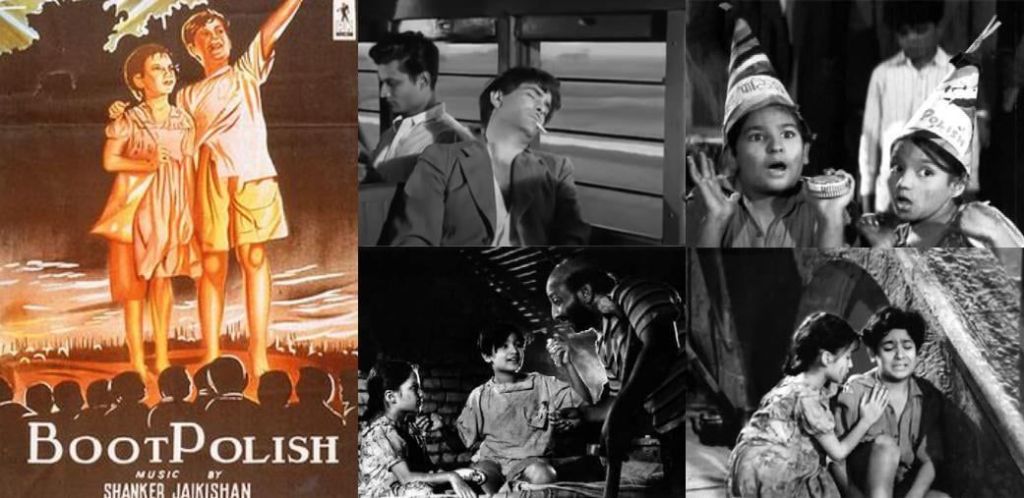
Boot Polish (1954) is a critically acclaimed Indian Hindi-language comedy-drama directed by Prakash Arora, with Raj Kapoor as the producer. Kapoor is also believed to have ghost-directed portions of the film.
The film stars child actors Ratan Kumar and Naaz in lead roles, delivering heartfelt performances that anchor the story. The narrative focuses on themes of poverty, resilience, and dignity, as it follows two orphaned siblings who strive to overcome their circumstances by earning a living shining shoes, rather than resorting to begging.
Boot Polish portrays the heart-wrenching yet inspiring story of two orphaned siblings, Bhola and Belu, as they navigate a harsh and unforgiving world. Following their mother’s death, the children are placed under the care of their cruel aunt Kamla, a woman who exploits their vulnerability for her own gain. Kamla, a prostitute, forces the children to beg on the streets and confiscates their earnings, punishing them brutally when her authority is challenged.
In this bleak environment, the siblings find a beacon of hope in John (David), a kind-hearted bootlegger who lives nearby. John instills in Bhola and Belu the value of self-respect and teaches them the dignity of earning an honest living. Inspired by John, the children secretly save money from their daily collections, hoping to start a new life away from begging.
Eventually, they purchase a shoe-polish kit and embark on their modest business as shoe shiners. Their hard-earned independence enrages Kamla, who views it as defiance. In a fit of rage, she beats them mercilessly and throws them out of her home, leaving them to fend for themselves entirely. This pivotal moment sets the stage for a moving narrative of resilience, hope, and the pursuit of self-worth.
The second half of Boot Polish delves deeper into the struggles of Bhola and Belu, underscoring themes of sacrifice, dignity, and the enduring bond between siblings. After being expelled from their aunt’s house, the children continue their efforts to survive. John, their kind-hearted neighbor, observes their hardships—Belu dreams of a new frock, and Bhola longs for a decent shirt. Moved by their plight, John decides to help by selling unauthorized liquor, a decision that leads to his arrest. This leaves the children completely on their own.
When the rainy season arrives, the demand for shoe polishing dwindles, and hunger begins to overwhelm them. Bhola, resolute in his vow never to beg again, rejects a coin tossed to him by a passerby. However, driven by desperation, Belu attempts to take the coin, leading to a heated confrontation where Bhola strikes her, forcing her to drop it. This moment of tension highlights their shared anguish and the moral dilemmas they face.
When authorities arrive to take the children into custody, Belu escapes by boarding a departing train, while Bhola is captured and sent to an orphanage. On the train, Belu is adopted by a wealthy and compassionate family, but her newfound comfort is overshadowed by sorrow for her brother.
After being released from the orphanage, Bhola searches tirelessly for Belu but fails to find her. Desperate and hungry, he breaks his vow and returns to begging. By chance, he encounters Belu at the railway station as she and her adoptive family are leaving for a vacation. Overwhelmed with shame, Bhola flees, but Belu, overjoyed to see him, chases after him. Their reunion is further complicated when John arrives at the station to bid farewell but is injured during the chase. Witnessing John’s injury prompts Bhola to stop running, allowing for an emotional reunion between the siblings.
In a heartwarming conclusion, the wealthy family adopts Bhola as well, bringing the siblings back together. United once more, Bhola and Belu find the love and security they had yearned for, and their story concludes on a hopeful and uplifting note.
Raj Kapoor’s perspective on Boot Polish, as expressed in his article for the Indian Express, reveals the film’s deeply rooted social message and its connection to his broader cinematic vision. He wrote, “In Awaara I tried to prove that Vagabonds are not born, but are created in the slums of our modern cities, in the midst of dire poverty and evil environment. Boot Polish graphically shows the problem of destitute children, their struggle for existence, and their fight against organized beggary.”
This statement highlights how Boot Polish extends Kapoor’s exploration of societal issues, focusing on the plight of orphaned and destitute children. The film serves as both a critique of societal neglect and a call to action, as Kapoor continues: “The purpose of this film is to bring home to you that these orphans are as much your responsibility as that of the Government. Individual charity will not solve this problem because the only solution is co-operative effort on a National scale.”
Through Bhola and Belu’s story, Kapoor emphasizes that systemic change, rather than isolated acts of charity, is essential to address the root causes of poverty and exploitation. The film’s portrayal of the children’s resilience and dignity in the face of hardship seeks to evoke empathy and inspire collective responsibility among audiences. This vision aligns with Kapoor’s legacy as a filmmaker committed to blending entertainment with meaningful social commentary, making Boot Polish not just a poignant drama but also a compelling piece of advocacy for social reform.
1955 Cannes Film Festival, Naaz received a special recognition for her performance as a child actress, highlighting the international acclaim the film garnered.
Filmfare awared for Best film to Raj Kapoor as the producer, Best Supporting Actor to David for his portrayal of the kind-hearted John, who becomes a mentor to the children and Best Cinematographer to Tara Dutt, for the evocative black-and-white visuals that beautifully captured the emotional depth and struggles of the story.
The accolades reflect the film’s artistic, technical, and emotional achievements, both in India and internationally.
The songs of Boot Polish are an integral part of the film’s narrative, reflecting its emotional and thematic depth. The lyrics were crafted by the renowned trio Hasrat Jaipuri, Shailendra, and Deepak, while the music was composed by the iconic duo Shankar–Jaikishan. Their collaboration resulted in a soulful soundtrack that complemented the film’s poignant story.
The song “Nanhe Munne Bachche Teri Mutthi Mein Kya Hai“ is one of the most iconic and memorable tracks from the film. Song sung by Mohammed Rafi and Chorus, the song is an uplifting anthem of hope and resilience.
Its lyrics inspire children to dream big and instill the belief that the future lies in their hands. The imagery of a small fist symbolizing the power to hold the world reflects the film’s underlying message about overcoming adversities with courage and determination.
This song not only encapsulates the spirit of Boot Polish but also resonates with audiences as a motivational piece that celebrates the potential of youth and the promise of a better tomorrow. It remains a classic in the annals of Indian cinema music.
The movie’s emotional depth and moral undertone resonated with audiences and critics alike, making it a landmark in the genre of socially conscious cinema in India.
Photos courtesy Google. Excerpts taken from Google.
 Writer Sunita