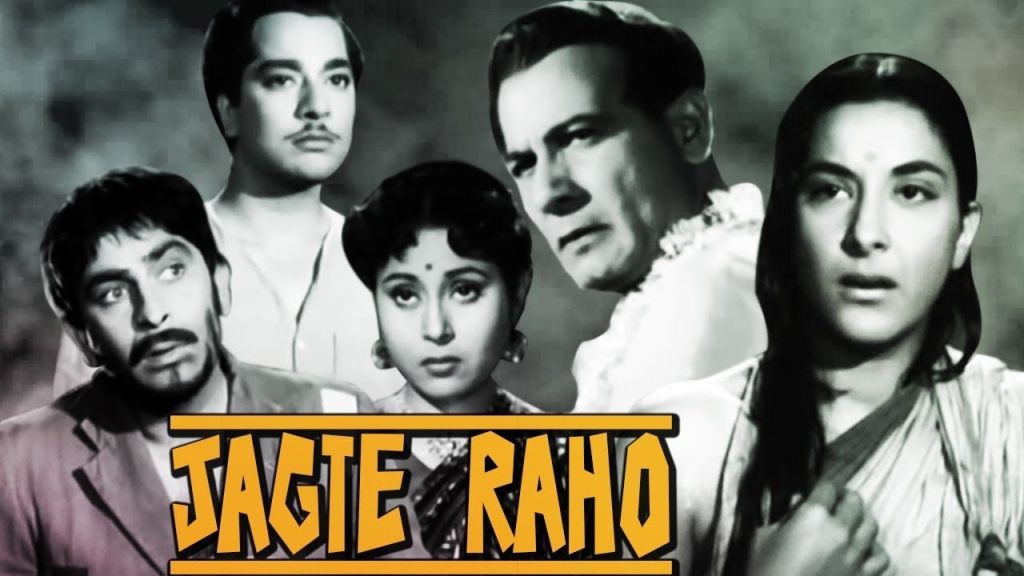
Jagte Raho (1956) is a poignant Hindi/Bengali social drama that highlights the challenges of urban life through the journey of a poor villager, played by Raj Kapoor, who arrives in the city seeking a better future. Directed by Amit Maitra and Sombhu Mitra, with a screenplay by Khwaja Ahmad Abbas, the film explores themes of greed, corruption, and human vulnerability. The narrative starkly contrasts the villager’s innocence with the city’s moral decay, offering a critique of middle-class ethics.
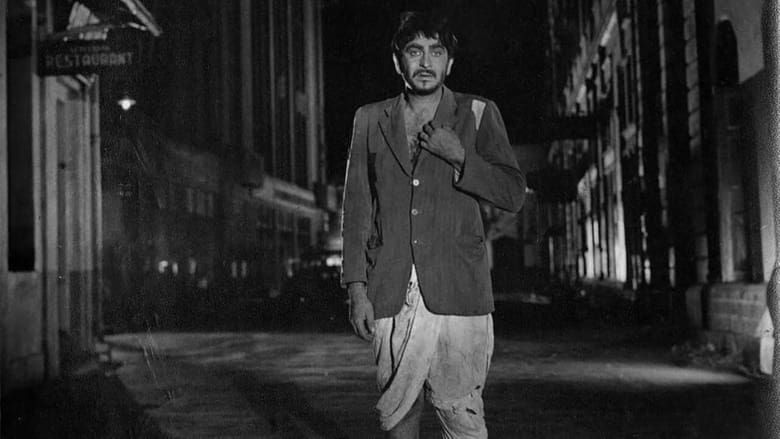
The plot of Jagte Raho is a compelling allegory of urban moral decay and the resilience of the human spirit. Raj Kapoor’s portrayal of a poor peasant from the village highlights the stark contrast between innocence and the corruption of urban life. His journey begins with a simple, human need: water to quench his thirst. However, his quest inadvertently plunges him into a night-long odyssey through an apartment complex, where he becomes an unwilling witness to the duplicity of its residents.
The irony is striking: while the peasant is mistaken for a thief and hunted by the “respectable” citizens, he observes these very people committing crimes and engaging in immoral activities behind closed doors. Their outward appearances of respectability crumble under the scrutiny of his innocent gaze, revealing the hypocrisy and greed hidden within.
As he navigates this hostile environment, the peasant encounters moments of fear, despair, and fleeting hope. A pivotal encounter with a young girl, played by Daisy Irani, rekindles his self-belief and gives him the courage to confront his circumstances. This moment of human connection serves as a counterpoint to the hostility he has faced, symbolizing the possibility of goodness amidst the chaos.
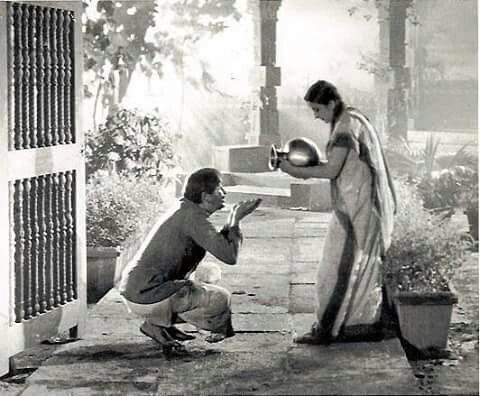
The climax is poignant and symbolic. As the peasant finally escapes the oppressive apartment complex, his thirst—both literal and metaphorical—remains unquenched. His journey ends when he hears a serene song and follows it to a woman, played by Nargis, drawing water from a well. This moment of solace and fulfillment underscores the purity and simplicity of life that the city, with all its pretensions, seems to lack.
The music of Jagte Raho is a cornerstone of the film’s emotional and narrative impact, composed by the legendary Salil Chowdhury with lyrics by Shailendra and Prem Dhawan. The soundtrack beautifully complements the film’s themes of moral introspection, human struggles, and fleeting moments of hope, creating a deeply immersive experience.
The iconic song “Zindagi Khwab Hai“ in Jagte Raho was a profound and reflective piece, sung by Mukesh in the Hindi version and picturized on Motilal. Its Bengali counterpart, “Ei Duniaye Shobi Hoi”, was sung by the legendary Manna Dey and picturized on the renowned actor Chhabi Biswas in the Bengali version, Ek Din Raatre.
Both versions carry the same philosophical depth, exploring the ephemeral nature of life and the blurred boundaries between truth and illusion. While Mukesh’s rendition imbues the Hindi song with a soulful, introspective quality, Manna Dey’s performance in Bengali adds a touch of classical elegance, seamlessly adapting the song to the cultural context of Bengal.
The contrasting visual interpretations—Motilal in the Hindi version and Chhabi Biswas in the Bengali one—further highlight the song’s universality, resonating deeply with audiences across linguistic divides. This dual adaptation underscores the timeless appeal of the song and the film’s themes.
Jagte Raho achieved remarkable success overseas, particularly in the Soviet Union, where Raj Kapoor enjoyed immense popularity. The film resonated deeply with Soviet audiences, drawing an astounding 33.6 million viewers at the Soviet box office in 1965.
Kapoor’s portrayal of the innocent, struggling villager struck a chord with Soviet viewers, who admired his everyman appeal and the film’s critique of societal hypocrisy. The film’s universal themes of social inequality, human dignity, and resilience transcended language barriers, making it a standout in Kapoor’s overseas repertoire. This success also reflects the broader appeal of Indian cinema in the Soviet Union during the mid-20th century, where films with strong moral narratives and emotional depth found a dedicated audience.
Jagte Raho garnered critical acclaim both domestically and internationally, showcasing the universal resonance of its themes. A shortened version of the film earned the prestigious Crystal Globe Grand Prix at the Karlovy Vary International Film Festival in Czechoslovakia in 1957, a significant recognition of Indian cinema on the global stage. This accolade highlighted the film’s artistic merit, social relevance, and Raj Kapoor’s compelling storytelling.
Domestically, the film was honored at the 4th National Film Awards, where it received the Certificate of Merit for its contribution to Indian cinema. This acknowledgment reflected its impactful narrative, powerful performances, and technical excellence.
These accolades underscore Jagte Raho‘s status as a milestone in Indian cinema, celebrated for its ability to weave a deeply philosophical and socially conscious tale that transcended cultural and linguistic barriers.
Photos courtesy Google. Excerpts taken from Google.
 Writer Sunita