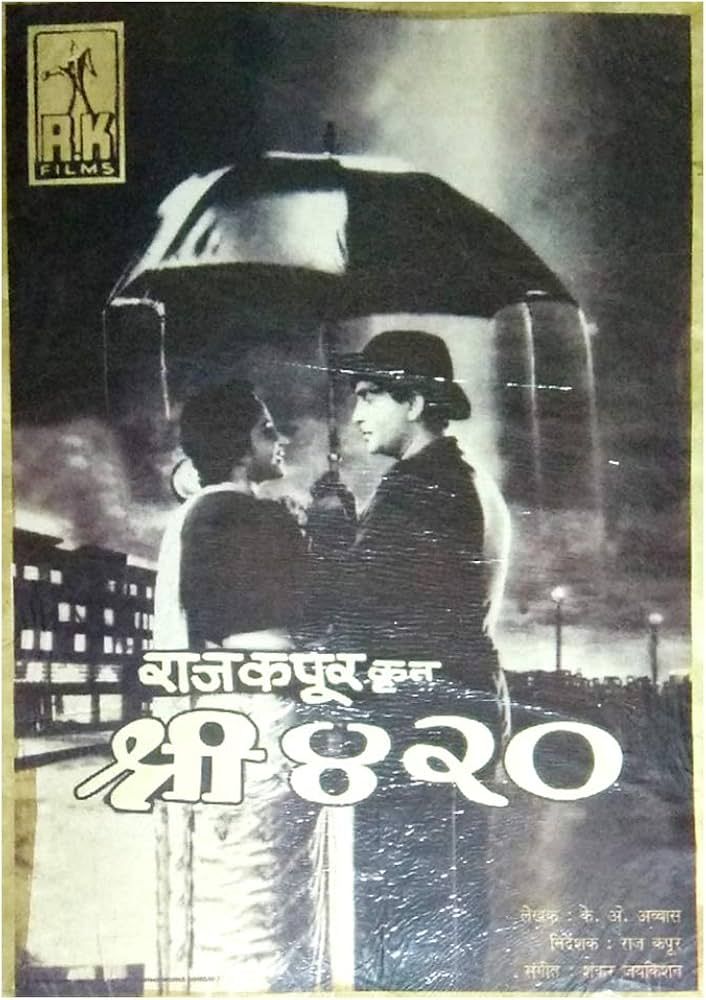

Shree 420 (1955) is an iconic Hindi comedy-drama film that combines satire, romance, and social commentary. Directed and produced by Raj Kapoor, the film is notable for its exploration of morality and societal corruption, encapsulated by its title—a reference to Section 420 of the Indian Penal Code, denoting fraud. The use of the term “Shree” in association with dishonesty sparked controversy at the time. Written by Khwaja Ahmad Abbas, Shree 420 cleverly critiques the growing materialism of post-independence India.
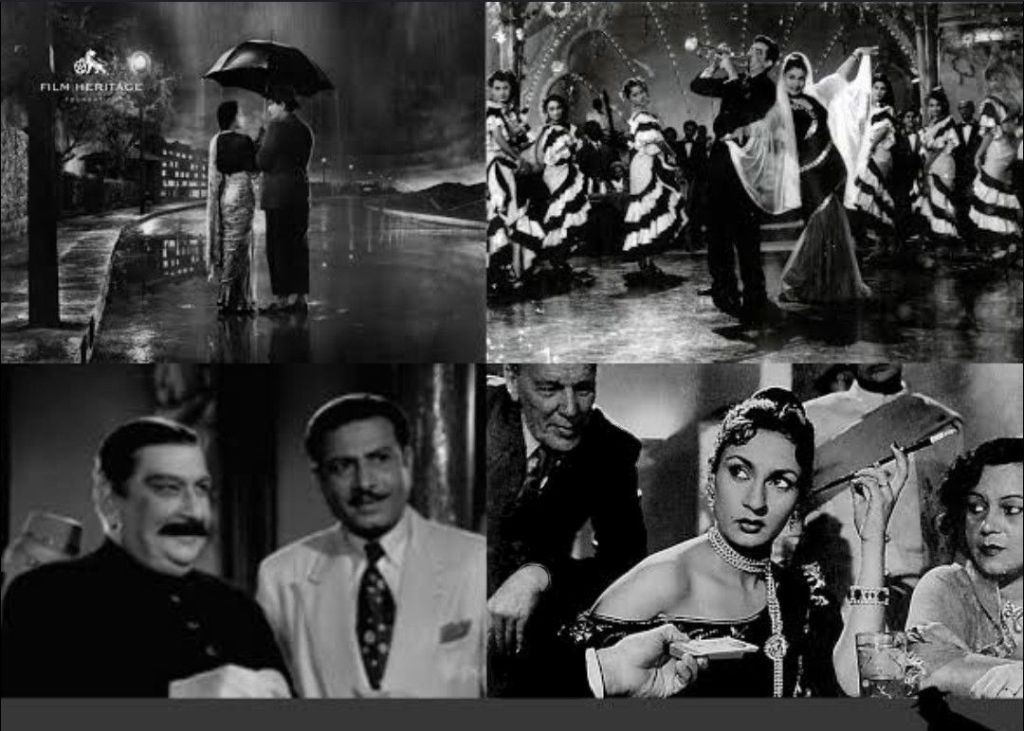
The film stars Raj Kapoor as Raj, a Chaplin-esque “little tramp” character, alongside Nargis as Vidya, his virtuous love interest, and Nadira as Maya, a femme fatale symbolizing materialism. Raj arrives in Bombay with hopes of prosperity but becomes entangled in the city’s corrupt underbelly. Torn between Vidya’s moral values and Maya’s seductive wealth, Raj’s journey reflects his internal conflict and ultimate redemption.
The story of Shree 420 encapsulates the moral dilemmas of an ambitious young man, Raj, as he navigates the contrasting worlds of virtue and vice. A naïve and hopeful country boy from Allahabad, Raj walks to Bombay in search of a livelihood. There, he encounters Vidya, a humble schoolteacher, whose simplicity and integrity capture his heart.
However, Raj is lured by the allure of wealth and a hedonistic lifestyle offered by the manipulative businessman Seth Sonachand Dharmanand and the seductive Maya. Under their influence, Raj becomes a “420” — a confidence trickster engaging in fraud, including cheating at cards. Vidya’s disapproval and persistent efforts to reform him seem futile as he grows increasingly entangled in unethical schemes.
Sonachand masterminds a Ponzi scheme, exploiting the poor by promising them homes for a mere Rs. 100, a dream that causes them to sacrifice essential needs. Initially complicit, Raj gradually realizes the depth of his moral corruption and the suffering caused by the fraudulent scheme. Determined to make amends, he takes a stand against Sonachand.
In a climactic confrontation, Raj steals the bond papers meant to dupe the poor but is caught and shot by Sonachand. Seemingly lifeless, Raj turns the tables in a dramatic twist, regaining consciousness to expose Sonachand’s deceit to the gathered crowd and the police. The villain is arrested, justice prevails, and Raj earns Vidya’s forgiveness.
The film concludes with Raj declaring, “Yeh 420 Nahin, Shree 420 Hain,” symbolizing the façade of respectability that often cloaks dishonest practices. Through its poignant narrative and memorable performances, Shree 420 critiques societal greed and highlights the transformative power of conscience and love.
The layers of meaning in Shree 420 add depth to its narrative, reflecting the socio-cultural and philosophical undertones of the film. The title, referring to Section 420 of the Indian Penal Code, directly ties to the protagonist’s descent into fraud and deception, emphasizing the moral struggles of his journey.
The symbolic significance of the characters’ names enhances the story. Vidya, meaning “knowledge” in Sanskrit, represents virtue, wisdom, and the moral compass guiding Raj toward righteousness. In contrast, Maya, meaning “illusion,” symbolizes temptation and the deceptive allure of materialism that diverts Raj from his ethical path.
A notable moment early in the film has Raj telling a policeman that the world only makes sense when viewed upside down, an idea metaphorically underscoring the absurdity and contradictions of societal norms. This statement also reflects the protagonist’s journey through a morally inverted world, where wealth often supersedes integrity.
In Shree 420, Raj’s journey in Bombay introduces him to the warmth and resilience of ordinary people, exemplified by the character Ganga Mai, portrayed by Lalita Pawar. Ganga Mai serves as a maternal figure and a symbol of moral grounding in Raj’s life. Despite her modest circumstances, she embodies kindness, generosity, and the enduring spirit of the common people.
Her unwavering support and affection for Raj reflect the film’s broader theme of humanity’s inherent goodness, even in the face of systemic corruption and materialism. Ganga Mai’s character also highlights the importance of community and compassion, as she provides Raj with guidance and a reminder of the values he risks losing in his pursuit of wealth. This connection between Raj and the common people, especially through figures like Ganga Mai, is central to his eventual realization of the importance of integrity and his redemption arc in the story.
The performances in Shree 420 are instrumental in conveying the film’s core message of ethical living and the triumph of morality over materialism. Each actor brings depth to their character, enhancing the narrative’s emotional and thematic resonance. Raj Kapoor is the beating heart of the film. His portrayal of innocence, ambition, and eventual redemption is both endearing and relatable. Kapoor’s ability to embody the vulnerability of an idealistic dreamer succumbing to human flaws makes his transformation into a man of conscience all the more impactful. His nuanced performance ensures that the audience remains invested in Raj’s journey of self-discovery and moral awakening.
Nargis as Vidya represents quiet strength and virtue. Her understated demeanor contrasts beautifully with Kapoor’s exuberance, grounding the film in a moral framework. Through her subtle expressions and measured dialogue delivery, Nargis becomes a powerful symbol of ethical steadfastness, embodying the hope that love and integrity can guide even the most wayward.
Nadira as Maya exudes danger and allure. With her lacquered appearance, diamond-studded glamour, and fiery eyes, Nadira perfectly captures the essence of a temptress, representing the deceptive allure of wealth and vice. Her performance is magnetic, making Maya a memorable antagonist who challenges Raj’s principles. Nadira’s iconic appearance in Mud Mud Ke Na Dekh is a testament to her dedication and the film’s meticulous attention to visual storytelling. Her seductive gown, stitched so tightly that she couldn’t sit down, became a defining element of her character, emphasizing Maya’s allure and the opulence of her world. Decades later, the song’s popularity endures, with fans still associating Nadira with this memorable number.
Shree 420 masterfully blends these elements of symbolism, language, and social commentary to craft a narrative that is as thought-provoking as it is entertaining, cementing its place as a classic in Indian cinema.
The music of Shree 420, composed by Shankar-Jaikishan, is one of the film’s most enduring legacies, blending simple yet profound lyrics with memorable melodies that resonate with the film’s themes. Shailendra writing in songs like Mera Joota Hai Japani and Ramaiya Vastavaiya carries a universal appeal, balancing simplicity with deep meaning. The song “Ramaiya Vastavaiya,” with its Telugu refrain meaning “Ramaiya, come quickly,” adds a unique linguistic touch. The song encapsulates themes of longing, hope, and eventual redemption, resonating with Raj’s internal conflicts and aspirations. Mud Mud Ke Na Dekh song, with its lively rhythm.
Film won Filmfare Awards for Best Cinematographer to Radhu Karmarkar, for his brilliant use of light and framing that enhanced the film’s narrative and thematic depth, Best Editing to G. G. Mayekar, for his seamless transitions and pacing, which brought coherence and rhythm to the storytelling and National Film Awards for Certificate of Merit for the Second Best Feature Film in Hindi
These accolades highlight the film’s significant contribution to Indian cinema, both in terms of artistic innovation and storytelling.
Photos courtesy Google. Excerpts taken from Google.
 Writer Sunita