
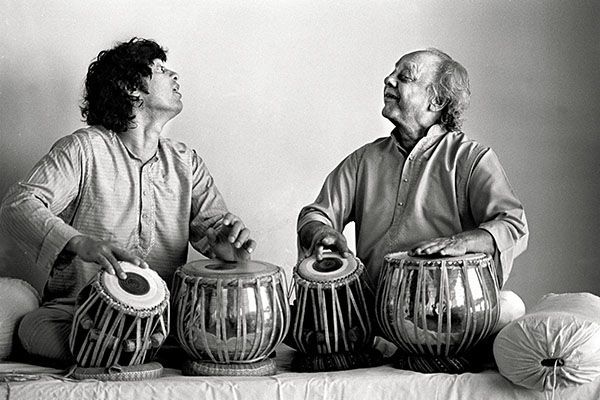
Zakir Hussain is a renowned Indian tabla virtuoso, composer, and music producer whose contributions have elevated Indian classical music on the global stage. Born on March 9, 1951, in Mumbai, India, he was the eldest son of the legendary tabla maestro Alla Rakha, inheriting and furthering a rich musical legacy. Zakir showed prodigious talent in tabla from a young age, training under his father’s guidance.
Ustad Alla Rakha played a pivotal role in shaping Zakir’s career, emphasizing discipline, tradition, and innovation. Their joint performances, especially duets, are considered masterclasses in rhythm and have inspired generations of musicians. Together, they preserved the Punjab gharana while pushing the boundaries of what tabla could achieve in Indian classical and world music contexts.
Hussain’s career is marked by his versatility and ability to bridge cultures through music. He collaborated extensively with Indian classical musicians and global icons, seamlessly blending Indian rhythms with Western and other world music traditions. His involvement in projects such as Shakti, alongside John McLaughlin, and his work with artists like George Harrison and Yo-Yo Ma, cemented his reputation as an ambassador of Indian music.
Zakir Hussain’s collaborations with prominent global musicians highlight his versatility and his role as a cultural bridge. Notably, he contributed to:
- George Harrison’s 1973 album Living in the Material World, where his tabla playing enriched the album’s spiritual and introspective themes.
- John Handy’s 1973 album Hard Work, blending Indian rhythms with jazz to create a unique soundscape.
- Van Morrison’s 1979 album Into the Music, where his tabla added depth to Morrison’s soulful compositions.
- Earth, Wind & Fire’s 1983 album Powerlight, showcasing his ability to adapt Indian percussion to funk and R&B grooves.
Zakir Hussain’s collaboration with Mickey Hart of the Grateful Dead was a landmark moment in the world of percussion music. Hart, who had known Hussain since the 1960s, invited him to participate in the groundbreaking project Planet Drum, which aimed to bring together drummers from diverse musical traditions.
- Planet Drum (1991) : This album featured drummers from around the world, including Zakir Hussain from India and Vikku Vinayakram, Hussain’s collaborator from Shakti. Released by Rykodisc, the album won the 1992 Grammy Award for Best World Music Album, marking the first Grammy awarded in this category. It was a trailblazing achievement, showcasing global percussion as a cohesive and innovative art form.
- Global Drum Project (2008) : To celebrate the 15th anniversary of Planet Drum, Hussain reunited with Mickey Hart, Sikiru Adepoju, and Giovanni Hidalgo. The album Global Drum Project further pushed the boundaries of world music and earned the Grammy Award for Best Contemporary World Music Album at the 51st Grammy Awards in 2009.
Both projects highlight Zakir Hussain’s ability to transcend cultural and musical boundaries, demonstrating his exceptional skill in creating harmony among diverse rhythmic traditions. His contributions to these albums played a pivotal role in bringing global percussion to the forefront of contemporary music.
Zakir Hussain’s contributions to cinema are as remarkable as his musical achievements, with his involvement spanning acting, composing, and performing. His work in films demonstrates his versatility and ability to integrate Indian classical music into diverse cinematic contexts.
Notable Contributions to Films :-
Malayalam Film Vanaprastham (1999) :-
Hussain served as the Indian music advisor, composer, and performer for this critically acclaimed film. A Cannes Film Festival entry, it was nominated for the Grand Jury Prize at the AFI Los Angeles International Film Festival and won multiple awards, including at the 2000 Istanbul International Film Festival, Mumbai International Film Festival, and National Film Awards in India.
Soundtracks for Merchant Ivory Films :-
He composed music for films like In Custody and The Mystic Masseur, both directed by Ismail Merchant, showcasing his ability to enhance cinematic narratives with his musical depth.
Tabla Contributions to International Films :-
Hussain’s tabla playing enriched the soundtracks of iconic films such as :
Francis Ford Coppola’s Apocalypse Now
Bernardo Bertolucci’s Little Buddha : These projects highlight his global influence and adaptability in diverse genres.
Acting and Musical Roles :-
Heat and Dust (1983) : Hussain co-starred as Inder Lal in this Merchant Ivory production and contributed as an associate music director.
He also appeared in documentaries such as :
Zakir and His Friends (1998), a film showcasing his musical performances.
The Speaking Hand: Zakir Hussain and the Art of the Indian Drum (2003), directed by Sumantra Ghosal, which delves into the intricacies of tabla playing.
Hussain’s ventures into cinema not only brought Indian music to international platforms but also reflected his passion for storytelling through rhythm and melody.
Zakir Hussain’s illustrious career has been marked by groundbreaking collaborations, prestigious invitations, and deep connections with his craft and its artisans.
Hussain was a founding member of Bill Laswell’s world music supergroup, Tabla Beat Science. This innovative ensemble fused Indian classical rhythms with electronic and world music, creating a unique genre that appealed to diverse audiences. The group’s work exemplified Hussain’s pioneering approach to blending traditional and contemporary music.
In 2016, Zakir Hussain was among the distinguished musicians invited by President Barack Obama to perform at the International Jazz Day All-Star Global Concert held at the White House. This event celebrated the universal language of jazz and featured global icons, reinforcing Hussain’s status as a cultural ambassador of Indian music.
For over 18 years, Haridas Vhatkar crafted Hussain’s tablas, tailoring them to suit the maestro’s exacting standards. Haridas learned the intricate art of tabla-making specifically to create instruments worthy of Hussain’s mastery, highlighting the symbiotic relationship between the musician and the artisan. This dedication ensured that the instruments matched the precision and tonal quality required for Hussain’s performances.
Zakir Hussain’s career stands as a testament to his ability to transcend cultural and musical boundaries, whether through collaborations with global artists, prestigious performances, or his commitment to excellence in his instruments and art.
Zakir Hussain’s philosophy toward music reflects his deep respect for the art form and its sacredness. In his conversation with author Nasreen Munni Kabir, documented in her book Zakir Hussain: A Life in Music, he shared his perspective that music deserves undivided attention and reverence.
Hussain refrained from performing at private gatherings, corporate events, or weddings. He believed that music should not serve as mere background entertainment at events where people are primarily socializing, drinking, or dining. For him, music was an experience meant to engage listeners completely, where the focus is on the performance and the emotional journey it creates.
There is a beautiful shot in the Films Division documentary Khayal: A Musical Journey with Zakir Hussain, Zakir Hussain serves as the central figure and narrator, guiding the audience through the intricacies and beauty of Indian classical music. His role goes beyond that of a performer, as he bridges the gap between the art form and the audience, making its depth accessible to both connoisseurs and newcomers.
Zakir Hussain’s mastery as a tabla virtuoso and his charismatic presence allow him to contextualize the traditions and philosophies of Indian classical music. He interacts with other maestros like Pandit Jasraj and Pandit Shiv Kumar Sharma, providing insights into their music and lives while also showcasing his own musical prowess in various sequences.
As a cultural ambassador, Zakir Hussain embodies the spirit of the documentary, celebrating the universal appeal of Indian classical music and its transformative power. His role is pivotal in weaving together the film’s narrative and its meditative, uplifting exploration of musical heritage.
This stance underscores Hussain’s commitment to preserving the integrity and dignity of music, ensuring it remains an art form that commands and receives the respect it deserves. His approach also highlights his role as a custodian of Indian classical music, emphasizing its profound cultural and spiritual significance.
In addition to these collaborations, Hussain’s performances in India were equally iconic. One such memorable event was his tabla recital at Bharat Bhavan in Bhopal, a venue known for celebrating Indian art and culture. His ability to captivate audiences with intricate rhythms and emotional expressions further solidified his status as a maestro.
Zakir Hussain’s exceptional contributions to music and his role as a global ambassador for Indian classical traditions have been recognized with numerous prestigious awards, both in India and internationally.
United States National Heritage Fellowship awarded by the National Endowment for the Arts, this is the highest honor in the U.S. for traditional artists and musicians. Hussain’s receipt of this fellowship highlights his impact in bringing Indian music to global audiences and his status as a cultural icon.
Sangeet Natak Akademi Award (1990) Conferred by the Government of India, this award is one of the most prestigious honors in Indian performing arts, recognizing Hussain’s mastery and contributions to Indian classical music.
Sangeet Natak Akademi Fellowship (2018) also known as the Ratna Sadsya, this is the highest honor awarded by the Sangeet Natak Akademi, India’s National Academy of Music, Dance, and Drama. It is given to individuals who have made unparalleled contributions to their art forms, cementing Hussain’s legacy as one of the greatest tabla maestros of all time.
These accolades not only celebrate Hussain’s extraordinary talent and lifelong dedication to music but also recognize his role in elevating Indian classical music on the global stage. His awards reflect a career marked by innovation, cultural exchange, and a steadfast commitment to the preservation and propagation of traditional art forms.
Zakir Hussain’s illustrious career includes an impressive tally of seven Grammy Award nominations, with four wins, marking him as one of the most celebrated Indian musicians on the global stage.
First Win 1992 for Best World Music Album, Planet Drum album (collaboration with Mickey Hart). This was the inaugural Grammy in this category, establishing Hussain as a pioneer in world music.
Second Win 2009 for Best Contemporary World Music Album, Global Drum Project album. Reuniting with Mickey Hart, Sikiru Adepoju, and Giovanni Hidalgo, this win reinforced his innovative contributions to the global music scene.
Zakir Hussain’s landmark success at the 66th Annual Grammy Awards on 4 February 2024 further solidified his legacy as a global music icon. His triple win showcased his versatility and ability to collaborate across genres.
- Best Instrumental Composition, Collaboration with Béla Fleck (banjo), Edgar Meyer (bass), and Rakesh Chaurasia (flute). This piece blended classical Indian influences with Western musical styles, exemplifying Hussain’s innovative approach.
- Best Contemporary Instrumental Album, a collaboration with Béla Fleck, Edgar Meyer, and Rakesh Chaurasia. The album seamlessly merged elements of classical music and jazz, displaying an eclectic and boundary-pushing sound.
- Best World Music Album, performed with the legendary band Shakti, marking their critically acclaimed comeback. The album highlighted Shakti’s pioneering role in world-fusion music, blending Indian classical rhythms with Western jazz and other global influences.
Hussain’s triple win in 2024 emphasizes his continuous evolution as an artist and his ability to remain at the forefront of global music. These awards not only celebrate his exceptional skill as a tabla maestro but also his commitment to collaboration, innovation, and bringing Indian music to a worldwide audience. Hussain’s role in introducing Indian percussion to global audiences also included his work in films as a composer and actor, enhancing the cultural exchange between India and the world.
The “Wah Taj!” advertisement featuring Zakir Hussain is one of India’s most iconic and enduring commercials, created to promote Tata Tea. It captures the essence of Indian culture, pride, and the everyday love for tea. It became synonymous with the Tata Tea brand, symbolizing quality and excellence. The ad features the legendary tabla maestro Zakir Hussain as its central figure, blending his association with Indian classical music and cultural pride with the narrative. The ad conveys that Tata Tea is a premium product, offering rich taste and authenticity, much like the heritage of Indian music and the excellence Zakir Hussain represents.
Zakir Hussain is seen performing tabla in traditional Indian attire. The imagery emphasizes Indian heritage, drawing parallels between the richness of classical music and the flavor of Tata Tea. After a sip of tea, Zakir Hussain smiles and exclaims, “Wah Taj!” This exclamation perfectly blends admiration and delight, making it memorable and easy to associate with quality tea.
Photos courtesy Google. Excerpts taken from Google.
 Writer Sunita