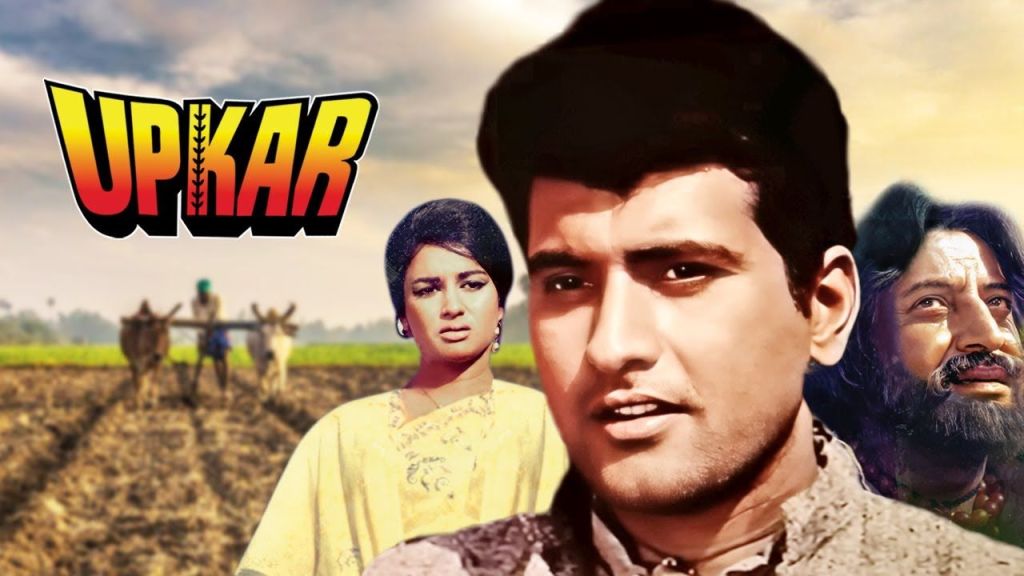
Upkar is a 1967 Indian Hindi film directed by Manoj Kumar. Set against the backdrop of the Indo-Pakistani War of 1965, the film is a heartfelt tribute to rural India, celebrating the vital contributions of farmers and soldiers to the nation. Inspired by Prime Minister Lal Bahadur Shastri’s stirring slogan “Jai Jawan Jai Kisan” (Hail the Soldier, Hail the Farmer), the film was Kumar’s response to his call. Upkar features a notable ensemble cast, including Manoj Kumar, Prem Chopra, Asha Parekh, Kamini Kaushal, Pran, and Madan Puri.
A humble villager from Atali (Ballabgarh, Haryana), Bharat dedicates his life to supporting his younger brother Puran’s education. While Puran studies in the city, he becomes enamored with urban luxuries and high-society living. Upon returning to the village, Puran, now self-centered and materialistic, demands his share of the family property. Refusing to divide the land out of principle and love for family unity, Bharat instead transfers the disputed land to Puran’s young son, choosing sacrifice over conflict.
When the Indo-Pakistani War of 1965 breaks out, Bharat selflessly enlists to serve his country. Meanwhile, back home, his greedy uncle Charandas manipulates Puran into hoarding and selling grains on the black market to exploit wartime scarcity. As the scheme unfolds, Puran comes to realize Charandas’ true intentions—to drive a wedge between the brothers for personal gain. Overcome with guilt and remorse, Puran turns himself in to the authorities, seeking redemption.
Bharat fights valiantly on the battlefield but is eventually captured by enemy forces. Though he manages a daring escape, he sustains severe injuries and loses both his hands. Upon his return, he is hailed as a war hero. Deeply moved by Bharat’s sacrifice, Puran expresses heartfelt remorse and seeks his forgiveness. The brothers reconcile, and together, they return to their roots—tilling the soil of their ancestral land, side by side, embodying the spirit of “Jai Jawan Jai Kisan.”
Some portions of Upkar were filmed at renowned studios such as Rajkamal Kalamandir, Kamal Studio, Guru Dutt Films, and Mehboob Studio. However, the principal photography took place in the village of Nangal Thakran in Delhi and Atali Village in Ballabgarh, Haryana. To bring realism to the screen, the film unit borrowed bullock carts and plows from the villagers of Garhkhera (near Atali). Bharat’s house and farmland were actual locations in Nangal Thakran and Atali, including the iconic field where the patriotic anthem “Mere Desh Ki Dharti” was filmed—forever etching those rural landscapes into cinematic history.
Manoj Kumar as Bharat, the protagonist and embodiment of the “Jai Jawan Jai Kisan” ideal. A humble, patriotic farmer who later becomes a soldier during the Indo-Pakistani War of 1965. He sacrifices his own comforts and land for his younger brother’s education. Symbolizes love for the motherland and agrarian pride.
Pran as Mangal Chacha, Bharat’s neighbour and well wisher, a respected elder in the village. He represents wisdom, loyalty, and patriotism, serving as a moral anchor to the story. Unlike many of Pran’s earlier villainous roles, this was a complete shift, a positive, deeply emotional, and inspirational character.
Prem Chopra as Puran is initially a sincere, promising young man whom Bharat sends to the city for education, sacrificing everything for his future. Once in the city, Puran is seduced by a lavish lifestyle. He becomes selfish and materialistic, distancing himself from his village roots and values. Upon returning home, Puran demands his share of the family property and falls under the influence of their corrupt uncle, Charandas, becoming involved in black marketing of food grains even as Bharat goes off to fight in the war. Eventually, Puran realizes his grave mistake, uncovers Charandas’s manipulation, and repents by surrendering to the police. He reconciles with Bharat in a deeply emotional climax.
Prem Chopra, typically cast in villainous roles, delivered a nuanced performance as Puran—blending arrogance, inner conflict, and eventual remorse. His character’s moral downfall and redemption was crucial to the film’s message about values, duty, and national pride.
A soundtrack celebrated for its patriotic fervor and emotional resonance, composed by Kalyanji–Anandji with lyrics by Gulshan Bawra.
Mere Desh Ki Dharti, iconic song of the film, this patriotic anthem is still played during India’s national celebrations.
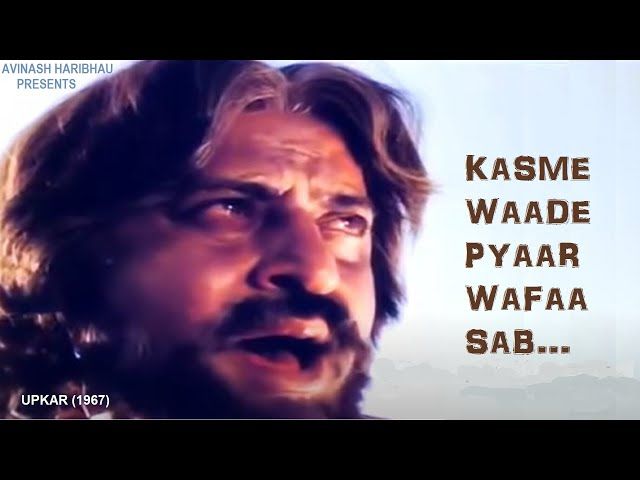
The timeless song “Kasme, Waade, Pyar, Wafa, Sab bate hai, bato ka kya. Koi kisi ka nahi, ye jhuthe nate hai, nato ka kya (Swears, promises, love, loyalty, thease are all words and nothing else. No one is dear to anyone. These relationship are all false)” was picturised on Pran. This is one of Pran’s most emotionally resonant performances. Known for his villainous roles, this moment allowed him to show vulnerability and guilt, breaking away from the usual “bad man” image. His tearful expressions and internal torment bring depth to the character. It’s a rare example of a sad, philosophical song being picturised entirely on Pran, and it remains one of his most memorable on-screen moments.
Film was edited by B. S. Glaad, whose crisp and emotionally resonant editing played a vital role in the film’s impact. His editing maintained the emotional rhythm of the story, especially in balancing scenes of village life, family drama, and wartime patriotism. The smooth transitions between dramatic and musical sequences, particularly songs like “Mere Desh Ki Dharti” and “Kasme Waade Pyar Wafa,” added to the film’s powerful storytelling.
The cinematography of Upkar was beautifully handled by V. N. Reddy, a respected and veteran cinematographer in Indian cinema. Visual Aesthetic of Rural India: Reddy captured the lush green fields, sunlit village lanes, and simple, rustic life of Indian farmers with warmth and authenticity, enhancing the patriotic and emotional tone of the film. “Mere Desh Ki Dharti”, his camera work during this iconic song made it visually powerful. Wide shots of Bharat (Manoj Kumar) plowing the land, panoramic views of the village, and golden light helped emphasize the beauty and value of the Indian soil. Reddy’s skill in framing battle scenes with dramatic lighting and camera angles gave the war portions intensity without relying on over-the-top effects—particularly effective in showing Bharat’s capture and escape. V. N. Reddy’s cinematography was key in translating Upkar’s message “Jai Jawan, Jai Kisan” into a visual experience that connected deeply with audiences.
Upkar garnered widespread acclaim and swept the Filmfare Awards, winning in several major categories. Best Film was awarded to V. I. P. Films. Best Director went to Manoj Kumar for his impactful directorial debut. Best Supporting Actor was won by Pran for his memorable role. Best Lyricist was awarded to Gulshan Bawra for the iconic patriotic song “Mere Desh Ki Dharti.” Best Story and Best Dialogue both went to Manoj Kumar, showcasing his strength as a writer. Best Editing was awarded to B. S. Glaad for his sharp narrative pacing.
In addition to its Filmfare triumphs, Upkar also received prestigious honors at the national level.
The Bengal Film Journalists’ Association (BFJA) honored Manoj Kumar with the Best Dialogue (Hindi) award for his compelling and patriotic writing.
Manoj Kumar was awarded the National Film Award for Second Best Feature Film, recognizing his impactful debut as a director.
Mahendra Kapoor received the National Film Award for Best Male Playback Singer for his powerful rendition of “Mere Desh Ki Dharti.”
Upkar marked Manoj Kumar’s directorial debut. The film dominated the box office in 1967, emerging as the highest-grossing Indian film of the year.
Photos courtesy Google. Excerpts taken from Google.
 Writer Sunita