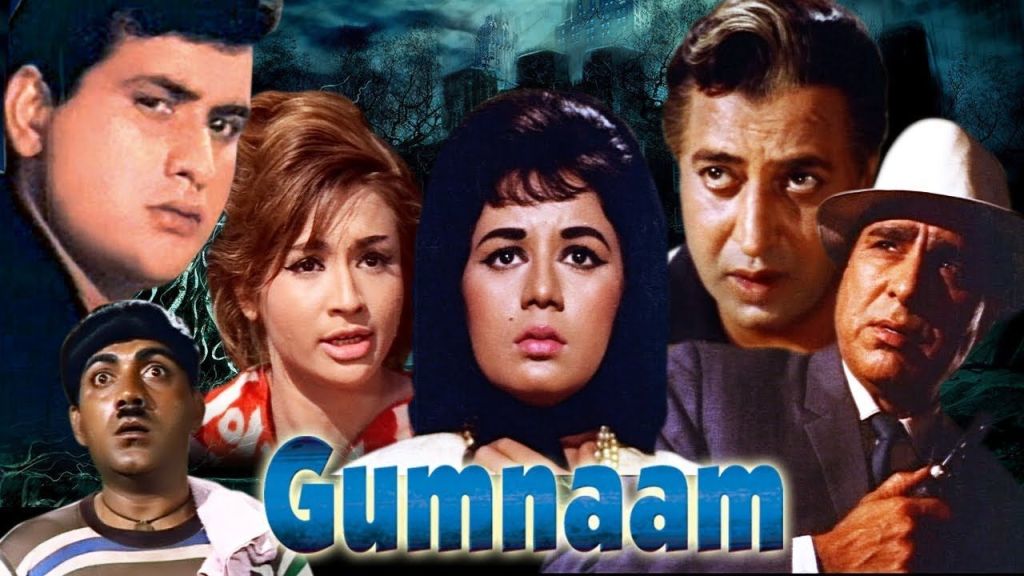
Gumnaam (1965) is a stylish and suspenseful Hindi mystery thriller that took inspiration from he film is a loosely inspired adaptation of Agatha Christie’s 1939 mystery novel “And Then There Were None“. Film directed by Raja Nawathe and produced by N. N. Sippy.
On a dark, rain-slicked night, the wealthy and inebriated Seth Sohanlal stumbles out of a hotel. As he steps onto the street, a speeding car barrels toward him, striking him down. He dies instantly.
From a shadowed room overlooking the hotel, Khanna (Hiralal), the mastermind behind the murder, watches the scene unfold. Moments later, the car’s unseen driver arrives at the room. Without a word, Khanna hands over a thick bundle of banknotes.
Khanna begins making a series of cryptic phone calls. First, to a doctor—he instructs him to forge a medical certificate. Next, to a mysterious young woman—he tells her that the will must be sent to the “right place.” Then, to a lawyer—informing him that the will will reach him by morning, after which it becomes his responsibility.
Finally, Khanna calls Seth Sohanlal’s niece, Asha (Nanda), and breaks the news of her uncle’s untimely death. Asha is devastated. But as she screams in anguish, the call is interrupted by the chilling sound of gunshots. An unseen figure in a long coat and hat has entered Khanna’s room and shot him dead.
A few days later, at a bustling nightclub filled with music and laughter, an announcement is made that catches everyone’s attention. Seven winners—five men and two women—have been selected through a “lucky draw.” Their prize: a complimentary, fortnight-long trip to an undisclosed international destination. The group will be flown out together on a special chartered airplane.
The seven winners board a chartered airplane, excited for their mysterious holiday. However, mid-flight, a storm forces the plane to make an emergency landing on a remote, uninhabited island. Soon after the landing, the pilot disappears, leaving the group stranded.
After the sudden abandonment by the pilot, the seven lucky draw winners and the mysterious flight attendant Anand (Manoj Kumar) are left confused and alarmed. They follow the haunting, disembodied female voice singing “Gumnaam Hai Koi”, which leads them to a mansion that seems ready and waiting yet its host is unknown.
They find a mansion on the island that seems ready for guests with food and rooms prepared. The only other person they meet there is a strange and eccentric butler, played by Mehmood, who welcomes them with an unnerving smile and says he has been “expecting them.”
The next day passes without incident, but that night, Anand and Asha are horrified to discover Kishan (Manmohan) stabbed to death. Beside his body lies a half-smoked cigar and a letter addressed to the group. Clues left beside his lifeless body, chillingly revealing, “Kishan was the driver of the car that ran over Seth Sohanlal,” His death confirms that each person is being punished for their role in the conspiracy.
The group immediately suspects Dharamdas (Dhumal) of murdering Kishan, but he insists he is innocent. Anand and Asha later find Dharamdas strangled to death. The killer remains unseen. Anand and Asha begin their own investigation, trying to uncover who among them is capable of such calculated killings.
Rakesh (Pran) then accuses Dr. Acharya (Madan Puri) of poisoning Dharamdas. As tensions rise, it becomes clear that everyone present was connected to Seth Sohanlal in some way. Kitty (Helen) had been Sohanlal’s private secretary and had sent his will to Rakesh on Khanna’s instructions. Rakesh, in turn, had written the will on Khanna’s orders though neither he nor Kitty knew of each other’s involvement.
The following day, Anand notices Rakesh furtively hiding an axe. Soon after, Dr. Acharya reports that Sharma (Tarun Bose) has been murdered with an axe. Once again, a letter is found next to the body, stating that Sharma was Khanna’s co-conspirator in the murder of Seth Sohanlal, and has now paid the price.
Now, only three men—Anand, Rakesh, and Dr. Acharya and two women Asha and Kitty—remain alive and terrified on the island, along with the butler.
That night, Dr. Acharya catches the butler behaving suspiciously and uncovers a secret. A scuffle breaks out between them. Moments later, a severely wounded Dr. Acharya stumbles into the dining room in front of Asha and Kitty. With his last breath, he utters Anand’s name before collapsing, dead from a stab wound.
Anand and Rakesh immediately accuse each other of Dr. Acharya’s murder. Asha, confused and shaken, begins to doubt Anand and questions whether she ever truly knew him.
The following day, Kitty goes for a solitary walk and is later found strangled with a rope. Rakesh and Asha, searching for her, are horrified to discover her lifeless body with Anand’s hat lying ominously beside it. Rakesh spots Anand fleeing the scene and gives chase, but ultimately loses his trail in the thick foliage of the island.
Consumed by rage and grief, Rakesh returns to the mansion that night and, in a disturbing turn, attempts to assault Asha. She manages to escape, but runs into him again this time, he collapses dead in front of her, with two daggers embedded in his back.
Suddenly, the lights in the mansion go out, plunging Asha into darkness. The killer is now on the prowl, and she is next. Terrified, Asha faints as the killer approaches.
When she regains consciousness, she finds herself in a hidden room. To her utter shock, the man standing before her is Sharma alive. He reveals that he orchestrated everything: the butler was working under his instructions to make arrangements on the island. Posing as one of the victims, Sharma had murdered Kishan and Dharamdas. He then persuaded Dr. Acharya to declare him dead, claiming it would help him secretly investigate the killer. But once he had no further use for the doctor, he killed him too followed by Kitty and Rakesh.
When tension peaks, Anand dramatically reveals his true identity. He is not a mere flight attendant, but an undercover police inspector, assigned the secret mission to track down the escaped convict,
Nawathe successfully adapted the tense, isolated murder mystery format to appeal to Indian audiences, retaining the core suspense while adding emotional layers and glamour. He kept the tension building steadily, introducing red herrings, timed deaths, and shocking reveals, yet allowed breathing space for song and dance sequences and comic interludes. He used lighting, camera angles, and framing effectively—especially during the haunting sequences like the mysterious woman’s voice singing “Gumnaam hai koi…” echoing through the mansion. The isolated island setting was made to feel eerie and claustrophobic, emphasizing the feeling of entrapment.
The film had a rich cast: Manoj Kumar, Nanda, Mehmood, Helen, Pran, Tarun Bose and others. Nawathe balanced their screen presence, giving each a distinct character arc while maintaining focus on the mystery. His direction allowed Mehmood’s performance as the comic butler to stand out so much so that Mehmood won the Filmfare Award for Best Supporting Actor.
With songs composed by Shankar-Jaikishan, Raja Nawathe ensured that the musical segments enhanced rather than disrupted the narrative flow. Tracks like “Jaan Pehchaan Ho” and “Gumnaam Hai Koi” became iconic.
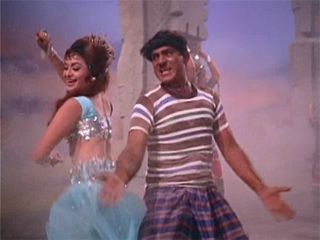
“Hum Kaale Hain To Kya Hua Dilwale Hain” song Picturised on Mehmood . Mehmood, in his butler avatar, sings this catchy number to woo Helen’s character (the housemaid) in his quirky, lovable style. Mohammed Rafi’s energetic and playful vocals match Mehmood’s comic timing perfectly. The song has become a cultural classic, often referenced as a celebration of embracing one’s looks with pride and joy. It’s one of Mehmood’s most popular songs, often associated with his legacy as a comic genius. The choreography and expressions are hilarious yet heartwarming, and it offered a much-needed breather amid the film’s suspenseful atmosphere.
Editing is especially crucial in a mystery thriller, and D. N. Pai’s work ensured that Gumnaam kept viewers engaged, tense, and constantly guessing. Pai’s crisp scene transitions helped keep the plot moving without confusion, even as the body count rose and the mystery deepened. The effectiveness of the horror and suspense sequences like the eerie singing of “Gumnaam Hai Koi” echoing through the halls owed much to editing. Cutting between the terrified faces of the guests and empty, shadowy corridors created a sense of dread. Songs like “Jaan Pehchaan Ho”, “Is Duniya Mein Jeena Ho To”, and “Gumnaam Hai Koi” were interwoven into the story without derailing the pace. Editing played a key role in keeping these musical sequences snappy and stylish while staying in sync with the thriller’s mood.
Photos courtesy Google. Excerpts taken from Google.
 Writer Sunita