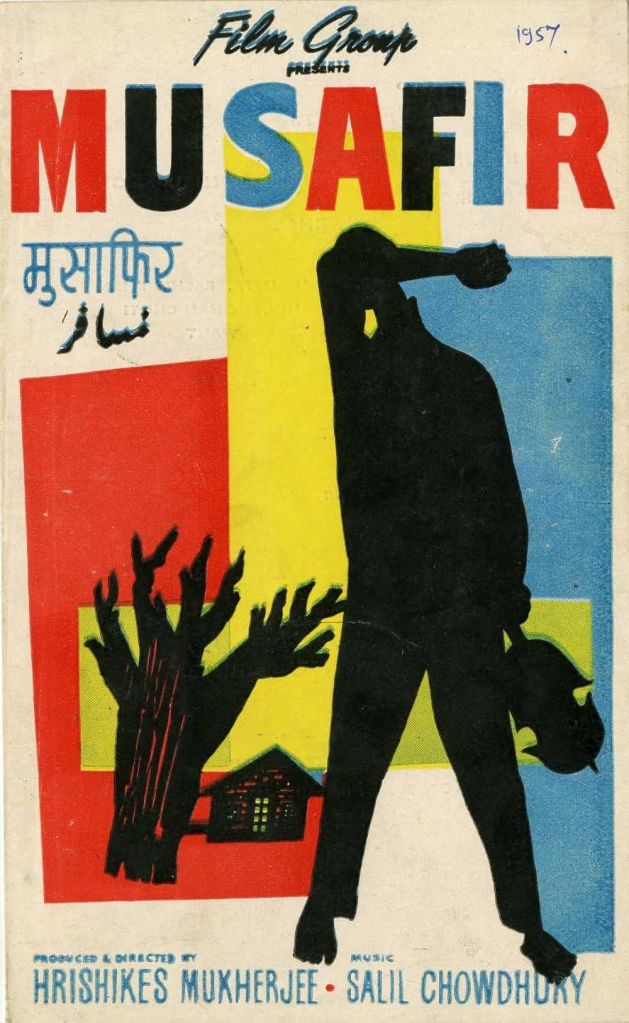
Musafir (1957) is quite a special film not just because it marked Hrishikesh Mukherjee’s directorial debut, but also because of its unique anthology style structure, which was very rare in Hindi cinema at the time. Also fascinating is that Ritwik Ghatak collaborated on the screenplay. His touch in the emotional depth and symbolic layering of the film, even though the tone stays more hopeful and humanistic, very Mukherjee style.
The movie is structured around a single house, telling the interconnected stories of three different families who reside there. Film is divided into three stories, marriage, birth and death.
The film begins with a voice-over by Balraj Sahni, who introduces the central theme with the lines: “Lakh lakh makaan aur in mein rehnewala karodon insaan… Musafir teen kirayedaron ke jeevan chakron ki kahani hai jo ek ke baad ek is makaan mein rehne aate hain” (Millions of houses and within them, countless people… Musafir is the story of three tenants and the cycles of their lives, who come to live in this house one after the other). As the narration unfolds, the camera pans across a cluster of old houses, eventually focusing on an aged suburban house, the primary setting of the film, located in an unidentified area.
In this segment of Musafir, the first story of Shakuntala (Suchitra Sen) and Ajay (Shekhar) highlights the themes of love, acceptance, and the creation of a home. Their relationship is juxtaposed against the house, which serves as a silent observer of their evolving journey. The act of Shakuntala transforming the house into a home reflects her desire to build a nurturing environment, despite the tension of having eloped.
The garden that Shakuntala tends becomes a living metaphor her patience, hope, and nurturing spirit are mirrored by the plants she sows. Her acceptance into Ajay’s family fulfills her emotional yearning for belonging. Even as they move out, the seeds remain, just like the memories they leave behind a quiet testimony that love and acceptance once bloomed there.
In the second story, Madhav’s family represents resilience in the face of loss. Bhanu’s character ( Kishore Kumar) adds a bittersweet flavor his attempts to cheer up his sister-in-law despite his own burdens show how humor often coexists with sorrow. That unforgettable twist the failed suicide attempt not only highlights societal failures but also points toward the randomness of life, where even despair can turn back into hope by sheer accident. The birth of the child serves as a literal and symbolic rebirth for the broken family. As they leave, it’s with the assurance that life, however fragile, will persist and thrive.
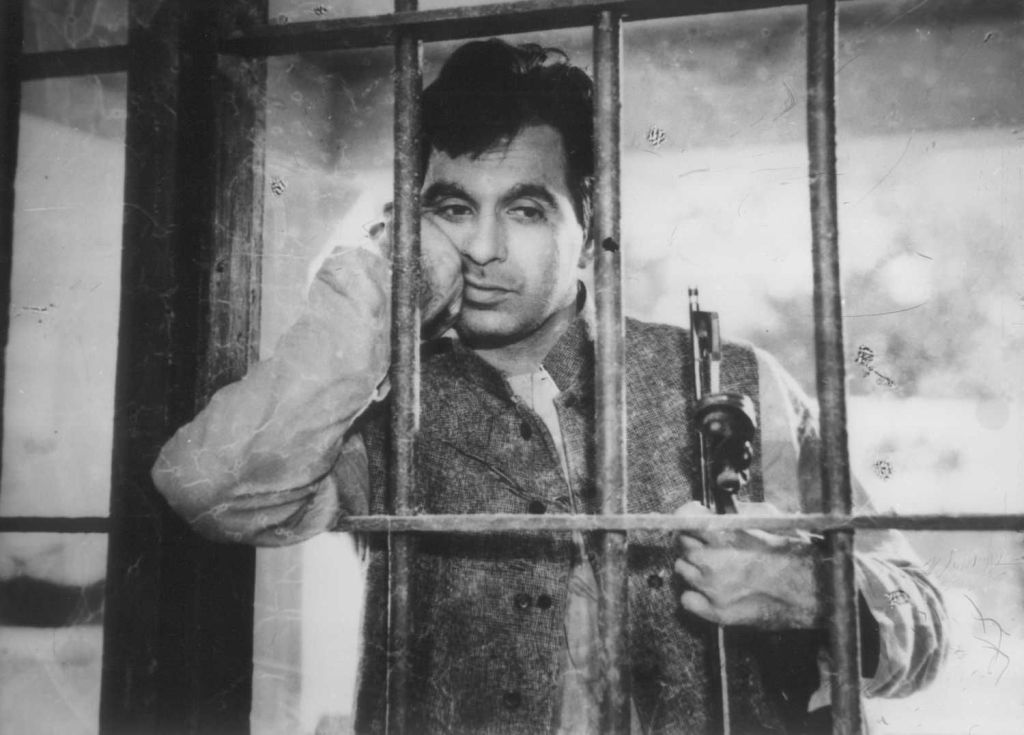
The final segment of Musafir brings the trilogy to a poignant close, tying together the overarching themes of love, loss, and renewal. Raja (Dilip Kumar) dying, yet still giving life to the crippled boy becomes almost a Christ like figure of sacrifice and hope.
The seed’s journey from germination (hope and beginning) in the first story, to budding (renewal after grief) in the second, and blossoming (spiritual fulfillment) in the third is profoundly moving and exactly the kind of subtle narrative craftsmanship Hrishikesh Mukherjee was known for.
The house as a vessel a silent, patient observer of human struggles, joys, and transformations ties the entire film together into one deeply humanistic meditation on life’s fragility and resilience. “The triumph of hope over despair” is particularly beautiful and sums up Musafir‘s spirit with both simplicity and depth.
Dilip Kumar’s performance in Musafir is so touching precisely because of that inner sorrow he carries quietly, even while outwardly smiling. His scenes with the boy especially when he talks about flowers and bees are layered with such tenderness. On the surface, it feels light and cheerful, but underneath, the ache of a man who has made peace with his own approaching death.
The beauty is in his restraint, he never overacts the sadness. It’s just there in his eyes, in the slight pauses between his laughter, in the way he looks at life savoring its small joys even as he prepares to leave it behind. When he meets his lost lover again, the joy is real but bittersweet because it comes too late for a full life together, yet in time to offer him a final peace. His performance in those 30 minutes is a masterclass in understated emotion.
The supporting characters like Mahadev Chaudhary (played with such natural warmth by David), the tea vendor, and the gossipy neighbor create a living, breathing world around the central stories. They bring color, humor, and realism, reminding us that life is not just shaped by our private joys and sorrows but also by the community around us sometimes nosy, sometimes kind, but always present. The mysterious violin music played by Pagla Babu adds another poetic layer.
Shailendra’s lyrics are another quiet strength of Musafir simple, deeply emotional, always resonating with the film’s themes of transience, hope, and longing. Salil Chowdhury’s music complements the narrative beautifully blending.
“Laagi Nahi Chhute” is a rare and fascinating gem hearing Dilip Kumar himself sing softly, soulfully adds an incredibly personal, raw feeling to that moment. His voice is not polished like professional singers, but it carries authentic emotion, which makes it even more touching.
Kamal Bose’s cinematography, just with careful composition and lighting, Bose creates a mood that’s dreamy yet grounded a true lesson for contemporary cinematographers who sometimes over-rely on technology instead of emotional framing. His panoramic shots, especially the way he frames the house, the skies, the empty rooms give a sense of space and impermanence, like life constantly moving beyond human grasp.
Film won National Film Awards for Certificate of Merit for Third Best Feature Film in Hindi.
Photos courtesy Google. Excerpts taken from Google.
 Writer Sunita