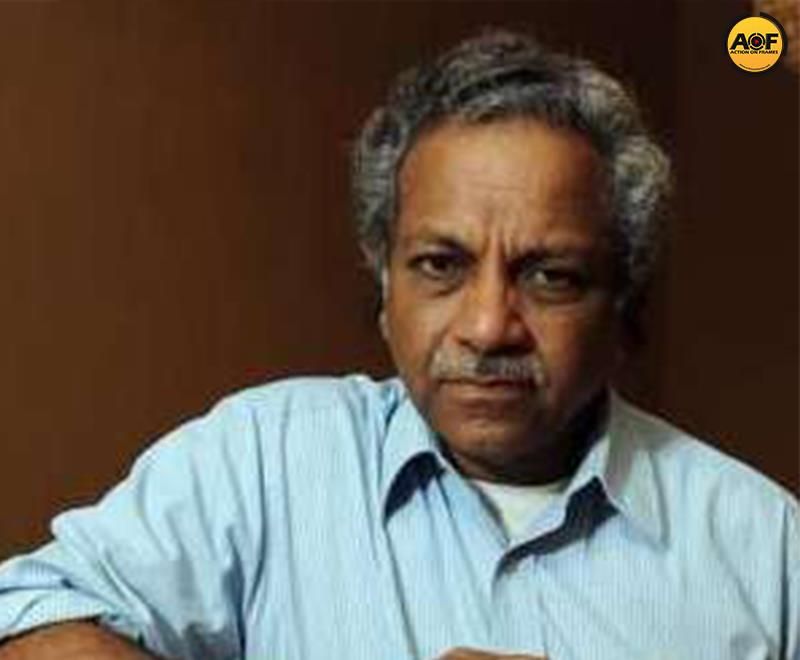
Shaji Neelakantan Karunakaran, fondly known as Shaji N. Karun, was born on New Year’s Day, 1 January 1952, as the eldest son of Mr. N. Karunakaran and Mrs. Chandramati, in the present-day Kollam district of the erstwhile Travancore state (now Kerala), India. His early life was steeped in the cultural richness of Kerala, and in 1963, his family relocated to Thiruvananthapuram, the state capital, which would later serve as the nurturing ground for his artistic and cinematic pursuits.
Shaji N. Karun, was a trailblazing Indian film director and cinematographer whose contributions deeply enriched Malayalam and Indian cinema.
He completed his schooling at Palkulangara High School and earned a bachelor’s degree from University College, Thiruvananthapuram. In 1971, he was admitted to the Film and Television Institute of India (FTII), Pune, where he specialized in cinematography. His diploma film Genesis (1974), directed by Rahul Dasgupta, won multiple awards and marked the beginning of a distinguished career. Graduating with a Gold Medal in 1974, Shaji quickly emerged as a promising talent in Indian cinema.
After graduation, he worked on a contractual basis with ISRO in Ahmedabad, Mumbai Television, and the Madras Film Industry. His pivotal career turn came in 1975 when he became deeply involved with the formation of the Kerala State Film Development Corporation (KSFDC), alongside its founder chairman P. R. S. Pillai and managing director G. Vivekanandan. Together, they envisioned a revival of Malayalam cinema by shifting its base from Madras back to Kerala, establishing a local infrastructure that would support indigenous film production. Shaji played a strategic role in designing and planning the future of KSFDC, which became instrumental in nurturing meaningful Malayalam cinema.
His collaboration with prominent Malayalam filmmakers through KSFDC led to a renaissance in the regional film industry, enabling national and international recognition for Malayalam cinema. His own work as a director was marked by depth, visual poetry, and philosophical intensity.
Shaji N. Karun made his directorial debut with the Malayalam film Piravi (The Birth, 1988), a poignant tale of a father’s grief over his missing son. The film not only moved audiences in India but also gained international acclaim, winning the Caméra d’Or – Mention d’honneur at the 1989 Cannes Film Festival, firmly establishing Shaji as a filmmaker of global significance.
His second film, Swaham (1994), continued to explore the theme of grief, this time through the lens of a mother’s loss and resilience. Swaham became a landmark in Indian cinema history when it was selected to compete in the official competition at the 1994 Cannes Film Festival a rare honor for any Indian filmmaker.
In Vanaprastham (The Final Dance, 1999), Shaji turned his lens toward the identity crisis of a classical artist, with Mohanlal delivering one of his most critically acclaimed performances. The film was not only artistically lauded but also recognized for its technical excellence and emotional depth, becoming another cornerstone in Shaji’s illustrious career.
Nishad (2002) is a contemplative Hindi-language film directed by Shaji N. Karun, and it stands apart for its quiet intensity and emotional depth. Set against the backdrop of the 1971 Indo-Pak war, the film explores how global conflicts seep into and shatter the lives of ordinary, peace-loving individuals. Film premiered at the Fukuoka International Film Festival (Japan) in 2002, reflecting the director’s ongoing engagement with international cinema and his ability to blend Indian storytelling with universal themes.
Kutty Srank (2010), is a layered, evocative Malayalam film that explores identity, memory, and the emotional imprint one leaves on others. Featuring Mammootty in a remarkable triple role, the film is structured in an unconventional, non-linear narrative through the perspectives of three women from different regions and social contexts. Film won the National Award for Best Feature Film, adding to his distinguished list of accolades.
In Swapaanam (2013), Shaji N. Karun once again explores the familiar terrain of the tormented artist, a recurring theme in his cinema, as seen earlier in Vanaprastham. Swapaanam is less about a linear story and more about the psychological rhythms of creation, madness, and transcendence. It’s a dense, abstract film that continues Shaji’s cinematic meditation on how art consumes the artist, elevating and destroying them at once. Shaji once again broke new ground by premiering the film at the Dubai International Film Festival, marking a rare world premiere outside India for a Malayalam film.
As of January 2018, Shaji N. Karun was in the final stages of post-production for his film Olu, starring Shane Nigam and Esther Anil. In one of his final interviews, Shaji described Olu as a fantasy-laced parable about a girl who is gang-raped and sinks to the bottom of the backwaters, where she mysteriously survives for nine months until the birth of her child. The film delves into the girl’s inner world of spiritual transcendence, using poetic visual language to explore the perception of innocent feminine desires. With its surreal setting and emotional intensity, Olu stood as a bold departure from conventional storytelling in Malayalam cinema.
Olu, which explored fantasy and surreal perception, was chosen as the opening film for the Indian Panorama section at the International Film Festival of India (IFFI) in Goa, 2018. Olu further garnered global attention as the opening film at two major international festivals: the Innsbruck International Film Festival (Austria) and the Isola Cinema International Film Festival (Slovenia). It also won the National Film Award for Best Cinematography at the 66th National Film Awards.
An earlier project titled Gaadha was announced in September 2012, with an initial shooting schedule set for November 2014, though the production was later postponed indefinitely. The film was to feature a score by renowned Polish composer Zbigniew Preisner, indicating Karun’s continued pursuit of international artistic collaboration and aesthetic sophistication.
In May 2022, Shaji announced another ambitious undertaking: a biographical film on Amrita Sher-Gil, the iconic Hungarian-Indian painter and pioneer of Indian modern art. In a conversation with Jisha Surya of News9Live, he revealed that the film would be based on Sher-Gil’s own writings and personal letters. Conceived as a multilingual Indo-French-American co-production, the project aimed to cast international actors and crew, including a Mexican actor to portray Sher-Gil herself. True to Shaji’s vision, the film was to bridge continents and cultures, reflecting the painter’s own hybrid identity and global artistic influence.
In addition to his feature films, Shaji directed numerous short films and documentaries, each marked by his signature visual language and thoughtful engagement with social and cultural themes.
In 1998, under the cultural leadership of the late Shri T. K. Ramakrishnan, then Cultural Minister of Kerala, Shaji founded and served as the first chairman of the Kerala State Chalachitra Academy, the first film academy in India. That same year, he also initiated the International Film Festival of Kerala (IFFK) as a competitive festival, which was later recognized by FIAPF (International Federation of Film Producers Associations) as an internationally competitive festival a landmark achievement under his stewardship.
Shaji N. Karun played a foundational role in India’s film institutions, serving as the inaugural chairman of the Kerala State Chalachitra Academy and as executive chairman of the International Film Festival of Kerala (1998–2001). From 2022 to 2024, he chaired the Kerala State Film Development Corporation, continuing his commitment to nurturing film culture in India.
In 2023, he was honored with the J.C. Daniel Award, the highest film award conferred by the Government of Kerala, recognizing his lifetime achievement and extraordinary contributions to cinema.
Shaji N. Karun began his cinematic journey as a cinematographer, and before becoming an acclaimed director, he had already established himself as a master of visual storytelling. His work as a cinematographer in the late 1970s and early 1980s significantly influenced the aesthetics of Malayalam parallel cinema.
Thampu (1978) – Directed by G. Aravindan, a landmark in Indian parallel cinema, this black-and-white documentary-style film about a circus troupe showcased Shaji’s minimalist and observational cinematography. The film is noted for its long takes, fluid camera movement, and poetic stillness.
Kummatty (1979) – Directed by G. Aravindan, a magical-realist children’s film, Kummatty featured lush visuals and naturalistic lighting that elevated its folk-tale narrative.
Esthappan (1980) – Directed by G. Aravindan, known for its allegorical and spiritual tone, the film displayed Shaji’s skill in capturing coastal landscapes and religious imagery with a sense of mysticism.
Pokkuveyil (1981) – Directed by G. Aravindan, a landmark experimental film, it had no dialogue, relying entirely on visuals and music. Shaji’s cinematography was crucial in conveying the protagonist’s emotional state and descent into isolation.
Elippathayam (1981) – Directed by Adoor Gopalakrishnan, this internationally acclaimed film (won the British Film Institute Award) relied heavily on Shaji’s visual composition to reflect the theme of psychological and cultural stagnation. His use of space, light, and shadow is considered masterful.
Mukhamukham (1984) – Directed by Adoor Gopalakrishnan, Shaji’s visuals added depth to the narrative about political disillusionment. The interplay between interiors and exteriors helped convey the character’s internal conflicts.
Anantaram (1987) – Directed by Adoor Gopalakrishnan, this film, which plays with dual narratives and memory, was visually intricate. Shaji used lighting and framing to enhance the ambiguity and psychological texture.
Shaji N. Karun’s cinematography was deeply influenced by classical art, Indian aesthetics, and the rhythms of nature. His imagery was meditative, often balancing realism with lyrical beauty. He played a vital role in defining the visual identity of the Malayalam New Wave and is credited with elevating Indian cinematography to international standards.
His eye for framing, mastery of light, and the ability to visually interpret silence and stillness became hallmarks of his later work as a director as well.
He passed away on 28 April 2025, leaving behind a legacy of cinematic excellence and institutional leadership that inspired generations of filmmakers.
Pay our heartfelt tribute to the legendary filmmaker and visionary, Shaji N. Karun, whose contribution to Indian cinema has been both profound and unforgettable. A pioneer in blending visual poetry with human emotion, he gave the world masterpieces like Piravi, Swaham, Vanaprastham, and Kutty Srank films that spoke the language of silence, sorrow, and the soul.
Through his artistic vision and leadership, he elevated Malayalam cinema to the global stage, earning accolades at Cannes and other international festivals. As the founding chairman of the Kerala State Chalachitra Academy and a guiding force behind the International Film Festival of Kerala, he dedicated his life not only to filmmaking but also to the promotion and development of film culture in India.
Photos courtesy Google. Excerpts taken from Google.
 Writer Sunita