Chidambaram (1985) is a Malayalam film written, directed, and produced by G. Aravindan. It is an adaptation of a short story by C. V. Sreeraman. The film explores complex themes of human relationships, particularly between men and women, through the lives of three individuals living on a cattle farm. The lead roles are played by Bharath Gopi, Smita Patil, Sreenivasan, and Mohan Das.
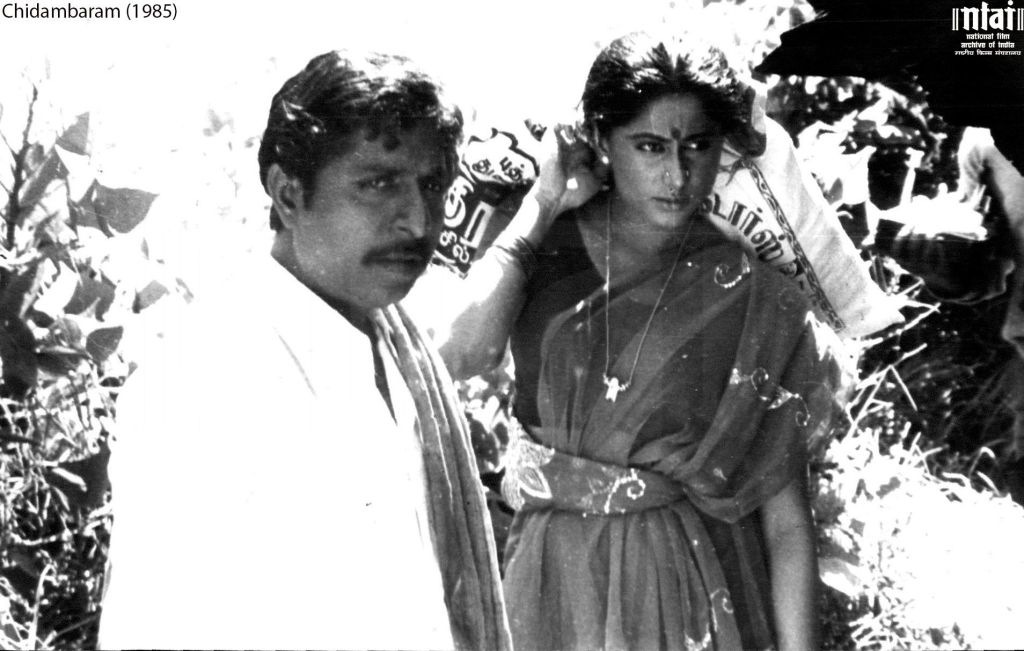
Shankaran, an amateur photographer, travels to attend Muniyandi’s wedding in a Tamil village. On the way he focuses his camera on the clay horses standing in a row. At the wedding, he photographs the bride and groom. After the ceremony, Muniyandi brings his new wife, Shivkami, from the arid, brown landscape of Tamil Nadu to the lush, green meadows of the farm. As they walk toward their quarters, Shankaran observes them from his office window. Shivkami, mesmerized by the vibrant surroundings, pauses along the way to take in the unfamiliar beauty of the farm’s landscape.
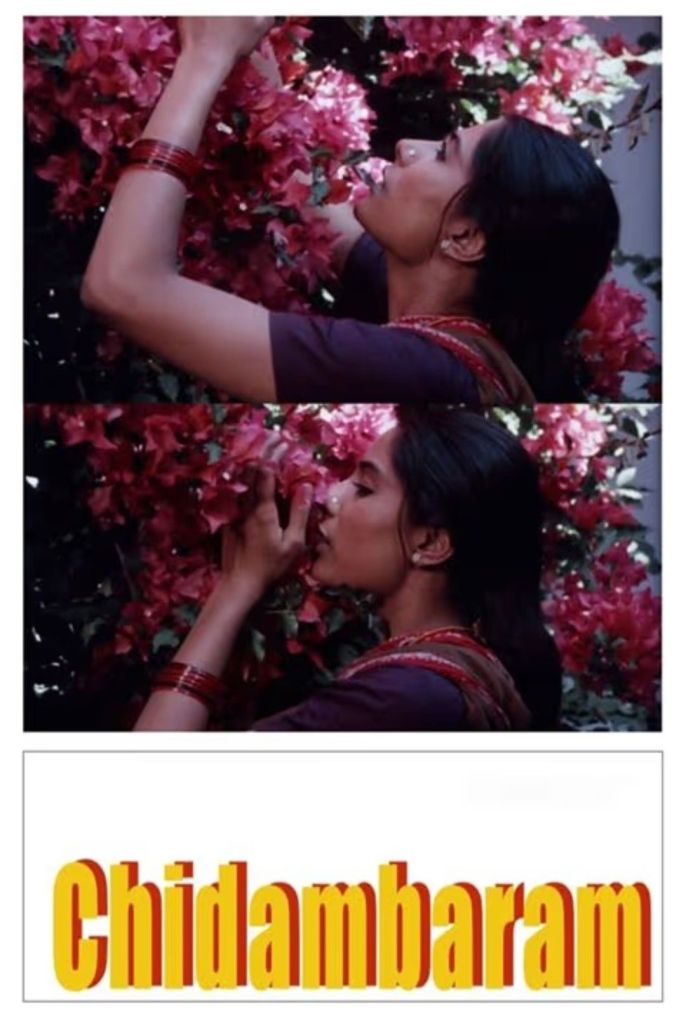
Shivkami reacts like a frightened deer to every new sound. Her fear of unfamiliar stimuli reflects a deep cultural and emotional displacement, from her arid homeland to a strange, fertile world that offers both beauty and isolation. The sight of the massive, well-fed cows, the roar of the motorbike, the appearance of new faces all of it causes her to withdraw into herself. When Muniyandi is away at work, she wanders aimlessly, exploring the gardens, her hands gently brushing against each flower with a sense of awe and wonder.
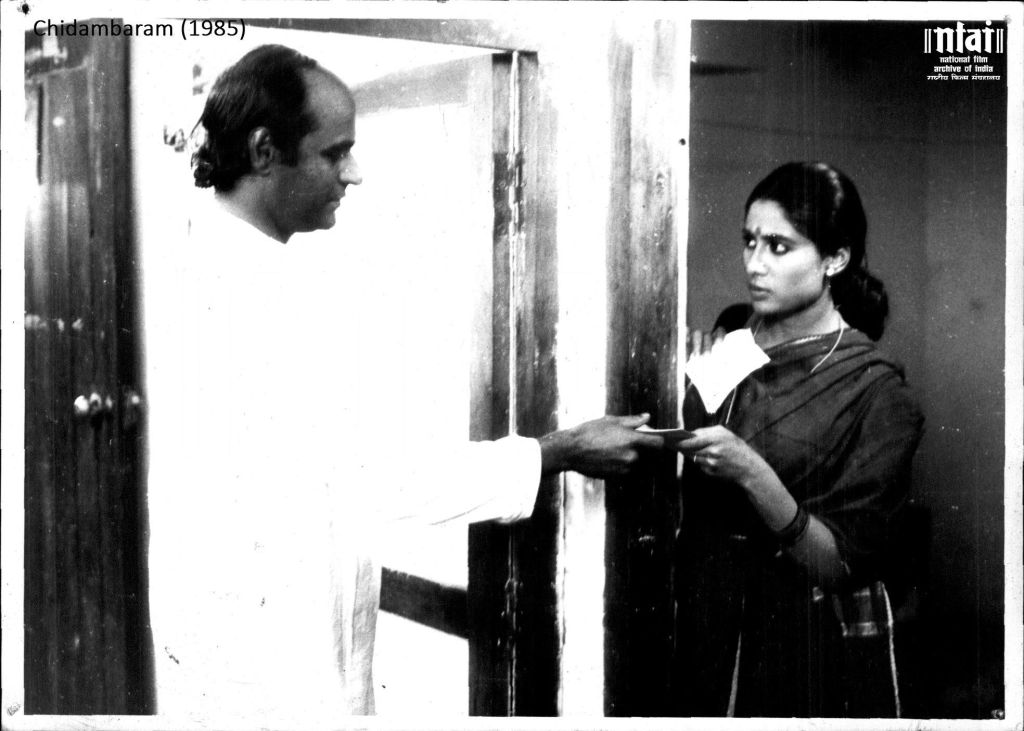
Shivkami’s growing comfort with Shankaran marks a fragile shift in trust. Her willingness to be photographed and to seek his help signals a tentative intimacy one that remains unequal, largely unspoken, and charged with unacknowledged desire.
To Shankaran, Shivkami becomes a mirror of the farm’s verdant, untouched beauty something to be admired, perhaps even preserved or possessed. This romanticized projection distances him from the ethical clarity he once embodied. The arrival of the film stars and younger colleagues introduces an element of urban frivolity and external gaze, sharply contrasting with the internal crisis brewing within Shankaran.
Meanwhile, Jacob has been trying to find work for Shivkami on the farm. Muniyandi, however, is unsettled by the idea. Shivkami, now restless in her isolation, expresses interest in the job. One day, while Muniyandi tends to the cattle, Jacob approaches to inform him that he has found a position for her. Jacob, who usually maintains a distance from the laborers, takes offense. In retaliation, he assigns Muniyandi to night duty, effective immediately.
That night, stationed in the cattle shed, Muniyandi remains alert, straining to catch any sound. When a motorbike roars past, he stiffens, suspecting Jacob might be heading to Shivkami’s home. Alarmed, he rushes back, only to find the house silent and cloaked in darkness. Suddenly, a shadow flits behind the house and vanishes into the night. It isn’t Jacob, as he feared but Shankaran, the very man he once trusted.
The next morning, a crowd gathers outside the cattle shed. Through the half-open shutters of the high windows, the farm workers peer in silently. Inside, Muniyandi’s heavy figure hangs lifeless from a wooden beam. When Shankaran opens one of the shutters from the outside, he is met by Muniyandi’s cold, dead face a confrontation that sears into him the unbearable weight of his own shame.
Overcome with horror, Shankaran flees into the dense forest, pursued by the devil within. He runs until nightfall, collapsing in exhaustion onto the soft forest floor. Meanwhile, back at the quarters, his two younger colleagues are preparing for bed when a frantic knock shakes the door. It is Shankaran, returned from his self-imposed exile, seeking penance. Bewildered by his disheveled state, they place him in one of their rooms, where he falls into a deathlike sleep a brief escape from the horrors of the day.
Haunted by guilt and unable to find solace in work, alcohol, or religion, Shankaran drifts through life burdened by Muniyandi’s death. Even a visit to the sacred Chidambaram temple fails to lift his torment. But as he leaves the sanctum, a chance encounter jolts him—he recognizes the shoe attendant as Shivkami, her scarred face a living testament to the brutality of the past he cannot escape.
Shankaran’s journey has come full circle. He has reached the end of his road, trapped in the guilt and consequences of his actions. His punishment is eternal.
Shankaran is shown as a thoughtful and kind person who cares about others and tries to understand them. He feels things deeply and connects with people in a real, human way. In contrast, Jacob is the opposite he believes in rules, order, and power. He sees people based on their status or role and acts like a strict boss. Muniyandi stands for the poor, hardworking people. He is simple, religious, and wears his heart on his sleeve, but he is also powerless and easily hurt because of his low position in society.
In Chidambaram, the teamwork between director G. Aravindan and talented actors like Smita Patil and Bharath Gopi brought a special energy to the film, making it feel real and emotionally strong. Smita Patil had always wanted to work with Aravindan, which led her to take part in this project. Bharath Gopi, known for his intense acting, also joined, and once people heard that Aravindan was producing the film on his own, more artists were eager to be part of it.
Smita Patil portrays Shivkami, a quiet, dignified woman whose inner strength and sorrow reflect the silent suffering of women bound by rigid social norms. As Muniyandi’s wife, she becomes the emotional core of the film, caught in a web of desire and betrayal. Her performance is widely praised for its subtlety, emotional depth, and naturalism. Though her screen time is limited, her presence is profound and haunting, shaping the soul of the film.
This collaboration was not driven by financial incentives, as Aravindan notes. He explained that no actor in the film expected any financial returns, but rather, they participated out of respect and admiration for him as a filmmaker. This speaks to the strong personal bonds that Aravindan shared with the actors, who were willing to contribute to a project that was deeply personal to him. Their involvement was motivated by a desire to be part of something meaningful rather than for monetary gain.
Shaji N. Karun, an acclaimed cinematographer, brought a deeply poetic and contemplative visual style to Chidambaram. Shaji uses available light masterfully, capturing the rural and forest landscapes with an organic, almost meditative quality. The visuals often reflect the internal states of the characters, especially guilt, longing, and redemption. Carefully composed frames evoke stillness, solitude, and introspection, often making the environment as expressive as the characters. The camera lingers, allowing the audience to absorb the emotional undertones of each scene.
The music for Chidambaram was composed by G. Devarajan, one of the most respected music directors in Malayalam cinema. His score in Chidambaram is restrained, enhancing the film’s meditative and emotional tone without overwhelming the narrative. The music serves as an emotional undercurrent soft, introspective, and deeply rooted in the atmosphere of the Kerala-Tamil Nadu border landscape where the story unfolds.
Chidambaram is an example of how G. Devarajan adapted his vast musical talent to suit the needs of parallel cinema, working in perfect sync with G. Aravindan’s vision and Shaji N. Karun’s cinematography.
Chidambaram received widespread praise from critics when it was released. Film critic Bikram Singh called it Aravindan’s finest work, noting that its powerful visuals were even more striking than those in Pokkuveyil, and that its deep, mysterious themes were clearer than in Estheppan. He remarked that while the plot might seem simple on the surface, Aravindan’s genius turned it into a profound meditation on love, life, nature, and death. Other respected critics, including Iqbal Masud and Ravindran, also praised the film highly.
Chidambaram won widespread acclaim, receiving the National Film Award for Best Feature Film and five Kerala State Film Awards, including Best Film and Best Direction, cementing its place as one of Aravindan’s most significant works.
Photos courtesy Google. Excerpts taken from Google.
 Writer Sunita