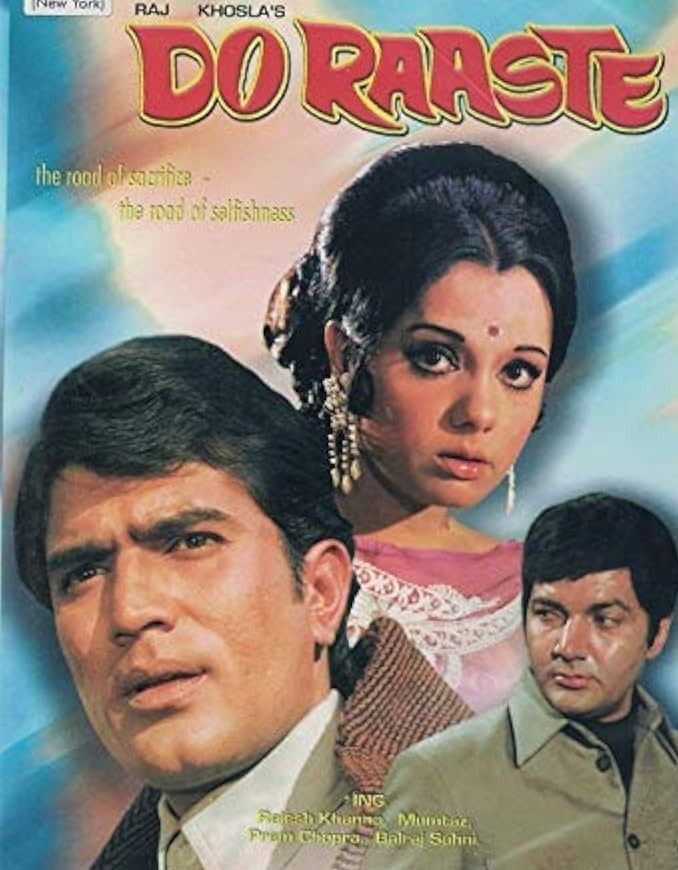
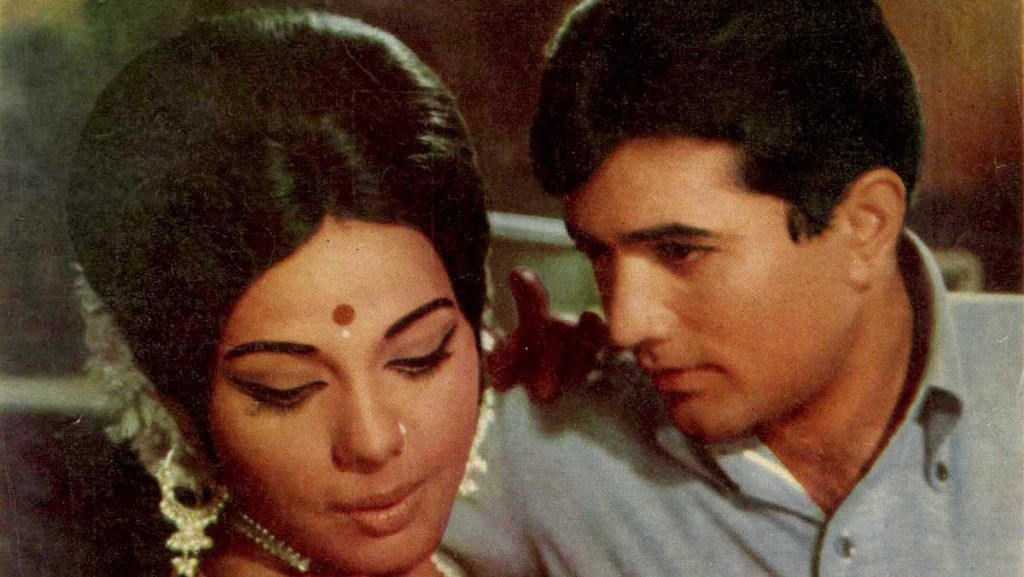
Do Raaste is a 1969 Indian Hindi film produced and directed by Raj Khosla, featuring Rajesh Khanna as a devoted and responsible younger son and Mumtaz as his love interest.
Navendu (Balraj Sahni) is the selfless patriarch of a close-knit joint family that includes his stepmother, wife, siblings, and children. Fulfilling a promise to his late father, he has devoted his life to keeping the family united and ensuring his younger siblings’ future.
Youngest brother Satyen (Rajesh Khanna) finds love with the lively Reena (Mumtaz), adding a romantic note to the family’s daily life. But the tone shifts when Birju (Prem Chopra) returns from England with an engineering degree. His warm homecoming, marked by gifts for everyone, initially signals success but soon, tensions arise that test the family’s bonds and threaten its unity.
Navendu, having borrowed heavily to fund Birju’s education in England, hopes Birju will now shoulder some family responsibilities. However, Birju returns married to Neela (Bindu), the wealthy but sharp-tongued sister of Reena.
Ignoring her mother’s advice not to live in a joint family, Neela moves into the crowded Gupta household, where her discomfort with the lack of privacy quickly turns into resentment. Her modern, individualistic mindset clashes with the family’s traditional values, setting off tensions that slowly begin to unravel the family’s harmony.
Neela’s replacement of simple, old furnishings with flashy, expensive ones unsettles Mrs. Gupta and Satyen. When she scolds Raju and Guddi for using “her” radio, Satyen retaliates by moving her belongings into her and Viju’s room, sparking a quarrel between the brothers.
Navendu and Madhavi urge Satyen to apologize to keep the peace, which he does reluctantly. Meanwhile, Mrs. Gupta warns Navendu that giving in to Neela’s selfishness will only worsen the situation, refusing to support his endless self-sacrifice.
Neela soon takes control of Birju’s salary and refuses to help repay the loans Narendu took for Birju’s education. When she lets friends believe Madhavi and Geeta are servants, it pushes Satyen to his limit. Her cruel treatment of Mrs. Gupta finally breaks even Navendu and Madhavi’s patience. Seizing the moment, Neela demands that she and Birju move into their own apartment, and Birju, influenced by her, agrees. As they leave, a heartbroken Narendu sits by his beloved gramophone once the home’s centerpiece but now banished while the ancestral mirror and his late father’s portrait silently bear witness to the broken family bonds and fading values.
On the very day Navendu loses his job, Birju is promoted to General Manager and hosts a lavish party but his family receives no invitation. The slight deeply wounds Mrs. Gupta, who sees it as a betrayal of Navendu’s sacrifices and values. Matters worsen when a money-lender demands repayment of the loan taken for Birju’s education, threatening to seize their home within a week. The stress makes Mrs. Gupta gravely ill, and her treatment adds to Navendu’s burden. Forced to sell their treasured belongings to stay afloat, Navendu quietly endures, while Birju and Neela revel in luxury, blind to the pain they’ve left behind.
Neela grows more ruthless, manipulating Birju and turning him further against Narendu, the brother who had once sacrificed everything for him. Her actions deepen the divide, starkly highlighting the clash between Navendu’s selfless duty and Neela’s selfish ambition.
In this film, Raj Khosla as director is both ambitious and conventional: he helms the story with sincerity but doesn’t bring the layered subtlety or psychological depth that defined his best work. Khosla leans into traditional emotional tropes, delivering a narrative filled with sharp moral contrasts good characters are saintly, and the antagonists are thoroughly selfish, with little room for complexity or redemption. While he captures some strong emotional moments, particularly those involving Balraj Sahni’s dignified suffering, the film lacks the cinematic tension and character shading that made his thrillers memorable.
His strength in visual storytelling still shows especially in symbolic touches like the gramophone, ancestral mirror, and portrait of the late father used effectively to evoke a sense of loss and fading values. His direction ensures that the drama is engaging and the emotions run high, but it falls short of the finesse seen in his more acclaimed works.
Rajesh Khanna as eldest son of the Gupta family, responsible and devoted, trying to keep the family together. Balraj Sahni as patriarch of the Gupta family, father to Satyan and Birju, a man trying to maintain family unity. Prem Chopra whose rebellious nature causes tension within the family. Veena is family matriarch who provides emotional support. Bindu involved in the family dynamics and tensions. Jayant as a supporting character in the film, involved in the unfolding drama.
Cinematography by V. Gopi Krishna was responsible for capturing the visual tone of the film, from the warmth of the joint family scenes to the emotionally heightened moments of conflict and separation. His work helps emphasize the changing moods from harmony to tension.
Edited by by Waman Bhonsle, handled the pacing and transitions. His editing choices play a key role in managing the film’s shifts between light romance and intense melodrama.
The film explores the struggles and values of a lower-middle-class joint family, focusing on themes such as reverence for elders, the central role of the mother, and the importance of familial unity. It portrays the joint family system as an enduring institution, emphasizing that emotional bonds and values often transcend even biological ties.
Music for all the songs in the film was composed by Laxmikant–Pyarelal and lyrics were written by Anand Bakshi. Together, they delivered a soundtrack that aligns well with the film’s emotional tone ranging from romantic and hopeful to sorrowful and reflective. The film itself is heavy on melodrama, the music provides some of its most memorable and emotionally resonant moments, help underscore the film’s themes of familial bonds, sacrifice, and estrangement.
Film won Filmfare Awards for Best Story and nominated for Best Film, Best Director, Best Supporting Actress, Best Music Director, Best Lyricist, Best Female Playback Singer.
Photos courtesy Google. Excerpts taken from Google.
 Writer Sunita