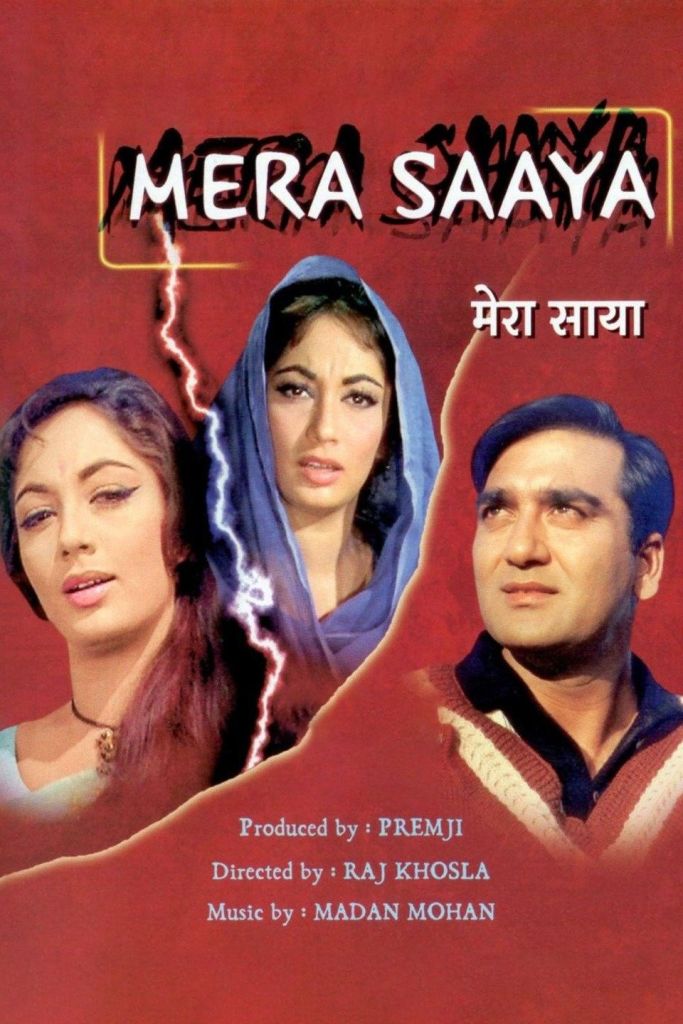
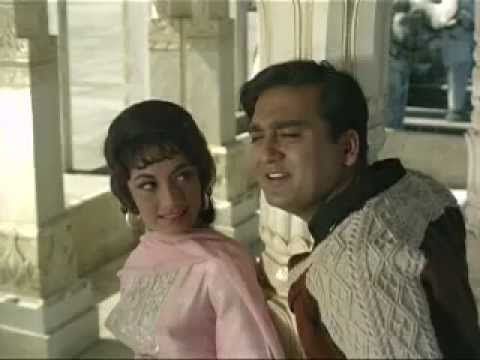
Mera Saaya is a 1966 Indian Hindi-language suspense thriller directed by Raj Khosla. The film stars Sunil Dutt and Sadhana in lead roles and is noted for its haunting music and gripping narrative. Mera Saaya is a remake of the acclaimed 1964 Marathi film Pathlaag (The Chase) by Raja Paranjape.
Thakur Rakesh Singh (Sunil Dutt), a wealthy and aristocratic lawyer, lives a blissful life with his beloved wife Geeta (Sadhana), to whom he has been married for three years. Their peaceful existence is interrupted when Rakesh leaves for London to pursue higher studies. After a year abroad, he receives distressing news of Geeta’s sudden illness.
Rushing back to India, Rakesh arrives just in time to witness Geeta’s death in his arms. Devastated by her passing, he constructs a small memorial for her within their mansion. Consumed by grief, he spends his days in solitude beside the memorial, finding comfort only in listening to recordings of Geeta’s songs, preserving her memory through her voice.
While Rakesh remains immersed in grief, one day Inspector Daljit arrives with startling news. He informs Rakesh that a notorious bandit named Raina was recently captured and that she claims to be none other than Geeta, Rakesh’s supposedly deceased wife.
Rakesh is initially dismissive, believing it to be a case of mistaken identity or fraud. But when he sees the woman in custody, he is shocked she is the spitting image of Geeta. Despite her resemblance, Rakesh insists she cannot be his wife, as he had personally witnessed Geeta’s death and performed her cremation.
The woman insists that she is truly Geeta, Rakesh’s wife, and starts sharing very personal and private memories from their married life things only Geeta could have known. Rakesh is clearly disturbed and confused, but he still doesn’t believe her. He thinks it might be some kind of trick or conspiracy, and that someone is trying to fool him because of how closely she looks like his late wife.
The case goes to court, and Rakesh, sure that the woman is not really his wife, begins to question her carefully. To his surprise, she answers every question calmly and correctly, remembering many personal details about their life together. This makes Rakesh more confused and unsure. She tells the court that she was kidnapped a few days before she was caught, which is why she was with the bandits.
Still, Rakesh does not believe her. He asks why she wasn’t wearing her mangala sutra, a very important symbol of marriage that Geeta would never have taken off. She says that she had removed it before going out that day. But to Rakesh, this is hard to accept because the Geeta he knew respected the mangala sutra too much to ever take it off, no matter what.
As the tension builds, Rakesh brings up Geeta’s diary, which she always kept nearby, but when the woman cannot remember anything about it, he becomes sure she is lying. Confidently, he calls her an impostor and asks the court to punish her. The emotional pressure becomes too much for the woman, and she breaks down, ending up in a mental institution. One night, she escapes and comes to Rakesh’s house, where, in a desperate and emotional moment, she begins to tell him the full truth about what really happened.
In a dramatic revelation, the woman explains that Geeta had a twin sister named Nisha, who, like their mother, was involved in criminal activities and lived as a bandit. Geeta had hidden this dark secret from Rakesh before their marriage. One night, a sick and desperate Nisha came to Geeta’s house seeking shelter. Out of sisterly love, Geeta dressed Nisha in her own clothes, gave her her mangala sutra, and went out quietly to buy medicine. While she was away, Nisha’s husband, Ranjit Singh, mistakenly took Geeta for Nisha and took her away without listening to her. After realizing the mistake, he agreed to return her, but before they could get back, the police arrested them, thinking she was the wanted criminal Nisha.
As Geeta tells this painful story, Ranjit Singh arrives, hurt but determined to prove her truth. Tragically, the police shoot him, and he dies at the memorial Rakesh had built for Geeta, turning it into a symbol of the buried truth. With the mystery solved, Rakesh feels deep remorse and relief, understanding that the woman he had doubted was truly his wife. The couple reunites and, leaving the past behind, they start a new life together.
Raj Khosla was a director famous for making movies full of mystery and strong emotions. In Mera Saaya, he showed his skill by keeping the story exciting and full of suspense while also making the characters’ feelings clear and deep. He helped Sadhana play two different roles in a way that made the audience and the main character both confused and curious. The courtroom scenes were very powerful because Khosla kept the tension high with good dialogue and timing. He also used the music in the movie carefully to help tell the story, not just as songs between scenes.
The cinematography of Mera Saaya was done by V. Babasaheb. He played a key role in creating the film’s suspenseful and emotional mood through his camera work, lighting, and framing. The visuals helped to enhance the thriller atmosphere and the intense drama between characters.
Sunil Dutt delivered a strong and emotional performance as Thakur Rakesh Singh, the grieving husband caught in a confusing and painful mystery. He balanced sorrow, suspicion, and love very well, making his character relatable and believable.
Sadhana played a challenging dual role as Geeta and her twin sister Nisha. She portrayed two very different personalities the gentle, loving wife and the bold, rebellious bandit sister with great skill and nuance. Her ability to switch between these roles kept the audience guessing and engaged throughout the film.
Prem Chopra as Ranjit Singh, the bandit husband, added intensity and depth to the story with his convincing portrayal of a tough yet tragic character.
The music for Mera Saaya was composed by the legendary Madan Mohan, with lyrics penned by Raja Mehdi Ali Khan. The film’s soundtrack is celebrated for its haunting melodies and emotional depth, seamlessly complementing the film’s suspenseful and dramatic narrative.
Among the standout tracks is the lively and iconic “Jhumka Gira Re, Bareilly Ke Bazaar Mein”, sung by Asha Bhosle, which became immensely popular and remains a classic in Hindi film music.
Other memorable songs from the film “Naino Mein Badra Chhaye”, “Tu Jahan Jahan Chalega“ a melancholic and haunting melody song became synonymous with the film’s emotional core, “Aap Ke Pehlu Mein Aakar” a romantic and poignant composition.
A major commercial success upon its release, Mera Saaya is also remembered for its technical excellence. Manohar Amberkar received the Filmfare Award for Best Sound for his work on the film.
Photos courtesy Google. Excerpts taken from Google.
 Writer Sunita