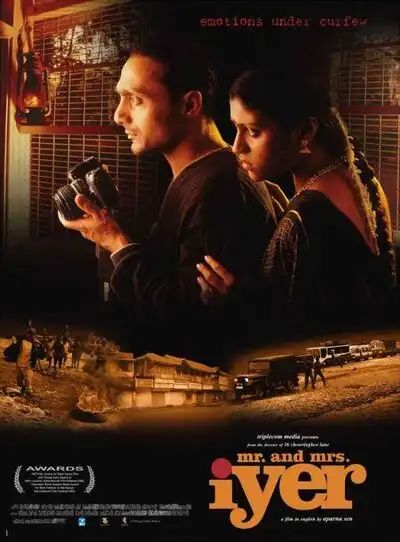
Mr. and Mrs. Iyer is a 2002 Indian English-language drama film written and directed by Aparna Sen and produced by N. Venkatesan. The film stars Konkona Sen Sharma as Meenakshi Iyer, a conservative Tamil Iyer Brahmin woman, and Rahul Bose as Raja Chowdhury, a liberal Bengali Muslim wildlife photographer. The story follows during a tense bus journey, a devout Hindu Brahmin woman finds herself compelled to protect a Muslim man when communal violence suddenly erupts, challenging her deeply held beliefs and social conditioning.
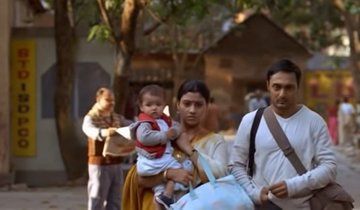
Meenakshi Iyer, accompanied by her infant son Santhanam, sets out on a bus journey to return home after visiting her parents. At the bus station, she is introduced to Raja Chowdhury, a wildlife photographer, by a mutual friend. Concerned for their daughter’s safety, Meenakshi’s parents request Raja to look after her and the child during the trip. Among the diverse group of passengers on the bus are a loud and lively group of youngsters, two Sikh men, an elderly Muslim couple, a romantically involved young couple, a mentally challenged boy with his mother, and a few men engrossed in card games.
The journey takes an unexpected turn when the bus is stopped by a roadblock. The driver tries to take a different route but ends up stuck in a traffic jam caused by growing violence between Hindus and Muslims in the area. Tension rises as the passengers realize the seriousness of the unrest around them.
During the journey, Raja tells Meenakshi that he is a Muslim. Meenakshi, who comes from a strict, high-caste Tamil Brahmin background, is clearly upset by this. She is especially disturbed that she drank water he gave her and quickly asks him not to touch her. Though hurt, Raja stays calm. He thinks about getting off the bus, but the police, enforcing a curfew because of the riots, stop him and tell everyone to stay inside.
Shortly after the police leave, a violent Hindu mob storms the bus. They begin aggressively questioning the passengers about their religion, creating panic and fear among everyone on board.
In a desperate attempt to save himself, a Jewish passenger who is also circumcised points to an elderly Muslim couple, turning the mob’s attention toward them. The rioters drag the couple off the bus, and when a young woman tries to stop them, she is violently attacked. As Raja prepares to intervene, Meenakshi swiftly places her baby in his lap and calmly tells the mob he is her husband, using the lie to shield him from harm.
The terrifying incident leaves everyone on the bus deeply shaken. As night falls and the danger continues, the passengers are forced to spend the night inside the bus, filled with fear and uncertainty.
The next morning, the passengers walk to a nearby village in search of shelter. Still posing as husband and wife, Raja and Meenakshi struggle to find a place to stay. A helpful police officer arranges shelter for them at an old forest bungalow. It has only one room, but Meenakshi, still bound by her beliefs, refuses to share it and argues with Raja about caste and religion. After a short argument, Raja lets her have the room and sleeps outside. The next morning, Meenakshi is worried when she doesn’t see him but feels relieved to find him sleeping outside safely.
Later, they run into the teenagers from the bus at a village restaurant, and the girls teasingly ask about their “love story.” To keep up the act, Meenakshi and Raja invent a tale about how they met and got married. As they spend more time together at the bungalow, they begin to understand each other’s beliefs and views on religion. One night, after witnessing a brutal mob killing, a shaken and terrified Meenakshi is comforted by Raja.
The next day, with help from the army, Meenakshi and Raja reach a railway station and board a train to Kolkata. At the station, Meenakshi’s husband comes to receive her and Santhanam. She introduces Raja as Jehangir Chowdhury, a Muslim man who helped her during the curfew. Before saying goodbye, Raja hands her a camera roll with photos from their journey. They share a quiet, emotional farewell, silently acknowledging the deep connection they built during the ordeal.
Mr. and Mrs. Iyer was both written and directed by Aparna Sen, marking one of her most acclaimed works as a filmmaker. Through her sensitive storytelling and nuanced direction, Sen explores complex themes such as communal tension, religious identity, and human connection. By setting the narrative in a confined space during a moment of national unrest, she creates a powerful, character-driven drama that reflects on prejudice and compassion. Her dual role as writer and director allows for a cohesive vision, blending subtle emotional shifts with a sharp social commentary, making the film both intimate and thought-provoking.
Konkona Sen Sharma as Meenakshi S. Iyer is a conservative Tamil Iyer Brahmin woman traveling with her infant son to reunite with her husband. Initially bound by rigid beliefs about caste and religion, she is forced by circumstances to rely on Raja, a Muslim co-traveler. As danger grows around them, she forms an unexpected bond with him.
Rahul Bose as Jehangir “Raja” Chowdhury is a liberal-minded Muslim and a wildlife photographer. During the communal riots, his life is at risk due to his religion. To protect him, Meenakshi introduces him to others as her husband, creating a false identity that eventually leads to a deeper emotional connection between them.
The cinematography was handled by Goutam Ghose, whose visual storytelling adds depth and atmosphere to the film. His use of natural lighting, wide landscapes, and close-up shots captures both the beauty of the journey and the tension of the unfolding crisis. Ghose’s camera work subtly reflects the emotional shifts between the characters moving from discomfort to trust while also portraying the fear and uncertainty caused by the communal violence. His cinematography enhances the film’s realism and emotional impact, making the environment feel like an active part of the narrative.
Ustad Zakir Hussain composed the music for the film and, for the first time in mainstream cinema, lent his voice to a part of one song a choice the producers made only after the track had been recorded. A renowned tabla maestro, Hussain crafted a background score that plays a vital role in shaping the film’s emotional tone. Rather than overpowering the narrative, his music subtly underscores the tension, intimacy, and growing bond between the lead characters. The use of atmospheric, minimalist sounds deepens moments of silence and uncertainty, enhancing emotional engagement. His evocative score perfectly complements the film’s realistic style, conveying themes of fear, empathy, and human connection without relying on conventional song sequences.
Mr. and Mrs. Iyer premiered at the Locarno International Film Festival in Switzerland and was subsequently screened at several other prestigious film festivals around the world. It was released in India on 19 July 2002 to widespread critical acclaim. The film received numerous national and international accolades, including the Golden Maile Award for Best Feature Film at the Hawaii International Film Festival and the Nargis Dutt Award for Best Feature Film on National Integration at the National Film Awards in India. While English is the film’s primary language, it also features occasional dialogues in Hindi, Tamil, and Bengali, reflecting the cultural and linguistic diversity central to its narrative.
Mr. and Mrs. Iyer received mixed reviews, with critics praising the performances but questioning the film’s subtlety. The New York Times called the romance “hard to resist” but noted the film “is not a subtle one.” The Chicago Reader also found the portrayal of social types unsubtle, though it appreciated the tender depiction of the central friendship. TIME lauded Sen’s “attention to detail,” while The Village Voice criticized her use of “hokey pseudo-lyricism” over deeper insight. Metacritic reflected this range of opinion with a score of 50 out of 100.
Photos courtesy Google. Excerpts taken from Google.
 Writer Sunita